









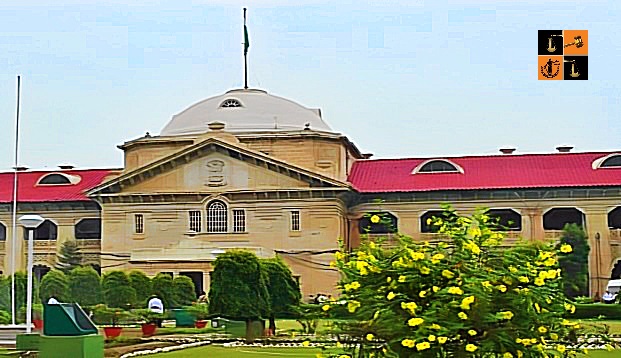
Recently, the Allahabad High Court has ruled that a Family Court cannot entertain an independent application under Section 27 of the Hindu Marriage Act, 1955 (HMA) for the return of ‘stree dhan’ in the absence of a live matrimonial proceeding.
The Division Bench comprising Justice Arindam Sinha and Justice Avnish Saxena set aside the judgment passed by the Family Court, directing the husband to pay ₹10,54,364 in lieu of the wife’s alleged ‘stree dhan’ articles.
The appellant had challenged the Family Court’s decree that ordered him to compensate the respondent for jewellery allegedly constituting her ‘stree dhan’. The partie’s marriage stood dissolved. Notably, an earlier maintenance order under Section 125 of the Criminal Procedure Code, 1973 (CrPC) had been passed in 2017, and partial payments aggregating ₹6 lakhs were previously made by the appellant, followed by an additional ₹1 lakh via demand draft submitted during the appeal.
Counsel for the appellant argued that the impugned order, made under Section 27 HMA, was unsustainable as the provision does not vest jurisdiction in the Court to independently adjudicate claims for joint property without an ongoing proceeding under Sections 9 to 13B of the HMA. Reliance was placed on the Chhattisgarh High Court decision in Babita @ Gyatri v. ModPrasad @ Pintu, wherein it was held that “the Court may make provisions in the decree as it deems just and proper with respect to any property presented, at or about the time of marriage, which may belong jointly to both the husband and the wife.,” but that Section 27 “has not been considered to be a separate and independent matrimonial proceeding.”
It was further contended that the respondent’s allegations regarding the incident, when she claimed to have been assaulted and dispossessed of jewellery, were undermined by her own admission during cross-examination that the appellant was not present in Karwi at the time but in Bombay.
The respondent's counsel, on the other hand, maintained that the documents demonstrating the ownership and gifting of ‘stree dhan’ were duly proved and that partial execution had already occurred. He also argued that the appeal was barred as the appellant had earlier failed in review and did not challenge the execution proceedings.
The Court noted that the Family Court had accepted photocopied jewellery receipts without establishing the foundational requirements for admitting secondary evidence. “There is no indication as to why they were accepted as secondary evidence,” the Bench remarked.
The Court further observed that the respondent’s own FIR implicated the appellant among seven accused persons but her cross-examination conceded his absence from the location during the alleged incident.
The Bench found that the Family Court's reliance on the pendency of criminal proceedings was an “oblique way of not directly dealing appellant’s contention that respondent had admitted in cross-examination, of him not being present at the time of incident.”
On the legal question, whether an independent proceeding under section 27 could not be initiated to result in a decree, the Court held: “We respectfully agree with view taken in Babita @ Gyatri (supra) that section 27 has not been considered to be a separate and independent matrimonial proceeding so as to entitle the Court to entertain such independent application.”
In the light of the foregoing discussion, the Court allowed the appeal and ordered that the amounts of ₹7 lakhs paid by the appellant, comprising ₹6 lakhs earlier and ₹1 lakh via draft, and ₹2,10,000 recovered by the respondent in part execution be “adjusted against respondent's claim pursuant to said maintenance order dated 11th August, 2017 made under section 125 in Code of Criminal Procedure, 1973.”
The Court further directed that, having succeeded in the appeal, the appellant was entitled to termination of the execution proceedings, as “pursuant to impugned order passed without jurisdiction, being a nullity.” The executing Court was instructed to act accordingly under Section 47 of the Civil Procedure Code, 1908.
Picture Source :




















