









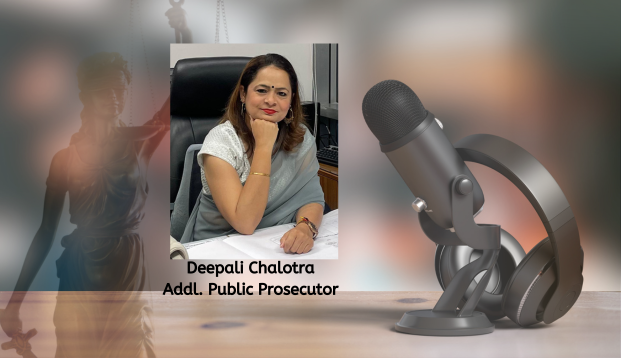
Journey of a legal stalwart
Ms. Deepali Chalotra, Deputy District Attorney, Gurugram District Court, was interviewed by Angela Arora. Angela is a fourth-year law student at University School of Law and Legal Studies, GGSIPU, New Delhi.
Name of Advocate- Deepali Chalotra
Court of practice- Gurugram District Court
Designation- Deputy District Attorney
Bar Council No.- D/1539/2000
Q1. Please tell us about your journey from starting your practice as a young female lawyer, to becoming the first female Public Prosecutor in Gurugram District Court?
ANS. I joined as the Assistant District Attorney in the Gurugram District Court in 2009. I was the first female Public Prosecutor there. In the entire Prosecution team, there was not even a female clerical staff, let alone an ADA. Police officers were in disbelief when they saw a female PP, they could not believe it at that time. It gives me a sense of pride that I achieved something which was so unimaginable to a large number. Today, it’s been fifteen years in different districts, I feel blessed, independent and thank God for his blessings.
Q2. Are you a first-generation lawyer? How does it make a difference in your work, in comparison with second-gen or third-gen lawyers?
ANS. I am a first-generation lawyer. But in my family, I had a cousin and an uncle who were judicial officers. As a young girl whenever I visited them, their work and the impact that they had influenced me greatly. My father wanted me to become a judge as I am a first gen lawyer, but I became a Public Prosecutor instead. Becoming a PP is a gruelling process. I studied for eight years to clear the exam, and fulfilled my familial obligations side by side. I also faced my share of failures, but never gave up. This goes to show, to attain this position, only your preparation and good luck matters.
Q3. How do you think law school education has changed since the time you graduated?
ANS. Law school education has changed a lot in these twenty-four years. I pursed both, my Bachelors’ and Post Graduate Law Degree from Delhi University (CLC). Back in the day the mooting culture was not as prominent. DU colleges are still excellent, but they follow old teaching patterns. Today, my daughter is pursuing a five-year integrated law degree, and I have observed a drastic change in the teaching and examination pattern. There is a lot of emphasis on all round development, as I have seen in the young law students who intern under us. They are extremely confident, and well versed with court etiquettes. Its heartening to see today’s law programs give much more emphasis to internships and practical knowledge.
Q4. Why did you choose law, and how did you end up in your present role?
ANS. I drew inspiration to pursue law from my cousin sister, who is a respected judge. It was her passion and commitment towards the job that drew me in. Secondly, it was my father who helped me secure my present position, without his support I would not have been here, giving you this interview. Thirdly, my husband always encouraged me to never give up, even after extreme failures. He travelled with me to different exam centres, took care of my daughter while I studied and ensured I got all the help I needed to continue my preparations post marriage. All this encouragement and support enabled me to also pursue my LLM from the coveted Indian Law Institute, New Delhi.
Q5. What is your greatest motivation to keep up with the demands of this job and maintain your zeal and enthusiasm?
ANS. I studied for eight years to reach where I am today. My family, my husband and father contributed greatly towards it. They are my biggest motivators to be the best at my job. As a judicial officer who has worked in the Women’s Court, I have seen the plight of victims first hand. I have also seen the kind of remarkable efforts the police officers put in their investigation. All of this drives me to put my best foot forward always, to ensure justice is delivered speedily.
Q6. What are certain underlying principles that every law student should imbibe in order to excel in life?
ANS. Law is a dynamic field. You are a learner for life. It is important to keep an open attitude and be receptive to learninhg from everyone around you, your seniors, juniors, interns, whomsoever it may be. Develop reading, writing and research skills, and always chase opportunities of practical experience, it helps a lot.
Q7. Being a Deputy District Attorney demands round the clock work. How do you balance your personal and professional life?
ANS. A job as demanding and rewarding as this requires your full attention all the time. Familial support is essential for the same. My daughter has always supported me, since her childhood. I fondly recall, she would never disturb me while I studied, rather she would sit next to me and quietly studied or drew. As she’s older and I have taken on more responsibilities, I try to never bring my office work at home, or discuss any office issues at home. Likewise, I never discuss my personal issues at the office, it is important to draw the line. I try to go on vacations with my family once a while to refresh myself and gear up for upcoming challenges.
Q8. What are some changes that you think should be brought in the Indian legal system?
ANS. Our legal system requires certain pressing changes. First, good infrastructure. There should be proper offices with advance technologies in the Courts. I see a lack of good and clean government offices in this domain. This is one reason why many talented law students are reluctant to join judicial services or become litigators, the suave corporate offices are very lucrative in that sense. Secondly, our Courts are overburdened. We need a system of speedy trials. As a PP I have seen a lot of harassment of the complainant or victim, rather than the accused. It’s saddening, how hard is the path to justice becoming day by day.
Q9. What are the most significant challenges a Public Prosecutor faces while preparing and arguing a case?
ANS. A Public Prosecutor argues on behalf of the police, and tries to fill in the lacunae in the police investigation. We follow a protocol where we make arguments based off the investigation of the police officers. On the other hand, the defence counsel has first-hand information, and is aware of the reality of the case, the nature of relationship between the parties etc. We lack this first-hand insight. PPs also do not have technological support, such as online research databases and law journal subscriptions for advanced research, which makes it a bit more challenging to do our research and find out the truth.
Q10. If you could share one piece of advice to young law schoolers and graduates, what would it be?
ANS. I think every law student should be confident and work on his/her social skills. Having a strong command over both English and Hindi, or whichever is the language of the court is very necessary. Law has also become a very competitive field, hence a student should explore, and figure out well in time what they wish to pursue, whether to join the judicial services, become a litigator or become a corporate attorney. Preparations in the chosen direction should be started accordingly.
Picture Source :




















