









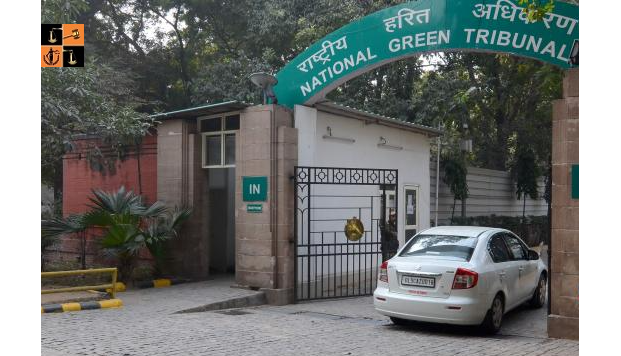
Supreme Court of India was dealing with the writ petition filed under Article 32 of the Constitution of India, the petitioners who are the Madhya Pradesh High Court Advocates Bar Association and the District Bar Association, have raised a challenge to the vires of the National Green Tribunal Act, 2010, and pray to Issue an appropriate writ of certiorari or any other writ of similar nature directing that the Bench of National Green Tribunal be set up at all the places where the principal seat of High Court is situated and Hold and declare that the proposed sitting up of Bench of NGT at Bhopal is not constitutionally and/or sustainable.
Petitioner’s Contention:
Learned counsel for the petitioner submitted that the Bhopal Bench of the NGT is located arbitrarily and the decision is inconsistent with the direction in S.P. Sampath Kumar vs. Union of India where this Court observed that for ensuring the efficacy and efficiency of any Tribunal, its seat should be at a place where the principal seat of the High Court is situated.
It was submitted that through incorporation of Section 14 and Section 22 in the NGT Act, the jurisdiction and the role of the High Courts under Article 226/227 is extinguished. This, therefore, has impacted the basic feature of the Constitution and as such the provisions of Section 14 read with Section 22 of the NGT Act should be struck down to the extent they divest the High Courts of their power as a superior Court.
Respondent’s Contention:
Learned Counsel for the respondent submitted that NGT was set up because of the prodding and recommendations made by the Supreme Court while dealing with environmental cases and the Parliament was repeatedly entreated by the Court to create specialized environmental court with qualified judges and technical experts on the Bench. It was submitted that the remedy before the High Court for a litigant under Article 226 and 227 continues to be available notwithstanding the enactment of the NGT Act and the provision for appeal to the Supreme Court under Section 22 of the NGT Act.
SC’s Observations:
The issues before the SC were:
- Whether the National Green Tribunal (hereinafter referred to as “the NGT”) ousts the High Court’s jurisdiction under Sections 14 & 22 of the NGT Act?
- Whether a seat of the NGT should be in every State? If yes, should they invariably be established at the principal seat of High Court, which in this case would be Jabalpur instead of Bhopal?
- Whether the remedy of direct appeal to the Supreme Court from the decisions of the NGT under Section 22 of the NGT Act is ultra vires to the Constitution? Whether an appeal mechanism be provided to the High Courts from the decisions of the NGT?
- Whether Section 3 of the NGT Act is ultra vires to the Constitution as suffering from the vice of excessive delegation?
SC stated that nothing contained in the NGT Act either impliedly or explicitly, ousts the jurisdiction of the High Courts under Article 226 and 227 and the power of judicial review remains intact and unaffected by the NGT Act. The prerogative of writ jurisdiction of High Courts is neither taken away nor it can be ousted, as without any doubt, it is definitely a part of the basic structure of the Constitution.
While answering the third issue SC stated that it cannot also be overlooked that it is the Supreme Court itself which had recommended the setting up of environmental court with direct appeals to the Supreme Court. This would also support the proposition on constitutional validity of Section 22 of the NGT Act and that it is not ultra vires to the Constitution.
SC stated that a litigating party must also realise that in any event, if the opposite side approaches the Supreme Court, the litigant on the other side would have to defend his case before this Court and at that stage they cannot be complaining about the distance to Delhi. Thus, the remedy of direct appeal to the Supreme Court under the NGT Act from the NGT’s decision cannot be seen as denial of access to justice to the litigants in the field of environmental law.
SC while answering the fourth issue stated that moreover, one must not overlook the distinction between the operation of the NTT Act vis-à-vis the NGT Act. To be specific, the NTT Act provided that the NTT would ordinarily sit at New Delhi. The NGT Act however provides for the creation of benches across the country. Additionally, the NTT was vested with the power of adjudicating appeals arising from orders passed by the Income Tax Appellate Tribunal on substantial questions of law. This was a jurisdiction that the High Courts were exercising under Article 227 in certain cases, and in that context, it was found that the NTT was indirectly impinging on the jurisdiction of the High Courts under Article 227. The jurisdiction exercised by the NGT is however distinct, and different, and not comparable.
SC further stated that besides, the NTT was constituted only to determine substantial questions of law and it was unclear how accountants and other technical members with no legal training would deal with the issues raised in such matters. Those troubling issues do not arise in the NGT Act. One must also be cognizant of the fact that the Selection Committee under Section 7 of the NTT Act was dominated by two secretaries of the Government, as opposed to the Selection Committee for the NGT under the Tribunal Reforms Act which clearly has judicial dominance.
SC Held:
After evaluating submissions made by both the parties the SC held that:
“A. The National Green Tribunal under Section 14 & 22 of the NGT Act does not oust the High Court’s jurisdiction under Article 226 & 227 as the same is a part of the basic structure of the Constitution.
- The remedy of direct appeal to the Supreme Court under Section 22 of the NGT Act is intra vires the Constitution of India.
- Section 3 of the NGT Act is not a case of excessive delegation of power to the Central Government.
- The seat of the NGT benches can be located as per exigencies and it is not necessary to locate them in every State. The prayer for relocating the Bhopal NGT to Jabalpur is unmerited and is rejected.”
Case Title: Madhya Pradesh High Court Advocates Bar Association and Anr. v. Union of India and Anr.
Bench: J. K.M. Joseph and J. Hrishikesh Roy
Citation: WRIT PETITION (CIVIL) NO. 433_OF 2012
Decided on: 18th May, 2022
Read Judgment @Latestlaws.com
Picture Source : twitter.com




















