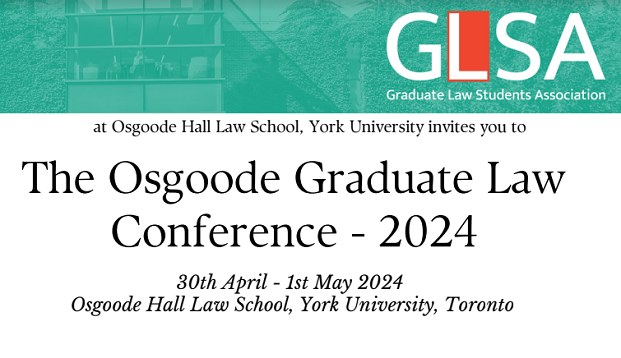
Law in the 21st Century: Building on the Former, Figuring out the Now, and Prefiguring the Future
Law is both constituted by, and constitutive of, society. It sits at the core of human interaction, drawing lessons from history to regulate contemporary society and preempt its future. Legal stakeholders are drawn into a delicate dance of effectively responding to contours of the present while simultaneously chiseling outlines for tomorrow. This conference invites reflections on if (and how well) laws and legal systems around the world have executed this dance. Our theme engages York University’s institutional ambition to “Right the Future,” within the context of legal thought and scholarship.
We hope to receive submissions that propose varied approaches, drawn from different experiences and theoretical perspectives, to understand what constitutes “law,” and if we should aspire towards a different understanding for the future. The predominant positivist approach today views law as a binding set of rules that govern human conduct, but this approach is not a single story. As society evolves, the understanding and meaning of law changes with time. Some activities, such as territorial expansion through colonialism, chattel slavery, and other forms of forced labor that enjoyed legal legitimation are now illegal. On the flip side, activities that were once illegal, such as variances in personal identity, are increasingly brought within legal protection. As new challenges have arisen, law has iterated towards the goal of effective and efficient response. How potent is the law’s essence as a tool to both discipline social conduct and midwife social progress? How does legal scholarship concentrate or dilute this essence?
The mid-20th century saw a flurry of activities around global decolonization and the consequent emergence of newly independent nation-states. National governments and international institutions engaged in legal reformatory research to create and promote idealized approaches to good governance. This era also witnessed a shift from strong state-led initiatives to engagement with private stakeholders for economic participation. The scholarly thought provided a potpourri of theories and ideas that invited further scrutiny. The necessity for continued dialogue on pressing developmental issues, as well as attempts to reconcile ideological tensions, is a core theme of scholarship produced in the 21st century.
York University’s institution-wide mission to “Right the Future” suggests an opportunity to make a positive change by pioneering fresh perspectives and quality research. There is an observable tendency to position law as an instrument for innovative solutions to current global challenges, and for the benefit of future society. These aspirations raise questions of how past and continuing legacies of harm are to be addressed. Within this context, the conference envisages a broad and thematically inclusive array of topics, including:
- Climate change and environment
- Technology, artificial intelligence, and ethics
- Intellectual Property
- Social, political, and economic inequalities—gender, race, sexual orientation, poverty and homelessness
- Healthcare and well-being
- Decolonization, equity and inclusion
- Sustainable Development Goals
- Human or animal rights
- Constitution, public administration and crime
- Indigenous interests
- International concerns
- Trade, finance and business
- Contracts, corporations, mergers & acquisitions, private equity, startups and investments
- Torts
- Family matters
Conference Details
Format
The conference will be held in a hybrid format, with simultaneous in-person and online options for participation. The in-person meeting will be held at Osgoode Hall Law School at York University in Toronto, in a space equipped with video conferencing facilities for simultaneous Zoom (or similar platform) participation for online attendees.
The conference will consist of panel presentations. Each presenter will be invited to present, followed by a period for questions and discussion. A facilitator or chair will provide feedback and lead the conversation to draw connections between presentations to promote dialogue among presenters and attendees. Information regarding panel themes and the length of each presentation will be shared closer to the conference date.
Presentations should be made in the typical conference format. However, creative outputs will also be considered, as they sufficiently pertain to the conference theme.
Application
Apart from creating a unique space for developing analysis, honing creativity and critical topical examination of contemporary issues, the conference provides graduate students and recent graduates with an opportunity to receive feedback on their research and build professional networks. It is open to-
- Doctoral candidates in a Ph.D., S.J.D or similar research program
- Master’s students in the research stream (Master’s by research) or with a strong research proposal in the professional stream (Master’s by coursework)
- Postdoctoral researchers or recent graduates from a graduate research program (up to 2 years from the date of graduation)
Applications are not restricted by geographical location of study or graduation. We welcome applicants from Canadian and international institutions. However, applicants outside Toronto should note that the conference will be held between reasonable hours in Eastern Standard Time. The conference accepts submissions in interdisciplinary research and a range of different disciplines that draw a connection with law and the conference theme.
Please submit proposals at the following link by 20th January 2024 by 11:59 PM, Eastern Standard Time (EST) : The 2024 Osgoode Graduate Law Conference-Proposal Submission (google.com).
Abstracts should be clear, concise, original, and relate to unpublished work. Each abstract will be approximately 250 words in length (this applies to creative proposals as well). Please include your name, affiliation, and a list of up to five keywords.
Registration
Successful applicants will be notified of acceptance around February 2024. There will be no conference fee for presenters and attendees this year to promote social inclusion, provide access to academic discourse, and mitigate economic barriers to participation. Unfortunately, we are unable to offer funding for participants’ costs. Registration for attendees (other than presenters) will be opened in due course.
Contributions
Successful applicants are expected to submit an outline—or, in the case of creative work, an equivalent preparatory object. The deadline for submitting the outline will be communicated along with notification of acceptance in February 2024. Where another format is intended, the successful applicant should discuss it with the conference organizers to ensure appropriate initial steps are taken.
Contact
In case of any questions or clarifications, please reach out to
Olaoluwa Oni (Laolu)
Jake Effoduh (Jake)
Divyangana Dhankar (Divya) (Conference Chair) on glsaconference@osgoode.yorku.ca.
Calendar link: https://www.osgoode.yorku.ca/events/the-osgoode-graduate-law-conference-2024/