









The Author, Jaanvi Rathi is a 5th Year BBA.LLB student at Vivekanada Insitutue of Professional Studies, GGSIP University, New Delhi.
1. Introduction
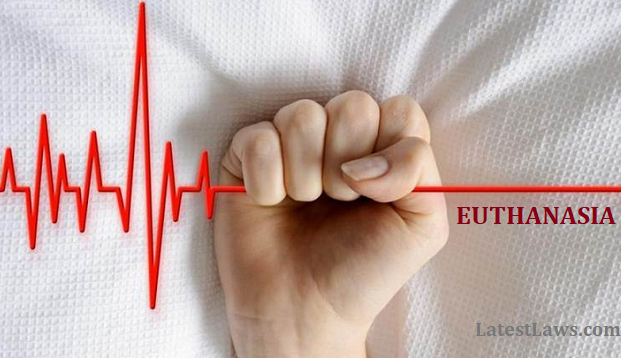
Euthanasia can be understood as practice of painlessly putting to death person suffering from painful incurable disease, this act is also called mercy killing. Some other factors such as incapacitating physical disorder or incurable disease or will to die without treatment or withdrawing treatment or the artificial life support measures are other ways of performing euthanasia. Right to die is a dilemma over issue of life and death. Mercy killing is an ethical dilemma. Death can be really hard, painfully vicious and in order to escape that, a person can practice euthanasia. This has a really strong opposition which is whether death by euthanasia is really painless. Why is euthanasia a topic of debate is an apt question to ask if it gives death in painless way? Term euthanasia comes from Greek-word "eu" meaning good and "thanatos" meaning death which when combined means well-death or dying well. It is a type of suicide and it is perceived that suicide is equivalent to murder thus people are in opposition but at same time growing support of euthanasia can be seen as changing perceptions.
Passive-euthanasia is legal in India since March 2018, where patient must consent through living will and must be terminally ill or in vegetative state. Whereas euthanasia has been topic of debate in countries and there has been vast inconsistence in views of different nations. Currently, voluntary euthanasia and/ or doctor assisted suicide is legally available in parts of Australia, Belgium, Canada, Colombia, Luxembourg, Netherlands, Switzerland, and several states of US. But most other countries do not entertain the idea of euthanasia and have pronounced it illegal.
2. Types of Euthanasia
Euthanasia can be categorized in one of the kind ways, including:
Active euthanasia - The place where a person deliberately intervenes in order to give up life of someone.
Passive euthanasia - The place where a person motives death by means of withholding or withdrawing therapy that is crucial to keep life.
Voluntary euthanasia - The place where a person makes a mindful decision to die and asks for help of someone else to do this.
Non Voluntary euthanasia - The place where a character is unable to supply their consent and other person takes decision on their behalf.
Involuntary euthanasia - The place where a person is killed towards their expressed needs.
3. Legislations in some jurisdictions relating to Euthanasia
There are different legislations which govern practice of euthanasia in different countries. Netherlands: “Termination of life on request and assisted-suicide (review procedure) Act 2002” regulates euthanasia in Netherlands. It legalizes euthanasia under specific circumstances. Debate started trough “Postma case” in 1973 when doctor facilitated her mother’s death after applying for euthanasia several times. She was convicted but court from then on said doctor would not be required to keep patient alive contrary to his will.
Australia - Wake v. Northern territory of Australia held euthanasia legal in 1996 making Australia first country to legalize it. But Euthanasia laws Act again made it illegal in 1997 repealing Northern territory legislation.
Belgium - ‘Belgium Act on Euthanasia’ in September 2002 made euthanasia legal in Belgium.
United States Of America - Washington v. Glucksberg and Vacco v. Quill stated euthanasia illegal in US. But physician assisted dying is legal in Oregon through Oregon Death with Dignity Act, 1997, in Washington under Washington Death with Dignity Act, 2008 and in Montana by state judiciary and not legislature.
Canada - Patients can refuse life support but cannot demand euthanasia or assisted-suicide. It is illegal through Section 241(b) of the criminal code of Canada. Supreme Court stated that interest of state prevails over individual’s interest in case of Sue Rodriguez v. British Columbia (Attorney General).
Switzerland - Article 115 of the Swiss Penal Code states that suicide is not crime and only selfish motive will cause criminal aspect. Physician or condition of terminally ill is not required.
United Kingdom - There is a distinction in UK between Active Euthanasia and Passive Euthanasia. Airedale NHS Trust v. Bland permitted non voluntary euthanasia in persistent vegetative state.
4. Position in India
As we know Indian constitution was longest constitution and was drawn from constitutions of other countries, it also referred to various foreign decisions also. Euthanasia is illegal in India. In cases on euthanasia and mercy killing as intention may not be published clearly but doctors in this case intention would be on doctors, hence it would clearly fall under Section 300 of the Indian Penal Code which deals with offense of murder. But in this case doctors would have consent of patient. In case of involuntary euthanasia that means without consent of patient would fall under Section 92 of the Indian Penal Code. which talks about act done in good faith. Indian law is also very clear about assisted suicide. There is no right to suicide in India. Section 309 of the Indian Penal Code is about suicide and punishment for suicide. Right to life is a fundamental right which is given by Article 21 of the Indian Constitution. It is said that right to life includes right to die but in judgement of case of Gian kaur v. State of Punjab[1], it was held that right to life don’t include right to die. It was made clear in case. Court held: Article 21 is provision guaranteeing “protection of life and personal liberty” and by no stretch of imagination can extinction of life be read into it.
According to the Indian Medical Council Act, Medical Council of India may prescribe standards of professional conduct and etiquette and code of ethics for medical practitioners.[2] There under act of euthanasia has been classified as unethical except in cases where life support system is used only to continue cardio-pulmonary actions of body. There were many rejections and arguments against Section 309 of the Indian Penal Code. It was said that Section 309 had no justification to continue in statute.[3]
5. Aruna’s Case: A New Legal Dimension
On 24 January, 2011 Supreme Court setup medical committee of 3 doctors in response of petition filed by journalist Pinki Virani who is a legal friend of Aruna for Aruna Shaunbaug’s active euthanasia, on which Court responded with rejection and laid down guidelines until a bill is introduced by parliament over passive euthanasia which involves abstinence of treatment or food that would allow patient to live.
The guidelines stated the following:
Decision for passive euthanasia should be taken for bona fide interest of patient. Either by close relatives or spouse or friend or in absence of any of them by attending doctor.
Along with approval of well wishers, the High court approval under Article 226 of the Constitution is also important before euthanasia is practices as per Airedale’s[4] case.
These guidelines are strict to circumstances and speciality of case such as that of Aruna Shaunbaug where victim was in Persistent Vegetative State (P.V.S) and has had no state of awareness and her brain was virtually dead. She was nurse in KMN hospital where she was brutally assaulted by ward boy who leashed her with dog-collar and harsh physical abuse made her blind and left her in Persistent Vegetative State, doctors have denied any scope of her improvement neither she wished to live anymore. Main reason for her wish was stated to be pain which she suffered on daily basis.
6. The Euthanasia Bill
The Bill proposing legalisation of euthanasia was introduced in Lok Sabha as “The Euthanasia (Permission and Regulation) Bill, 2007”[5]. In cases of persons with “no hope of recovery”, active euthanasia gives way out and it’s better alternative “than committing suicide offence under the Indian Penal Code.
Bill states that “before making decision it’s to be ensure that system is not misused by unscrupulous elements[6]”.
Additionally, “life of patient is taken only after due-process has been adhered to and in humane and compassionate manner in presence of family members or the elected representatives[7]”.
7. Arguments in favour of legalizing Euthanasia
- Major argument in favour of allowing exercise of right to die - It is a way to end extreme unbearable pain caused by disease, infirmity of body or mind or some incurable ailment[8].
- Exercising right to die provides way of relief when person's quality of life is low. It causes physical or emotional or financial stress on relatives and family members of the dying patient. Neither law nor medical ethics requires “everything be done” artificially to keep person alive. In cases of terminal illness, medical professionals do not prolong life of person, instead prolong death of person[9].
- Some argue, if option to die for terminally ill people is allowed, family-members may save on unproductive medical expenses. It may free up the funds of state to help needy people. Millions of people live below poverty line and cannot afford any expenses on treatment and die due to non affordability and non availability of medical help, funds freed may be utilized to save lives of poor and needy persons[10].
- Recognition of right to die is a case of freedom of choice and individual liberty. Constitution guarantees fundamental rights and freedoms to people where positive right includes negative right. For Example, freedom of speech carries along freedom not to speak. Right to carry on business includes right to close down business; similarly, the right to live should include within it, the Right not to live. People should not be forced to stay alive. It’s right of individual to make choice, whether to live or not i.e. the right to die[11].
8. Arguments against legalizing Euthanasia
- There is intense opposition from spiritual agencies and people from criminal or medical profession. According to them it’s not granting “right to die'” alternatively have to be referred to as “right to kill”.
- Today, superior medical research is continuously being made in therapy of pain/diseases. Many diseases which had no remedy in past are curable/controllable today with help of lookup in scientific area.
- Where euthanasia has first been legalized for terminally unwell people, later on it can grow to be non-voluntarily. Internationally where assisted suicide is allowed, it has to move into permitting mentally ill people to kill themselves as alternative than searching for remedy.
- Allowing exercising of right to die would put emotional or economic or psychological stress on patients or disabled persons, to select to die instead than be burden on households.
- Physicians and different scientific-care people should not be involved in inflicting death. It creates incentives to do less medical-research and to save money on clinical care by means of offering poison pills. There’s no way to manipulate assisted suicide once it is legalised. In India poverty and corruption is rampant, there’s no full proof way to write law without opening to abuse.
9. Suggestion
Risk of misuse and abuse could be done away despite Law Commission Report and Aruna Shaunbaug’s case guidelines. In spite, the suggestions are given to check the misuse and abuse:
- Circumstances where practitioner can lawfully cease/authorize cessation of life-sustaining treatment does not register any impulses.
- Euthanasia-request should come from patient suffering pain from incurable condition, physician must be convinced that-
- Request was voluntary, well considered
- Patient was facing unbearable suffering.
- They have informed patient about his situation.
- They have reached conclusion with patient that there is no alternative solution.
- Right of practitioner responsible for treatment of terminally ill patient to increase dosage for relieving pain or distress, even if secondary effect may be to hasten patient's death.
- Person who's going to die must:
- understand what will happen.
- know about kinds of treatment.
- freely repeat wish to die.
- suffering from something that won't stop.
- Whether it would be lawful for practitioner to act on request of well-informed terminally ill patient to end suffering by administering lethal agent.
- Quasi judicial officer be appointed by authority under statute to supervise all cases of euthanasia within territory. Such officer must be well versed with medical science. Doctor who feels that patient's request to die be fulfilled would report case to officer. Supervisor would interview patient and then refer case to 2 doctors for their opinion. If referred doctors feel that patient's beyond recovery or death would be more suitable then supervisor would inform patient's relatives about request and opinion, and issue certificate allowing doctor to let the patient die.
Above mentioned safeguards are necessary to minimize chances of misuse of right of euthanasia.
10. Conclusion
From above discussion we conclude that no law should be guaranteed to be free of possibility, if now not likelihood of abuse, primarily based on the lives of different ill people who didn’t choose their lives taken. As in particular unsafe component is such abuse can also be made undetectable. Demise is now not only personal-affair and difficulty of euthanasia is one in which interest of individual can't be separated from interest of society.
Ethics of euthanasia nevertheless remains debatable issue, additionally seems to be never-ending. Since regulation follows ethics in most cases, dilemma in field of euthanasia can be viewed in legal guidelines. Netherlands’ law in this regard is one of most complete laws for two reasons. On one hand, it lays crucial standards to be complied with earlier than conducting euthanasia and on other hand, it offers tests/balances by establishing Review Committees.
At last, Indian function is not very numerous to that of Dutch position. While Netherlands’ position is clearer due to unique legislation, Indian position remains doubtful in its absence. But in the case of Aruna Shanbaug, Apex Court of India rejected plea for its use on a female in vegetative state but issued tips permitting for use of passive euthanasia for terminally unwell patients via withholding treatment.
References:
[1] Gian kaur v. State of Punjab, A.I.R. 1996 S.C. 94
[2] Section 20-A read with Section 33 (m) of the Indian Medical Council Act.
[3] State v. Maruti Shripati Dubal,
[4] Airedale National Health Service Trust v. Bland, 1993 (1) All E.R. 821 (H.L.)
[5] The Euthanasia (Permission and Regulation) Bill, 2007, No. 55. If passed, the bill would provide for a compassionate, humane and painless termination of the life of an individual who are permanently invalid or bedridden because of an incurable disease. Chandrappan (who moved the bill in the house) says, “If there is no hope of recovery for a patient, it is only humane to allow him to put an end to his pain and agony in a dignified manner.”
[6] Statement of Objects and Reasons
[7] “a person who is completely invalid and/or bedridden or who cannot carry out his daily chores without regular assistance, can either himself or through persons authorised by him have the option to file an application for euthanasia (an instance of active euthanasia) with the civil surgeon or the Chief Medical Officer (CMO) of the district government hospital”
[8] Right to Die – “To be or not to be?”; Indian Streams Research Journal ISSN 2230-7850 Volume-3 | Issue-12 | Jan-2014
[9] Should Euthanasia be Legalised in India? http://www.ebc-india.com/lawyer/articles/592.htm (last visited on 06/04/2020 at 10:29)
[10] See supra note 8, at 5.
[11] See supra note 9, at 5.
Picture Source :



















