









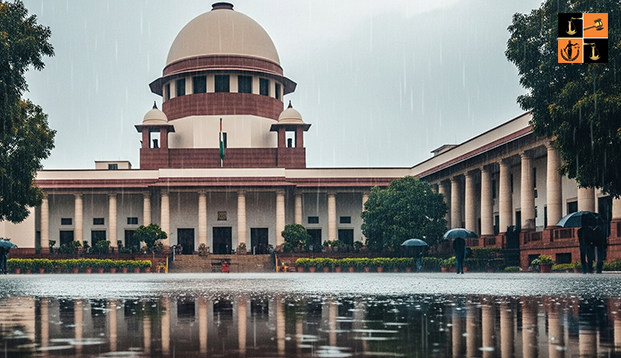
Recently, in a significant pronouncement on individual autonomy and religious freedom, the Supreme Court has held that the right to freedom of religion under Article 25 of the Constitution is intrinsically connected to the right to privacy “in the sense of non-interference from State.” The Division Bench of Justice J.B. Pardiwala and Justice Manoj Misra, while quashing multiple FIRs registered under the Uttar Pradesh Prohibition of Unlawful Conversion of Religion Act, observed that freedom of conscience and religious choice exist within the protected realm of personal privacy.
The Court emphasised that Article 25 is not limited to the external manifestation of faith but also encompasses the internal domain of individual belief. It remarked, “In other words, Article 25 carries with it the facets of privacy rights, whereby a person has the intrinsic right to freedom of conscience and also the choice to express it to the world at large.”
Relying on the nine-judge Bench decision in Justice K.S. Puttaswamy (Retd.) v. Union of India, the Court reiterated that although the Constitution does not explicitly enshrine privacy as a distinct fundamental right, the essence of privacy pervades Part III, including Article 25. “This court highlighted that although Part III of the Constitution does not have a separate article declaring privacy as a fundamental right, yet the broader scheme of Part III portrays and contains in it the various aspects of privacy, Article 25 being one of them,” the Bench recorded.
Reinforcing this linkage, the Court stated, “Freedom of conscience as ensured under Article 25 falls within the zone of purely private thought process.”
The Bench clarified that privacy operates as a condition precedent for the effective exercise of religious freedom, adding that “this court also read privacy rights in other rights pertaining to religious belief under Articles 26 and 28, respectively.”
In its reasoning, the Bench drew an analogy between religious choice and marital choice, noting that both derive from the broader constitutional guarantee of individual autonomy. Citing earlier precedents, the Court recalled, “It held that the right to marry a person of one's choice is integral to Article 21 of the Constitution as an expression of one's right to life. It categorically held that the intimacies of marriage, including the choices which individuals make on whether to marry, or whom to marry, form one of the rights from a bouquet of rights of right to privacy, and most importantly, transcend the control of the State.”
The Court held that the State cannot dictate or regulate personal decisions rooted in faith, belief, or conscience. “The court, while observing that the Constitution guarantees the right to practice, profess and propagate religion, held that an individual's autonomy is supreme in choices of faith and belief which are intrinsic in matters of marriage. The court prohibited the State as well as the law from controlling the choice of choosing a partner or even limiting or regulating the ability to decide on such matters,” the Court Observed.
Disclaimer: This news/ article includes information received via a syndicated news feed. The original rights remain with the respective publisher.
Picture Source :




















