









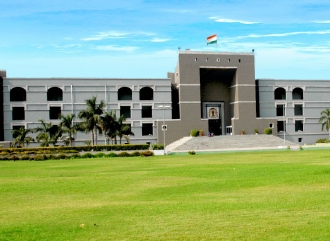
A single judge bench of the Gujarat High Court of Dr. Justice Ashok kumar C. Joshi upheld the acquittal of an accused in case under several sections of the Indian Penal Code and the Schedule Castes and Schedule Tribes (Prevention of Atrocities) Act, 1989. It discussed the current jurisprudence on appreciation of evidence by the appellate courts and conditions under which the decision of the trial court can be overturned.
Facts:
The complainant Karshanbhai Naranbhai Pardhi was sitting with the accused at the Bus Stand of Village Pithad. There, the complainant requested the accused to not take sand from the lease land granted to his son Muljibhai. Hearing this the accused got excited and gave filthy abuses relating to the caste of the complainant in public at large and also administered threat to cause death of the complainant and thereby committed the offence. Thereby a complaint was filed against the accused and after investigation of the offence, he was charge sheeted for offence under section 504, 506(2), and 114 of the Indian Penal Code and section 3(1)(10) of the Scheduled Castes and Scheduled Tribes (Prevention of Atrocities) Act 1989. However, the accused was acquitted by the Fast Track Court, Jamnagar and in furtherance of this the state filed an appeal before the High Court.
Observations of the Court:
The High Court found it pertinent to refer to the scope of interference in acquittal appeals, when the presumption of innocence is strong in favour of the accused. It cited to catena of judgments, which highlight that the High Court has full power to review, re-appreciate and consider evidence upon which the order of acquittal is founded. The High Court should not disturb the finding of acquittal recorded by the trial court in cases where two reasonable conclusions are possible. Further, while exercising the powers in appeal against the order of acquittal, the Court of appeal would not ordinarily interfere with the order of acquittal unless the approach of the lower Court is vitiated by some manifest illegality and the conclusion arrive at would not be arrived at by any reasonable person. Having clarified the scope of the powers of the High Court in cases of appeals from acquittal, the court went on to adjudicate upon the facts of the case at hand.
Since the court found too many discrepancies in the testimonies of the witnesses of the appellant, several of which even turned hostile, and the fact that the appellant concealed some of the material facts to the case, the court came to the conclusion that the trial court was right is acquitting the accused.
Conclusion:
The High Court did not find any discrepancies in the judgment of the trial and court and in the compliance of other procedural requirements; therefore, it refused to overturn the acquittal of the accused-respondent.
Date: 13.10.2022
Case: State of Gujarat v Sahdevsinh Chhanubha Jadeja
Citation: R/Cr. Appeal No. 1561 of 2010
Coram: Dr. Justice Ashokkumar C. Joshi
Read Judgment @Latestlaws.com
Picture Source :




















