









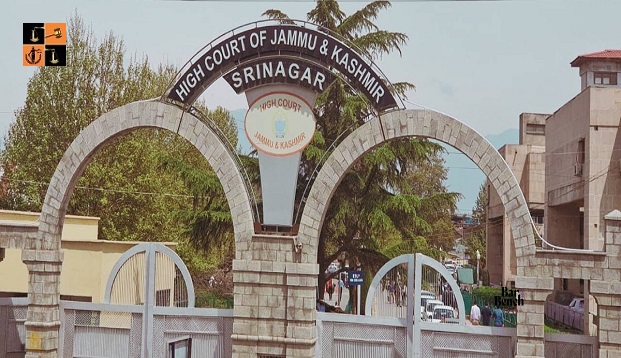
Recently, the Jammu and Kashmir and Ladakh High Court set aside a preventive detention order passed under the J&K Public Safety Act, holding that the detention was based on vague allegations and on acts allegedly committed when the detenue was a juvenile. Deciding an intra-court appeal arising from the dismissal of a habeas corpus petition, the Court observed that the detaining authority failed to provide specific, proximate grounds and had relied on material that could not legally form the basis for preventive detention.
The case concerns a young man who had earlier been arrested in connection with an FIR and later released on bail by the Juvenile Justice Board. After his release, surveillance was reportedly kept on him. A dossier was subsequently prepared alleging that he had again associated with militants and was providing support to them. Based on this dossier, a preventive detention order was issued under the Public Safety Act. The writ petition challenging the detention was dismissed by the Single Bench, leading to the present intra-court appeal.
The appellant’s counsel argued that the detention order was fundamentally flawed because it relied on an incident that occurred when the appellant was a juvenile, noting that a juvenile cannot be detained under the Act. It was submitted that the dossier did not mention any specific, new act after his release, and the allegations were vague, making it impossible for the appellant to file an effective representation.
Counsel also contended that the relevant material forming the basis of the detaining authority’s satisfaction was never supplied to the appellant, violating constitutional safeguards. Further, a representation made by the appellant was not considered in accordance with law, which, according to the counsel, invalidated the detention.
Per contra, the State submitted that the Single Bench had dealt with all issues raised by the appellant and that the detention order was passed strictly in accordance with the Public Safety Act. It was argued that the grounds of detention were sufficient and the allegations contained therein justified the preventive detention.
Examining the detention record, the Court noted that the dossier relied on the appellant’s earlier involvement in an FIR when he was a juvenile, observing that “an illegal act committed by a juvenile does not stigmatize his future and likewise cannot form the basis for issuance of a detention order under the Act, particularly when a juvenile cannot be detained under Section 8(3)(f) of the Act.”
The Court then considered whether the detention could still survive under Section 10-A, which permits severance of unlawful grounds. However, the remaining allegations were found to be vague and lacking essential particulars, as they did not specify any incident, timeframe, place, or details about the persons allegedly assisted or instigated. The Court held that such ambiguity failed to meet the statutory threshold for preventive detention, remarking that “the ambiguous and unclear grounds do not satisfy the legal requirement for detaining an individual under preventive detention laws.”
The Court further relied on the principles laid down in Ameena Begum v. State of Telangana, reiterating that preventive detention must rest on clear, proximate, and rationally probative material. Reference was also made to Fazalkhan Pathan v. Police Commissioner, emphasising that vague allegations deprive a detenu of the constitutional right to make an effective representation. Reaffirming this mandate, the Court noted that “the detenu must be supplied with grounds of detention in a language intelligible to him, and the grounds must be clear, precise, and unambiguous. Vague or unintelligible grounds violate the detenu’s right to submit an effective representation.”
Holding that the detention order suffered from vagueness and relied on acts allegedly committed when the appellant was a juvenile, the Court allowed the appeal. The impugned judgment of the Writ Court was set aside, and the detention order dated 04.04.2024 was quashed. The Court directed the authorities to release the appellant forthwith, provided he is not required in any other case.
Case Title: Tahir Riyaz Dar Vs. UT of J&K through Principal Secretary & Ors.
Case No.: LPA No.121/2025
Coram: Chief Justice Arun Palli, Justice Rajnesh Oswal
Advocate for Petitioner: Adv. Wajid Haseeb
Advocate for Respondent: Adv. Furqan Yaqub
Read Judgment @Latestlaws.com
Picture Source : twitter.com



















