









February 3, 2019:
Intermediate-range Nuclear Forces Treaty, 1987 which US President Ronald Reagan & Mikhail Gorbachev, the Soviet leader at the time, negotiated & signed led to ban on deployment of intermediate-range nuclear missiles.
White House officials said Friday that the United States would begin withdrawal from a landmark 1987 nuclear arms-control pact with Russia, asserting the Russians have violated it for years.
The decision suspends American obligations under the treaty, & terminates the accord unless Russia comes into compliance within six months. But with Russia asserting it is complying, the outlook for preserving the treaty, regarded as one of the most important in the history of preventing nuclear war, is bleak.
U.S. to pull out of arms control deal in six months
The United States announced on Friday it will withdraw from the Intermediate-range Nuclear Forces Treaty with Russia in six months unless Moscow ends its alleged violations of the landmark 1987 arms control pact.
What is the INF Treaty & how did it come about? The treaty resolved a crisis of the 1980's when the Soviet Union deployed a missile in Europe called the SS-20, capable of carrying three nuclear warheads. The United States responded with cruise & Pershing II missiles based in Europe.
Russian President Vladimir Putin, center, attends a meeting with Russian Foreign Minister Sergey Lavrov, left, & Defense Minister Sergei Shoigu in the Kremlin in Moscow, Russia, Saturday, Feb. 2, 2019. Putin said that Russia will abandon the 1987 Intermediate-Range Nuclear Forces treaty, following in the footsteps of the United States, but noted that Moscow will only deploy intermediate-range nuclear missiles if Washington does so.
By the time President Ronald Reagan & Mikhail Gorbachev, the Soviet leader at the time, negotiated the deal to ban the weapons in 1987, the intermediate-range missiles had come to be seen as a hair trigger for nuclear war because of their short flight times — as little as 10 minutes.
Trump Versus the Experts This was particularly troubling to the Soviet command, which could be destroyed by a “bolt from the blue” strike before it could order a retaliatory attack. Partly in response to this shortcoming, Moscow developed a “dead hand” trigger to fire its arsenal at the United States without an order from the leadership, based on computers interpreting radiation & seismic sensors.
The treaty prohibited land-based cruise or ballistic missiles with ranges between 311 miles & 3,420 miles. It did not cover air- or sea-launched weapons, such as the US Tomahawk & Russian Kalibr cruise missiles fired from ships, submarines or airplanes, although those missiles fly similar distances.
Was Russia actually in breach of the treaty terms? According to information dating to the Obama administration, it seems so. During the 2014 crisis in Ukraine, the United States accused Russia of violating the treaty by deploying prohibited tactical nuclear weapons designed to intimidate Europe & the former Soviet states that have aligned with the West.
Secretary of State Mike Pompeo, right, accompanied by State Department deputy spokesperson Robert Palladino, left, departs a news conference at the State Department in Washington, Friday, Feb. 1, 2019. Secretary of State Mike Pompeo has announced that the U.S. is pulling out of a treaty with Russia that’s been a centerpiece of arms control since the Cold War.
President Barack Obama personally informed President Vladimir Putin of Russia in a letter that the United States believed the Russians were violating the treaty, but that he wanted to resolve the issue through dialogue & preserve the accord.
The Russians have said there is no violation. But U.S. officials say Moscow is all but openly deploying a prohibited missile that the West calls the SSC-8, a land-based cruise missile that could be threatening to European nations.
Last month, Russian officials put a newly modified version of that missile on display for a foreign audience for the first time in an attempt to rebut the accusations that the weapon violates the treaty.
The display was intended to underscore Russia’s “increased transparency & our adherence to the INF Treaty,” said Lt. Gen. Mikhail Matveyevskiy, the chief of missiles & artillery for the Russian armed forces, & to show off new modifications.
Trump administration officials, who first signaled last year that they would withdraw the United States from the treaty, said the display was meaningless in allaying their concerns.
Is China obliged to honor the INF Treaty? No, & it may be a greater concern to the Trump administration than to Russia.
While the Chinese military is carving out a greater sphere of influence in the Western Pacific, the INF Treaty constrains the United States from placing short- & intermediate-range missiles on land near China as a deterrent.
For this & other reasons, President Donald Trump & his national security adviser, John Bolton, have called the INF Treaty outdated.
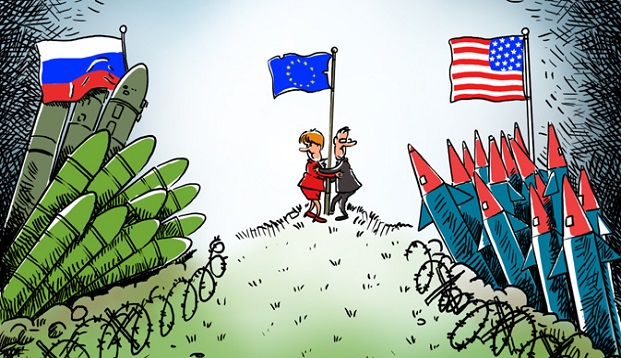
What comes next for Europe? European leaders have been among the most vocal protesters of the treaty withdrawal. While they agree with the United States that Russia’s new intermediate range missiles threaten Europe, they say the answer is to renegotiate the accord, not scrap it.
“Deeply concerned by the state of nuclear arms control after U.S. announcement to suspend the INF,” Margot Wallström, Sweden’s minister for foreign affairs, said in a statement posted Friday on Twitter after the announcement. “Fundamental cause is Russia’s noncompliance. Trend of less cooperation on disarmament must be reversed & new ways forward explored.”
Federica Mogherini, the European Union’s top diplomat, speaking during a meeting of EU defense ministers in Bucharest, Romania, this week said that Europe had benefited enormously from the treaty. “We continue to hope that there is a way to maintain it & to fully implement it,” she said.
Europe could have good reason to fear the impact of the treaty’s collapse. Russia, perhaps seeking to stoke European anxieties, has emphasized the risks of a nuclear missile buildup.
The chairman of the Russian Senate’s foreign affairs committee, Konstantin Kosachyov, said the withdrawal was a victory for “Washington’s hawks led by John Bolton” that would come at a direct cost for European security.
Vladimir Shamanov, head of the defense committee in Russia’s parliament, also had ominous words for Europe: “We will have to adjust our plans on the use of all arms & branches of the military & , naturally, Europe will find itself in a sticky situation.”
How is Russia expected to respond? Before the United States moved to withdraw from the treaty, Putin & Russia’s generals had suggested they didn’t have to respond with new deployments, as their current armaments were already enough to guarantee nuclear apocalypse for the United States.
In a speech to the Defense Ministry late last year, Putin suggested Russia would respond by quickly deploying missiles now banned by the treaty — something the United States says Russia has, in fact, already done.
On Friday, a former director of the Russian general staff, Gen. Viktor Yesin, suggested Russia will respond in kind if the United States deploys short-range missiles in Europe, but may not if the Americans limit deployments to the Pacific region.
“It would not be difficult” for Russia to make new short-range missiles, he told the Interfax news agency. “If they deploy missiles to Europe, the tensions, of course, will seriously increase.” Source Link
Picture Source :




















