









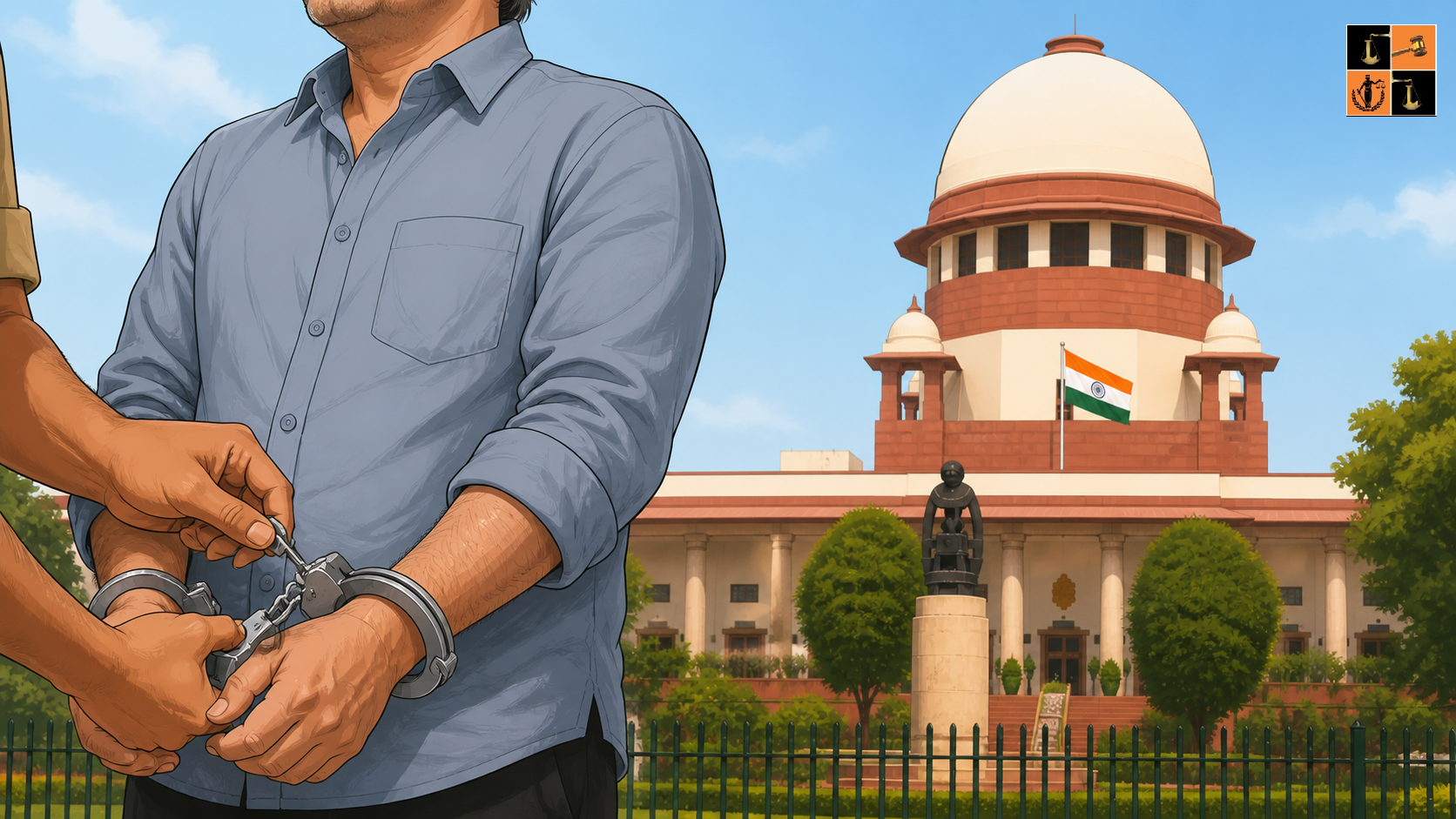
After revisiting the principles of Evidence Law, the Supreme Court called the allegation of dowry demand in a recent case “a legal gimmick”. The top court has set aside the conviction of a father-in-law under Section 498A IPC while upholding the acquittal in a murder charge arising from a young bride’s death within months of marriage.
Brief Facts
The case concerns the death of a woman who suffered burn injuries in April 2001, within nine months of her marriage in Madhya Pradesh. The prosecution alleged that her husband and in-laws had been harassing her over dowry demands, particularly a Maruti car.
Two dying declarations formed the crux of the case. In the first, recorded by an Executive Magistrate, the woman accused her husband and in-laws of setting her ablaze. In a second declaration recorded by a DSP, the following day, she stated that she had poured kerosene on herself and set herself on fire due to the distress caused by disputes over dowry.
The trial court convicted all three accused under Sections 302 and 498A IPC. On appeal, due to contradictory dying declarations and insufficient evidence, the High Court acquitted them of murder but upheld the conviction under Section 498A, reducing the sentence to the period already undergone.
Subsequently, appeals against the High Court order were filed before the Supreme Court by the father-in-law challenging the conviction under Section 498A IPC, and by the State and the victim’s family challenging the acquittal u/s. 302 IPC.
Supreme Court’s Observations
The Apex Court noted that the family members of the victim could not withstand the test of the cross-examination, as many contradictions emerged. Strangely, in the statements before the Police, the victim’s family did not state the demand of dowry or that the girl was being tortured by the in-laws, and they did not have a proper explanation as to how these facts were missing in their statements.
This led the Supreme Court to infer that the testimonies were an afterthought, “as the same improvements appear across the statements of all the witnesses, with a jarring accuracy which was hitherto missing in the statements recorded before the Police.”
Moreover, the SC observed that apart from the family members of the victim, not a single witness could corroborate the version of the prosecution. The top court followed the “rule of caution” that although usually testimonies of the family are enough to convict an accused but “if there are improvements or contradictions in the testimonies of the prosecution, then the Courts must look for corroboration through other evidence, which unfortunately is missing in this case.”
Calling the belated allegation of dowry a “legal gimmick”, the Supreme Court said, “a fact as important as demand of dowry that was so traumatic so as to lead to the death of a young lady could not have been left out of the statement under Section 161 before the police at the first blush.”
Prosecution had produced a letter written by the victim to her brother revealing the stress of her married life, but the bench found it unreliable as it was not proved by a handwriting expert.
The court took note of the fact that the accused persons had brought the victim to the hospital. The Court reflected, “If the accused persons wanted the girl to die, there is no reason for them to take the deceased lady to the hospital in the first place.”
It also noted that the testimonies of the neighbours gave the impression that the victim had cordial relation with her in-laws.
The SC said, “Whatever may be the cause of her unhappiness, the reason for her discontent, unless it is directly established that her in-laws have done something so cruel in nature that she felt, they cannot be held responsible or liable for abetting her causing cruelty in the nature of abetting suicide.”
“The settled law is that a dying declaration is regarded with utmost evidentiary value, because it is believed that a person will not meet the maker with lies in his mouth. However, as a matter of prudence, if there are some suspicious circumstances related to a dying declaration, then in that case, the same can be rejected,” the Supreme Court said, especially considering that the Tehsildar who recorded the first dying declaration deposed that at that time, 4-5 persons were there and one of them had told the deceased to depose in a certain way.
Since the first deposition appeared to be tutored, the Supreme Court found the second declaration to be more believable.
Reiterating settled principles of criminal law, the Court emphasized, “It is a settled position of law that circumstances cannot take the place of proof and in a criminal trial, the guilt has to be proved beyond reasonable doubt... In a criminal trial, in case there are two inferences possible, then the one favouring the accused must be followed.”
The Court also cautioned against implicating extended family members in Section 498A matters without clear evidence, noting that the father-in-law appeared to have been “roped in by an extension of roping the husband” without specific allegations and direct evidence.
Supreme Court’s Decision
Allowing the appeal filed by the father-in-law, the Supreme Court set aside his conviction under Section 498A IPC, holding that the prosecution failed to establish cruelty or dowry demand against him.
The Court also dismissed the appeals filed by the State and the victim’s family challenging the acquittal under Section 302 IPC.
Holding that the evidence on record was insufficient and unreliable, the Court concluded that the conviction could not be sustained in law.
Case Title: Narendra Singh v. The State of Madhya Pradesh
Case Details: Criminal Appeal No. 302 of 2014
Date of Judgement: 30th April 2026
Bench: Justices Aravind Kumar and N.V. Anjaria
Click Here To Read the Judgement @LatestLaws.com
Picture Source :




















