









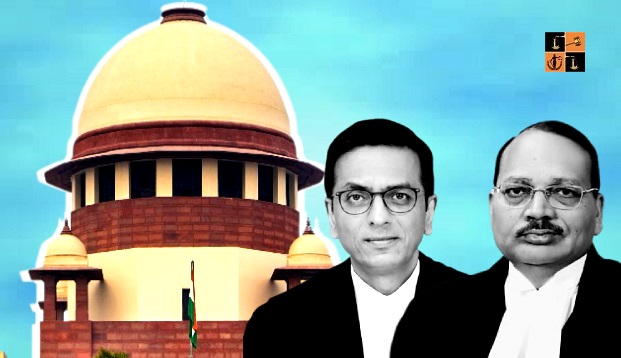
The Division Bench of the Supreme Court, presided by Justices DY Chandrachud and Surya Kant, has expanded the definition of 'Vulnerable Witness' while hearing a Miscellaneous Application on compliance with its directions in a previous judgment titled State of Maharashtra v. Bandu @ Daulat, wherein the apex court had directed setting up special centres for examining vulnerable witnesses in criminal cases to facilitate a conducive environment that would allow a vulnerable victim to make a statement before the court.
In 2019, notices were directed to be issued to all the High Courts through their Registrars for status reports concerning the establishment of vulnerable witness courtrooms.
In the present case, titled Smruti Tukaram Badade v. State of Maharashtra & Anr [2022 Latest Caselaw 984 SC], the Supreme Court relied on the deliberations and the suggestions by the amicus curiae and various High Courts to issue the following directions:
1. The definition of vulnerable witness in clause 3 of the VWVDC Scheme formed by the Delhi High Court would not be limited to child witnesses, and will include:
a) age-neutral victims of sexual assault
b) gender-neutral victims of sexual assault
c) age and gender-neutral victims of sexual assault u/s 377
d) witnesses suffering from mental illness as defined in the Mental Healthcare Act, 2017
e) any witness seen to have a threat perception under the Central Government Scheme
f) any speech or hearing-impaired individual or person suffering from any other disability who is considered to be vulnerable by the court concerned.
2. All High Courts shall adopt and notify a VWDC Scheme within a period of two months of this order unless a Scheme is already notified. High Courts with existing schemes may consider modification according to the present order.
3. Every High Court should set up a permanent VWDC Committee.
4. Every High Court is requested to give an estimate of the manpower required to have VWDCs in the entire state in three months.
5. Having due regard to the importance of conducting training programs to manage VWDC and sensitizing all stakeholders, including Bar, Bench and staff, Justice Gita Mittal, former Chief Justice of J&K High Court, is requested to act as Chairperson of the committee for designing and implementing an all-India VWDC training program. The initial tenure of the Chairperson shall be for 2 years. All High Courts shall facilitate and give full cooperation in conducting training programs on terms of the modules prepared by the Chairperson.
6. Upon the estimation of cost prepared by the VWDC of each High Court, the State government shall sanction adequate funds. The State government shall nominate a nodal officer from the finance department who shall be associated with the work of the VWDC Committee of the High Court.
7. The High Courts should ensure there is one centre in each district. In many states, ADR centres have been set up in close proximity to the court. Where such centres are in place, the High Court will be at liberty to ensure that a VWDC is made available within the premises of the ADR centre.
8. NALSA shall have a vital role to play especially in sensitizing programs. The Chairperson of the committee appointed by this Court is requested to engage with NALSA and SALSAs to provide an effective interface for schemes of training.
9. The Ministry of Women and Child Development shall designate a nodal officer to coordinate the implementation of these directions and facilitate logistical support to Justice Mittal. All such ministries on the state level shall provide financial support."
Senior Advocate Vibha Makhija, the amicus curiae, had submitted suggestions for effective implementation and setting up Vulnerable Witness Deposition Centres (VWDCs) in all the High Courts.
The bench directed that "A copy of this order shall be forwarded by the registrar general to the secretary, ministry of women and child development of the union government and to the secretaries of all state governments for compliance. Copies shall also be emailed to the registrars general of all the High Courts for necessary action."
Shri Surinder S Rathi, District Judge, New Delhi, had drafted the Delhi HC's 'Guidelines for recording evidence of Vulnerable Witnesses in Criminal matter, 2011'. The drafting was done under the directions and guidance of Justice Gita Mittal and was adopted by the Delhi High Court after it was released by Justice Altmas Kabir, Former Chief Justice of India, in September 2011.
Judge SS Rathi also dealt with Nirbhaya's victim compensation application in December 2012 while serving as an Officer on Special Duty with the Delhi State Legal Services Authority. There, he led the drafting of the 'Delhi Victim Compensation Scheme, 2015'. He also led the drafting of 'NALSA Women Victim Compensation Scheme, 2018'.
The drafting of the scheme titled 'NALSA Witness Protection Scheme, 2018' was also led by Judge Surinder S Rathi for the Ministry of Home Affairs while serving as the Director of the National Legal Services Authority. He had also drafted the 'Delhi Witness Protection Scheme, 2015' an off-shoot of the Jessica Lal Murder Case.
Picture Source : LatestLaws



















