









The Authors, Ashpinder Kaur and Ayush Bhardwaj, are third-year students at HPNLU.
I. INTRODUCTION
India's diverse and multifaceted society poses significant challenges to legal and religious rights. The concept of secularism made explicit in the Constitution through the 42nd Amendment in 1976, mandates that the State must remain neutral and respectful towards all religions. This principle underscores the necessity of equal respect for all religions, as outlined by judicial interpretations that have become a cornerstone of constitutional philosophy.
Article 25 deals with the Freedom of conscience and free profession, practice, and propagation of religion, as the bare language states that protect these rights and restrict the state from intervening in religious matters. The doctrine of 'Essential Religious Practices' has evolved through judicial interpretation to protect religious freedoms by ensuring that the State does not interfere with practices fundamental to a religion's core beliefs. This principle is crucial for personal laws governing marriage, divorce, and inheritance and is integral to various communities' religious and cultural identities.
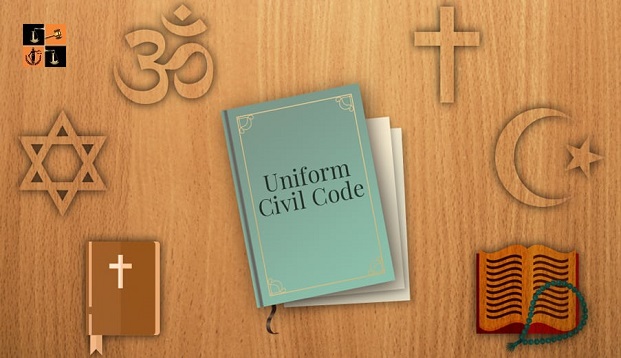
The call for a Uniform Civil Code mentioned in Article 44 of the Indian Constitution aims to unify personal laws under a single legal framework, promoting national cohesion. However, this initiative faces substantial challenges due to India's vast diversity and the constitutional provisions that protect regional and tribal customs. The debate over the Uniform Civil Code has gained significant traction with the release of the Bharatiya Janata Party’s manifesto, Sankalp Patra; among its promises, the BJP pledged to implement the UCC if it retains power in the upcoming General Elections. This pledge underscores the ongoing tension between the push for legal uniformity and the need to preserve India's rich cultural and religious diversity. Balancing these competing interests remains a critical challenge in maintaining the country’s secular ethos while addressing its complex multi-religious landscape.
Before understanding the implications of UCC, it is essential to understand the meaning of secularism in the Indian context, Article 25, the doctrine of essential religious practices, and the need for and challenges of implementing UCC.
II. IDEA OF INDIAN SECULARISM
In 1976, through the 42nd Amendment of the Constitution, the concept of secularism was made explicit by amending the Preamble.[1]In the case of Indira Nehru Gandhi v. Raj Naraian[2], Justice Chandrachud held that:
If there be any unamendable features of the Constitution on the Score that form a part of the basic structure of the Constitution, they are that:
(3) The State shall have no religion of its own and all persons shall be equally entitled to freedom of conscience and the right to freely profess, practice, and propagate religion. These are the pillars of our constitutional philosophy, therefore, of the basic structure of the Constitution.
During the Constitution Assembly Debate, the dominant position on secularism was that a ‘democratic’ Constitution finds a place for religion as a way of life for most citizens. This thought triumphed over the argument of those members who wished for the Assembly to grant only a narrow right to religious freedom or to make the uniform civil code a fundamental right. The problem before the Assembly was “creating a secular state in a religious society.”[3]Out of all the theories contested in the Assembly debates, the ‘Equal-respect’ theory was felt to be catering to the needs of Indian society the best. The theory of secularism in India emphasizes equal respect for all religions rather than mere tolerance or distancing from religious beliefs. It upholds religious liberty by acknowledging the significance of religion in people's lives and requires the state to respect all religions equally, moving beyond viewing them as mere private superstitions. This approach ensures that the state does not favor or disfavor any religion but treats all equally.[4]
III. JUDICIAL INTERPRETATION OF ESSENTIAL RELIGIOUS PRACTICES IN INDIA UNDER ARTICLE 25
The doctrine of ‘Essential religious practices’ evolved via judicial interpretation[5], safeguards the right of free religious practice as it states that the state shall not interfere in matters or practices that form an essential part of the religion. Marriage, divorce, inheritance, adoption, and maintenance are essential religious practices, as these practices form their very essence from the religious Scriptures and, in the case of Sarla Mudgal v. Union of India[6], the Supreme Court held that:
Marriage, inheritance, divorce, and conversion are as religious and content as any other belief or faith. Going around the fire seven rounds or giving consent before Qazi is as much a matter of faith and conscience as the worship itself.
In the case of G.V.Rao v. L.H.V Prasad and others[7]called marriage a "sacred ceremony, the main purpose of which is to enable the young people to settle down in life and live peacefully.”
Supreme Court in the case of The Commissioner, Hindu Religious Endowment, Madras v. Sri Lakshmindra Thirtha Swamiar of Sri Shirur Mutt,[8] held that “what article 25(2)(a) contemplates is not regulation by the State of religious practices as such, the freedom of which is guaranteed by the Constitution except when they run counter to public order, health, and morality, but regulation of activities which are economic, commercial or political in their character though they are associated with religious practices, what constitutes the essential part of a religion is primarily to be ascertained concerning the doctrines of that religion itself.” It was upheld in the case of Tilkayat Shri Govindlaji Maharaj v. State of Rajasthan[9], where the court opined that a practice is considered essential to a religion if necessary for the community following it. The guarantee under the Constitution not only protects the freedom of opinion but also acts done to pursue such religious opinion, and the provisions of Article 25 and 26 of the Constitution protect it.[10]
In the case of Sardar Syedna Taher Saiffuddin Saheb v. State of Bombay,[11] held that what constitutes an essential practice is to be gathered from the texts and tenets of the religion. Looking at the holy Scripture of the Quran, activities like marriage, divorce, inheritance, succession, and adoption are considered religious.
Art. 25[12] distinguishes between religious practices and secular activities associated with religious institutions. The state can regulate or restrict secular activities associated with religious practices unrelated to religion's core aspects.
IV. MANDATE FOR PERSONAL LAWS
Personal religious laws regulate marriage, divorce, and other related practices, including inheritance. The body of laws that only apply to an individual because they follow a specific religion is known as personal religious laws. Secular laws can be applied to any citizen, regardless of religious beliefs. As a codification of Hindu personal law, the Hindu Marriage Act of 1955 was enacted and continues to be operative solely for Hindu nationals of India. Similarly, the Dissolution of Muslim Marriages Act of 1939 applies to only Muslims. So, these personal codified laws are religious, not secular. To perceive the religious identities of these minorities, they were given protection under Articles 25 to 28.
In the case of Krishna Singh v. Mathura Ahir[13], the SC held that “Part III of the Constitution does not touch upon the Personal Laws of the parties' and that the Personal Laws of the parties have to be applied based on recognized authoritative sources of Personal Law and not based on the HC's concept of modern times.” In a case law, Hon'ble Justice J.S. Kehar[14], went one step further to hold that Personal Law is constitutionally protected under Art. 25.
V. THE NEED FOR GENDER JUSTICE UNDER PERSONAL LAWS
The UCC seeks to eradicate such practices or social dogmas shadowed by personal laws and reform society. A well-crafted UCC can foster gender justice & equal rights.
Personal laws are based on the scriptures and customs of each major religion, many of which discriminate against women. There have been various cases in which personal laws have been considered oppressive towards women, such as Jiauddin Ahmed v. Anwara Begum[15] and The cases of Nazeer v. Shemeema[16] and Shayara Bano v. Union of India[17] Show instances of misuse of Triple Talaq, which not only discriminatory against woman but also contravened the principle of constitutional morality. However, Triple Talaq has been made illegal, void, and punishable by the legislature in 2019; other forms of unilateral divorce by Husband still exist i.e., ‘talaq-e-ahsan’ and ‘talaq-ehasan’[18] which are discriminatory against women. Not only Muslim personal law[19], but specific provisions of Hindu Personal law are also discriminatory against women. For example, In the case of Githa Hariharan v. Reserve Bank of India[20], this Court held the provisions of the Hindu Minority and Guardianship Act, 1956,[21] unconstitutional. The practice of ‘Sati’[22], ‘Devadasi’[23] ‘Untouchability’[24] and ‘Polygamy’, which were components of Hindu religion that also discriminatory to women were done away with by various legislations in the past. However, many such practices still exist. Polygamy in the Hindu religion was done away with by legislation, but the same is not invalid in the Muslim religion; this is one of the instances which postulate the need for a Uniform Civil Code.
Not only women, but ‘Khula-Unilateral divorce at the instance of wife’ is discriminatory against men. Since Gender is a constitutionally unacceptable basis for differential treatment of people, it is violative of Articles 14 & 15 Of the Constitution.
These are various provisions in various personal laws that are discriminatory against women, e.g., S.2(7) of the Sharia Act allows polygyny but not polyandry. Furthermore, the Supreme Court has also emphasized the need for a UCC in various cases, Mohd. Ahmad Khan v. Shah Bano Begum & Ors.[25], Jordan Diengdeh v. S S Chopra[26] etc. Sarla Mudgal v. UOI[27] was a classic case of an individual’s attempt to misuse religious freedoms to evade legal restrictions, and this court emphasized the need for a UCC to curb the same.
VI. CHALLENGES AND FEASIBILITY OF IMPLEMENTING A UNIFORM CIVIL CODE
Implementing UCC will replace personal laws and govern every citizen with a standard set of laws. The citizens of this country are not forming a homogenous community but a heterogeneity in terms of ethnicities, religions, cultures, and languages. The primary purpose of implementing UCC on the part of the state is to seek an image of a unified political community. However, a country with such diversity will not be united if diversity is not respected. The same stance can be observed in the 21st Law Commission report, stating that a united nation does not necessarily need uniformity[28]. It is reconciling diversity with specific universal and indisputable arguments on human rights[29]. Supreme Court, in the case of T.M.A Pai Foundation v. State of Karnataka and Ors[30], reiterated that:
The essence of secularism in India is recognizing and preserving the different types of people with diverse languages and beliefs and placing them together to form a united India.
The feasibility of implementing a UCC faces challenges due to constitutional provisions like the Sixth Schedule and Art 371 (A) to (I). These protect states like Assam, Nagaland, Mizoram, Andhra Pradesh, and Goa regarding family law. The 6th Schedule provides for autonomous districts and regions with legislative competence over inheritance, succession, marriage, divorce, and justice administration. While protecting the status given to Schedule tribes, the Supreme Court, in the case of Madhu Kishwar & Ors v. State of Bihar[31], the Court had observed that:
In the face of these divisions and visible barricades put up by the sensitive tribal people valuing their own customs, traditions, and usages, judicially enforcing on them the principles of personal laws applicable to others, on an elitist approach or equality principle, by judicial activism, is a difficult and mind-boggling effort. ...it is not desirable to declare the customs of tribal inhabitants as offending Arts. 14, 15, and 21 of the Constitution.
VII CONCLUSION:
Implementing a Uniform Civil Code in India poses significant challenges due to the nation's inherent diversity in ethnicities, religions, cultures, and languages. The doctrine of Essential Religious Practices, upheld by judicial interpretation, emphasizes the importance of preserving religious freedoms and practices, which are deeply intertwined with personal laws governing marriage, divorce, inheritance, and adoption. While the BJP's push for a UCC aims to create a unified political community, it risks undermining the very fabric of India's secularism by disregarding the constitutional protections afforded to various communities, especially those in autonomous regions and states protected under the Sixth Schedule and Article 371. The SC's stance in cases like the T.M.A. Pai Foundation[32] and Madhu Kishwar[33] underscores the necessity of respecting diversity to maintain national unity. Thus, any move towards a UCC must carefully balance equality principles and preserve India's rich cultural and religious mosaic.
References:
[1] S.R. Bommai v. Union of India, AIR 1994 SC 1918.
[2] AIR 1975 SC 2299. See also Abhiram Singh v. C.D. Commachen,(2017) 2 SCC 629, Kalpana Mehta v. Union of India ,(2018) 7 SCC 1,M. Siddiq v. Suresh Das,(2020) 1 SCC 1.
[3] T N Madan, Modern Myths, Locked Minds, OUP, Delhi (1997).
[4] Shefali Jha, Secularism in the Constituent Assembly Debates, 1946-1950, 37 Economic and Political Weekly, 3175–80 (2002).
[5] The Commissioner, Hindu Religious Endowment, Madras v. Sri Lakshmindra Thirtha Swamiar of Sri Shirur Mutt, AIR1954 SC 282.
[6](1995) 3 SCC 635, See also: Ms. Jordan Diengdeh v. S.S. Chopra AIR 1985 SC 935.
[7] (2000) 3 SCC 693.
[8] Ibid.
[9] AIR 1963 SC 1638. See also, Hasan Ali v. Mansoorali, (1948) 50 BOM LR 389.
[10] The Commissioner, Hindu Religious Endowment, Madras v. Sri Lakshmindra Thirtha Swamiar of Sri Shirur Mutt (1954) AIR 282. See also, Hasan Ali v. Mansoorali, (1948) 50 BomLR 389.
[11] AIR 1962 SC 853.
[12] INDIA CONST. art. 25.
[13] AIR 1982 SC 686.
[14] Shayara Bano v. UOI, (2017) 9 SCC 1.
[15] (1981) 1 Gau.L.R. 358. See also Masroor Ahmed v. State (NCT of Delhi) 2008 (103) DRJ 137; Must. Rukia Khatun v. Abdul Khalique Laskar (1981) 1 Gau. L.R. 375.
[16] 2017 (1) KLT 300M.
[17](2017) 9 SCC 1.
[18] Sir Dinshaw Fardunji Mulla, PRINCIPLES OF MAHOMDAN LAW (1922).
[19] Muslim Personal laws refer to the laws which are applied to the people of Muslim religion in India in personal matters like Divorce, Marriage, Property, Succession, Adoption, Minority etc. some of which are The Muslim Personal Law (Shariat) Application Act, 1937; The Muslim Women (Protection of Rights on Marriage) Act, 2019; The Cutchi Memoms Act, 1938; The Kazis Act, 1880; The Mussalman Wakf Act, 1923.
[20] (1999) 2 SCC 228.
[21] Hindu Minority & Guardianship Act, 1956.
[22] The Comission of Sati (Prevention) Act, 1987.
[23] The Madras Devdasi (Prevention of Devdasi) Act, 1947.
[24] The Untouchability (Offences) Act, 1955.
[25] (1985) 2 SCC 556: AIR 1985 SC 945.
[26] (1985) 3 SCC 62. See also John Vallamattom v. Union of India, (2003) 6 SCC 611: AIR 2003 SC 2902; Jose Paulo Coutinho Vs Maria Luiza Valentina Pereira, (2019) 20 S.C.C 85.
[27] (1995) 3 SCC 635: AIR 1995 SC 1531.
[28] Law Commission of India, 21st Report (2018).
[29] Law Commission of India, 21st Report, at 14 (2018).
[30] (1994) 2 SCC 195.
[31] AIR 1996 SC 1864.
[32] Supra Note 18.
[33] Supra Note 19.
Picture Source : https://twitter.com/Anirudh_Astro/status/1225442864403894272/photo/1



















