









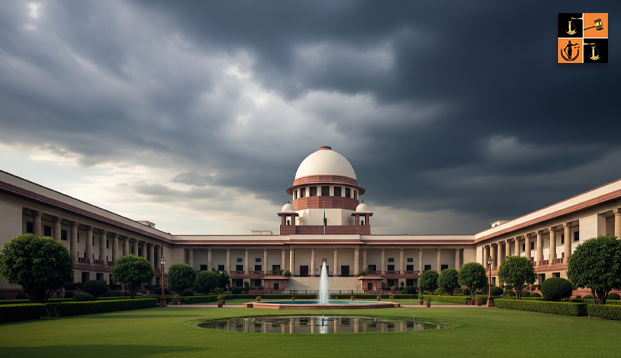
On Tuesday, the Supreme Court permitted the resumption of construction activities for various categories of buildings, including housing, educational institutions, and industrial sheds, with covered areas ranging between 20,000 and 1,50,000 square metres, ruling that such projects no longer require environmental clearance from the central authority. Clearance from the respective State Environment Impact Assessment Authority (SEIAA) would suffice.
The Division Bench of Chief Justice B R Gavai and Justice K Vinod Chandran upheld the validity of the Ministry of Environment, Forest and Climate Change's (MoEFCC) notification delegating environmental clearance powers to state-level authorities for specified construction projects. This decision effectively lifts the ex parte stay earlier granted by a different Bench on a plea filed by NGO Vanashakti, which had halted the implementation of the notification.
The Court clarified that although the previous notification granted total exemption from environmental scrutiny to certain categories such as industrial sheds, schools, colleges, universities, and hostels, the blanket exemption could not be sustained. These projects must still secure prior clearance from the SEIAA before proceeding.
The petitioning NGO had contended that exempting large-scale constructions from central environmental clearance would weaken environmental safeguards. However, the Bench was not persuaded that such delegation to the SEIAA would compromise the assessment process. When asked by the Court why SEIAA should not be authorised to grant clearance, counsel for Vanashakti, Gopal Sankaranarayanan, argued that the move would "dilute the stringent environment protection regime" applicable to projects of substantial size, potentially up to 15 lakh square feet.
Additional Solicitor General Aishwarya Bhati, appearing for the Union government, submitted that the Centre lacked the institutional capacity to vet state-level projects on such a vast scale, and noted the increasing backlog before SEIAAs, especially in Maharashtra where over 700 applications remain pending. She further informed the Court that thousands of educational and industrial projects across the country had been stalled as a result of the stay.
The Bench also addressed ambiguity regarding the competent authority for projects situated in eco-sensitive zones, wildlife-protected areas, critically and severely polluted areas (CPA/SPA), or those near inter-state boundaries. The Court upheld the provision in the notification assigning such clearance authority to the state.
Senior advocate Mukul Rohatgi and Senior advocate Atmaram Nadkarni, appearing for Godrej Properties and CREDAI respectively, defended the notification and pointed out that the exemption regime has existed since 2006. Rohatgi submitted that the recent notification did not introduce any novel exemption, but merely reiterated the existing position.
Chief Justice B R Gavai observed, “No country can progress without development. Duty to protect the environment and ecology is paramount, but development activities cannot be stalled altogether.”
Solicitor General Tushar Mehta added that both central and state authorities possess comparable levels of expertise, and highlighted the professional qualifications of SEIAA members.
Picture Source :




















