









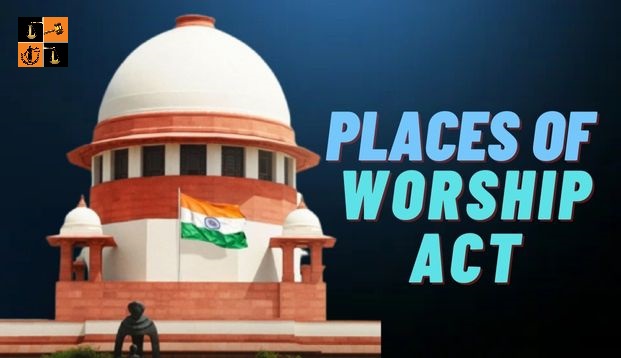
Recently, the Supreme Court directed trial courts nationwide to refrain from issuing effective orders or conducting surveys in cases questioning the religious character of existing structures. The Court emphasized that the Places of Worship (Special Provisions) Act, 1991, prohibits such suits unless its constitutional validity is determined. It further noted that this position was reinforced in the Ayodhya verdict.
The directive came while the Supreme Court was hearing a batch of petitions challenging the Places of Worship Act, 1991. The Act mandates that the religious character of any place of worship must remain as it stood on August 15, 1947. It bars courts from entertaining disputes on the character of such sites, with exceptions only for the Ayodhya Ram Janmabhoomi site. The petitions include one filed by BJP leader Ashwini Upadhyay, who contended that the Act perpetuates illegal acts by invaders and denies legal remedies to Hindus, Jains, Buddhists, and Sikhs. Other organizations, including the Jamiat Ulama-i-Hind, have sought to join the proceedings, arguing that some petitions indirectly target Islamic places of worship. The Act’s provisions have sparked legal disputes involving sites like the Gyanvapi Mosque in Varanasi, the Shahi Eidgah Masjid in Mathura, and others. These suits claim certain mosques were constructed over ancient temples.
The petitioners argued that the Places of Worship Act is unconstitutional as it denies the right to judicial remedy and enforces a blanket prohibition on revisiting historical grievances. They submitted that this denies fundamental rights guaranteed under Articles 14, 25, and 26 of the Constitution. Conversely, parties supporting the Act, including Jamiat Ulama-i-Hind, contended that the law is essential to maintain communal harmony and that revisiting disputes dating back to independence could destabilize public order.
The Apex Court underscored the constitutional importance of the Places of Worship Act in maintaining the secular ethos of India. It highlighted the Act’s role as a legislative measure aimed at ensuring that disputes over the religious character of places of worship, as they existed in 1947, do not reopen old wounds and disturb societal harmony. The Court observed that the Act was a critical safeguard to prevent historical grievances from being used as a tool for divisive politics or communal strife. Referring to its landmark Ayodhya judgment, the Bench noted that reopening disputes over religious structures could destabilize the delicate fabric of unity in a pluralistic society like India.
The Court remarked, “When the matter is sub judice before this Court, no other court should pass effective or final orders in such cases. This directive is vital to maintaining judicial discipline and ensuring consistency in legal interpretation. Allowing parallel proceedings would not only lead to confusion but also undermine the authority of this Court”.
It further emphasised that reopening such disputes without a robust legal foundation would contradict the principles enshrined in the Constitution, particularly under Articles 14 and 21, which guarantee equality before the law and personal liberty.
In a strong critique of procedural lapses, the Court noted, “The institution of fresh suits or the continuation of proceedings in existing cases directly contravenes the legislative intent of the Places of Worship Act. This law seeks to preserve the status quo and prevent the misuse of judicial processes to question the historical character of religious sites. Effective safeguards must be implemented to ensure that the objectives of this Act are upheld”.
The Top Court barred trial courts from passing orders or initiating surveys related to disputes over the religious character of structures covered by the Act. It reaffirmed that the validity of the Places of Worship Act must first be adjudicated. Additionally, the Court clarified that its directive does not preclude fresh legal remedies should the Act's constitutionality be overturned in the future.
Picture Source :




















