









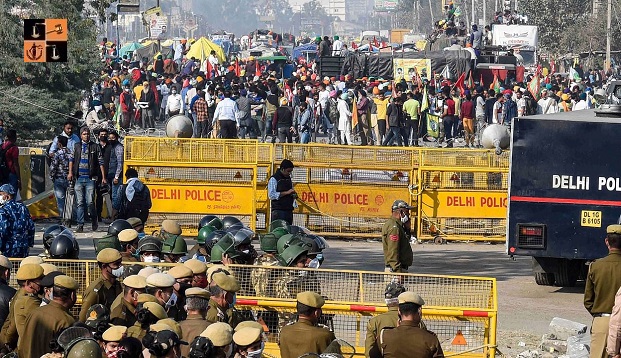
Recently, the Supreme Court while addressing a habeas corpus petition concerning farmer Jagjit Singh Dallewal’s alleged illegal detention, emphasised that protests must not obstruct public highways or inconvenience the public. The Court acknowledged the democratic right to peaceful protest but underscored the responsibility to ensure such demonstrations do not disrupt public life.
The matter arose when Jagjit Singh Dallewal, a protesting farmer advocating for a legal guarantee of Minimum Support Price (MSP) for crops, was allegedly removed from a protest site at the Khanauri border near Delhi. Dallewal claimed he was forcibly admitted to a Ludhiana hospital, asserting this constituted a form of detention. Subsequently, he was released and resumed his protest. Dallewal approached the Supreme Court, contesting the circumstances of his hospital admission and detention.
The Apex Court, comprising a Bench of Justice Surya Kant and Justice Ujjal Bhuyan, reaffirmed that the right to peaceful protest is a cornerstone of democratic values. However, the Court highlighted that this right is not absolute and must be exercised in a manner that does not infringe upon the rights of others. Specifically, the Court observed that obstructing highways or causing inconvenience to the public during protests undermines the balance between individual freedoms and public order.
The Bench further emphasised the responsibility of protestors to demonstrate awareness of their impact on public life. While recognising the legitimacy of Dallewal's grievances and his right to protest, the Court stressed that such actions must adhere to the principles of accountability and restraint. Noting that Dallewal had already been released from alleged detention and had resumed his protest, the Court disposed of the plea, reminding all parties of the necessity to respect public spaces while asserting democratic rights.
Picture Source :



















