









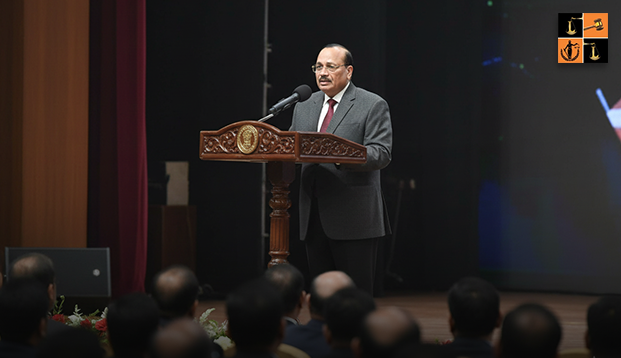
On Thursday, Chief Justice of India Surya Kant said that Artificial Intelligence has moved beyond the realm of emerging technology and is now reshaping governance, judicial systems, human rights, and the international legal order itself. Speaking at Birkbeck, University of London, the CJI observed that AI presents a defining moment for international law, requiring legal systems across the world to reassess traditional concepts of sovereignty, accountability, and jurisdiction in an increasingly algorithm-driven environment.
Delivering a public lecture on “Artificial Intelligence and International Law,” the Chief Justice described AI as one of the defining developments of the contemporary era. He noted that governments are already using AI systems to allocate welfare benefits, assess immigration applications, monitor borders, regulate financial systems, and support policing functions. Courts are likewise encountering issues involving AI-generated evidence, automated decision-making, and digital due process. At the same time, he highlighted AI's potential to strengthen justice delivery through legal research, case management, translation services, transcription of proceedings, and identification of precedents, helping reduce delays and improve access to justice when deployed under appropriate human supervision.
Addressing the challenge AI poses to traditional legal frameworks, the CJI observed, “Artificial Intelligence does not merely challenge legal regulation; it challenges the conceptual assumptions upon which modern International Law itself was constructed.” He further explained that international law remains deeply rooted in territorial concepts, whereas AI systems operate through globally distributed architectures that frequently transcend national boundaries. Highlighting this concern, he remarked, “The law, however, continues to think territorially while technology increasingly operates transnationally. We are therefore confronted with what may reasonably be described as a crisis of ‘distributed sovereignty / overlapping sovereignty’.” According to the Chief Justice, this raises fundamental questions regarding which sovereign's law should govern such systems, which court should exercise jurisdiction, and which authority should enforce accountability.
The CJI also cautioned that AI is creating what he termed an “accountability vacuum” by complicating established notions of legal responsibility. Referring to the challenge of attributing liability, he stated, “This diffusion creates what may be described as an accountability vacuum. When an autonomous system causes harm, who bears responsibility?” He noted that modern AI ecosystems frequently involve developers, data suppliers, deployers, corporations, cloud infrastructure providers, and governments operating across multiple jurisdictions, making accountability increasingly difficult to identify and enforce.
Turning to human rights concerns, Justice Kant warned that AI systems trained on historical data may replicate and amplify existing inequalities while maintaining an appearance of neutrality. In this regard, he observed, “Algorithms trained upon such may not only inherit these patterns; they might replicate and amplify them at unprecedented scale.” He further cautioned that the opacity associated with advanced AI systems presents a serious rule-of-law challenge, stressing that individuals affected by algorithmic decisions must be able to understand, challenge, and seek review of those decisions.
Discussing India's approach to AI regulation, the Chief Justice described it as an effort to balance innovation with constitutional safeguards. Emphasising the importance of constitutional values, he stated, “The Rule of Law requires far more than efficient administration. It requires transparency, rationality, accountability, and the possibility of review.” He added that the legitimacy of public power stems not from technological sophistication alone but from its continued adherence to constitutional discipline.
Calling for international cooperation among governments, courts, academic institutions, industry, and civil society, the Chief Justice stressed that the challenge before the global community extends beyond regulating a new technology. Concluding the address, he observed that the future of artificial intelligence “will be shaped not only by innovation but by the legal and moral choices that humanity collectively chooses to make.”
Source PTI
Picture Source :



















