









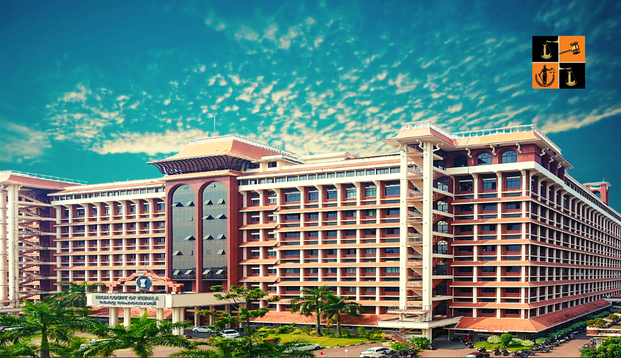
Recently, the High Court of Kerala reiterated that although the existence of an arbitration clause does not completely bar the exercise of writ jurisdiction under Article 226 of the Constitution, courts would ordinarily refrain from entertaining contractual disputes when efficacious remedies under the Arbitration and Conciliation Act are available. The Court made the observation while dealing with a challenge to the termination of a major EPC contract relating to the construction of an international and domestic cruise terminal at Mormugao Port Authority.
The matter was heard by a Division Bench comprising Justice Soumen Sen and Justice Syam Kumar V.M. in a writ appeal. The Appellant contractor had been awarded work for the construction of cruise terminal facilities at Mormugao Port Authority through an EPC contract. The dispute arose after the Cochin Port Authority issued a show cause notice alleging wrongful delay, suspension of work, slow progress, and inferior workmanship. The contractor replied stating that valid Coastal Regulation Zone (CRZ) approval and indemnity were unavailable and further contended that arbitration proceedings regarding variation in scope of work and consequential payments were already underway. Despite the reply, the authority terminated the contract in December 2025 citing non-compliance of the supplementary agreement, stoppage of work, lack of progress, breach of JV obligations, and defective execution of works.
The counsel for the Appellant contended that the termination order was ex facie illegal because several grounds mentioned in the termination letter were never part of the original show cause notice. It argued that this violated settled principles of natural justice as the contractor was denied an effective opportunity to respond to those allegations. Reliance was placed on judgments of the Supreme Court of India including Armour Security (India) Ltd. v. Commissioner, CGST, Gorkha Security Services v. Government (NCT of Delhi) and UMC Technologies Pvt. Ltd. v. Food Corporation of India.
The Contractor further argued that the existence of an arbitration clause did not bar invocation of writ jurisdiction under Article 226, particularly when the impugned action was arbitrary and violative of natural justice. It also submitted that disputed questions of fact could still be examined by the writ court in appropriate cases.
On the other hand, the Respondents argued that the parties had consciously agreed to arbitration as the dispute resolution mechanism and therefore the writ petition ought not to be entertained.
While examining the matter, the Court observed that though constitutional powers under Article 226 of the Constitution cannot be curtailed by contractual arbitration clauses, the writ court would ordinarily decline to exercise jurisdiction where effective alternative remedies exist under the Arbitration and Conciliation Act.
The Bench observed that “It is only in cases where there is an absence of an efficacious remedy available to the writ petitioner that, notwithstanding existence of such alternative remedy, the court may grant an interim relief.”
The Court also noted that some of the grounds relied upon in the termination order did not appear in the original show cause notice and such issues could have formed a valid ground before the arbitral forum or commercial court. However, the Bench held that disputed contractual questions were better suited for adjudication before the agreed arbitral mechanism rather than in writ proceedings.
The High Court disposed of the writ appeal while granting liberty to the appellant to pursue remedies under the Arbitration and Conciliation Act. The Court directed that joint measurements be conducted and ordered that no coercive steps be taken against the contractor for six weeks or until further orders, considering the practical difficulties arising due to the impending summer recess.
Case Title: M/s RCC-ACC (JV) v. Board of Major Port Authority for Port of Cochin & Anr.
Case No.: W.A. No. 834 of 2026
Coram: Hon’ble Mr. Justice Soumen Sen, Chief Justice and Hon’ble Mr. Justice Syam Kumar V.M.
Advocate for the Appellant: Amritha Pande, Ranjith Varghese, Rahul Varghese, Ralitzine Mendez, Akhila Sunil Nedungadi
Advocate for the Respondent: Pooja Menon, Joseph Markose, Abraham Joseph, Abraham Joseph Markose
Read Judgment @Latestlaws.com
Picture Source :




















