









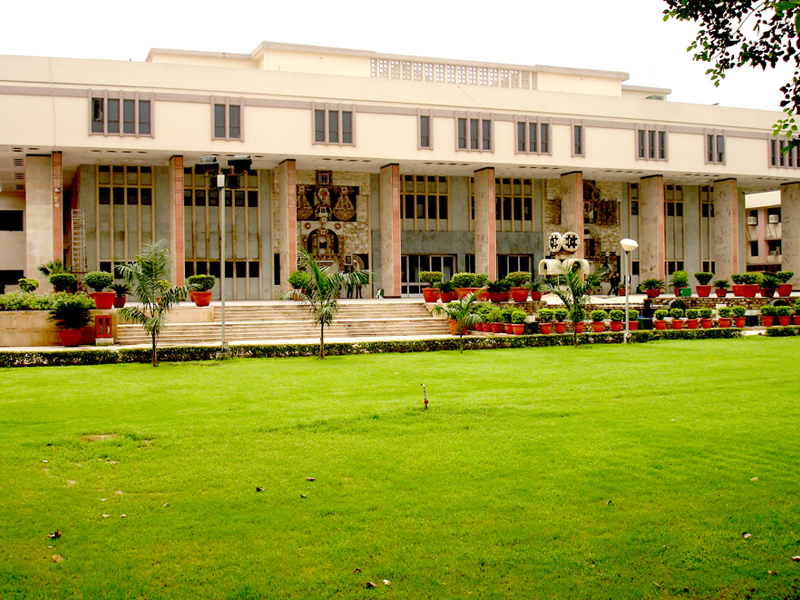
On 3rd June, a bench of the Delhi High Court consisting of Justice Jayant Nath, while allowing an application under Order 12 Rule 6 CPC, in the case of Mrs. Uma Hada v. Mr. Sunil Gupta, held that Sham defences given by a defendant in a case have to be nipped in the bud. It further pointed out that the defence set up by the defendant is sham and bogus because a prime property in South Delhi which was fetching a rent of Rs.2,30,000/- per month cannot possibly be agreed to have been sold for a pittance of Rs.2.50 crores as is being claimed by the defendant.
Facts of the Case:
An application was filed by the plaintiff under Order 12 Rule 6 CPC seeking a decree for delivery of possession of property to the plaintiff as well as praying that the defendant pays arrears in rent which was due upon him. The plaintiff in the present case was the absolute owner of the disputed property. The suit property was initially leased to the defendant by an unregistered lease deed dated 25.08.2016 for a period of 3 years w.e.f. 01.10.2016 to 30.09.2019. On a request from the defendant dated 02.09.2019 qua extension of the lease for a further period of 13 months, the plaintiff agreed to extend the lease for the said 13 months period i.e. from 01.10.2019 to 31.10.2020. However, the initial rent that was agreed upon being Rs.2 lakh per month was enhanced to Rs.2,30,000/- per month. However, The defendant was persistently in default of payment of rent since April, 2020 to October, 2020 at the rate of Rs.2,30,000/- per month with a total outstanding balance of Rs.14,10,000/-. Hence, the present suit for possession.
Contention of Plaintiff:
The plaintiff in her submission contended the following:
- As per the lease agreement the defendant had agreed to pay Rs.2,30,000/- per month. He also agreed to pay the electricity bills for the period the property was in his possession and to maintain the septic tank periodically at his costs and expenses.
- It was also contended that defendant was persistently in default of payment of rent since April, 2020 to October, 2020 at the rate of Rs.2,30,000/- per month with a total outstanding balance of Rs.14,10,000/-.
- The plaintiff issued a notice to the defendant by notice dated 16.09.2020 for termination of the lease under Section 106 and Section 111 (a) and (g)(1) of the Transfer of Property Act and calling upon the defendant to vacate the property by 31.10.2020.
- It was also stated that the pre-determined liquidated damages at the rate of Rs.12,000/- per day as mesne profit after termination of the lease were also sought on account of illegal and unlawful possession of the premises in terms of the lease dated 20.09.2019.
- Citing the case of Arun Kumar Tandon vs. Akash Telecom Private Ltd. & Anr., the counsel for the plaintiff further contended that under similar facts and circumstances, the Delhi High Court rejected the plea of an oral agreement to sell as has been raised by the defendant in the present suit.
The contention of Defendant:
The defendant submitted the following contentions:
- It was submitted that during the subsistence of the lease/tenancy agreement, the defendant at the instance of the plaintiff entered into an oral agreement to sell the suit property in question with the plaintiff.
- It was also stated that according to the agreed terms of the oral agreement to sell, the total sale consideration was mutually fixed at Rs. 2.50 crore out of which the defendant paid a sum of Rs. 1 crore.
- It was further claimed that the balance amount of Rs.1.50 crore was ready with the defendant and he was willing to pay the same to the plaintiff even though the balance amount was to be paid by May 2022. Hence, a suit for injunction and specific performance had been filed by the defendant against the plaintiff which was pending in the district courts.
- The defendant urged that the present suit is liable to be stayed in the light of the above mentioned grounds.
Judgement and Contention of the Court:
The Delhi High Court in the present case observed the following:
- Reference to the above case makes it clear that the application of Section 10 CPC would have no application to the facts of this case. Therefore, the said plea of the defendant is without merit.
- It was also considered that the trial court could not have given benefit of Section 53A of Transfer of Property Act to respondent under any circumstances even if a suit for specific performance filed by respondent No. 2 was pending.
The court held that the receipts which are relied upon by the defendant are unregistered documents hence the defendant cannot rely upon the same. It was also stated that there are clear admissions on record of the defendant about the existence of landlord and tenant relationship and therefore a claim that the property was bought by the defendant cannot be accept. Therefore, the defence set up by the defendant is sham and bogus.
Hence, the application was allowed.
Read Judgment @Latestlaws.com
Share this Document :Picture Source :




















