









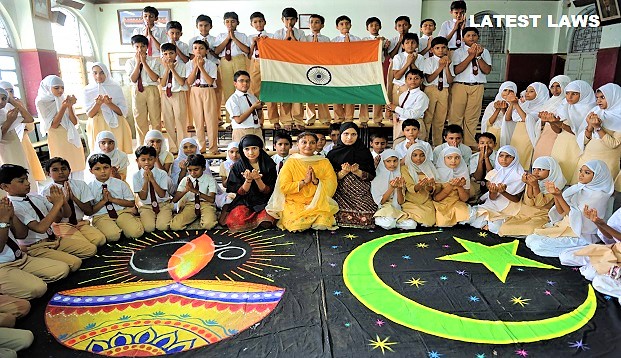
The bench comprising of Justice A. Muhamed Mustaque passed a judgement in case titled as The Trustee Hidaya Educational & Charitable Trust v. State of Kerala.
Brief Facts of the case:
A school is alleged to be functioning without Government recognition or CBSE affiliation and have admitted more than 200 students, all of them adherents to Islam. The State Government acting on intelligence report issued order of closure. The State Government noted that admission was being given exclusively to children belonging to one particular community.
Apart from achieving excellence in temporal education, an attempt is made to promote the individual identity of the pupil based on Islamic Shariah which would necessarily be possible only by imparting religious instruction in institutions.
The High Court of Kerala stated private institutions which impart elementary education discharge State function. The test of determination of State action of a private body is the nature of the authority related to the action. If the action emanates from the authority sanctioned by State, such action must satisfy all elements for validity based on constitutional norms.
The High Court of Kerala observed the idea of secularism in India does not negate religion in public space unlike the French concept of 'laicite', which excludes religion in public space. Indian secularism on the other hand envisages religious neutrality and equal treatment of all religions
“The concept of secularism that evolved in the Constitution is based on what was existing in ancient India. Perhaps that is the reason why the makers of the Constitution did not declare India as a secular State in the Constitution during its framing.” the Court remarked.
The High Court of Kerala stated that
“The idea of secularism in the Constitution is the result of the acceptance of the character of a pluralistic society composed of people having diverse interests. In a pluralist society, people enter into a social contract to live together equally without allowing dominance of any of the constituents over others. Secularism as envisaged in our Constitution epitomize the shared culture of the past.”
The High Court of Kerala observed that freedom available to a private body to promote his own belief or faith is not available to a private body when it discharges public functions. It is bound by public morality conceived in the Constitution.
The High Court of Kerala was of the view that although the Constitution protects the liberty of parents to choose the value and type of education, the State has not lost its power to regulate the curriculum of education to ensure guidance in the making of true citizens on the foundation of ideals of Constitution.
The HC stated “Exclusivism or preference of one religion over others by State or public functionaries or private bodies, while discharging public functions, strikes at the very root of the fundamental values of our Constitution, namely, secularism. It negates neutrality, promotes discrimination and denies equal treatment. Private schools which are required to have recognition from State must not promote one religion over others.”
The High Court of Kerala held that the status of minority institutions in relation to imparting elementary education is relatable to State function. Minority institutions, therefore, cannot shrug off their role as State functionaries and protect sectarian education under the garb of Articles 29 and 30.
The Court had only frowned on the actions of public functionaries, like provider of elementary education constricting the secular nature of education, promoting the religion of one sect in preference to other sects which would ultimately promote sectarian education and deny education to the students belonging to other sects. No elementary schools imparting secular education can promote one religion over others. Therefore, it would be open to any private unaided educational institution to approach the Government for permission toimpart religious education or instruction based on religious pluralism.
Read the Judgement:
Share this Document :Picture Source :




















