









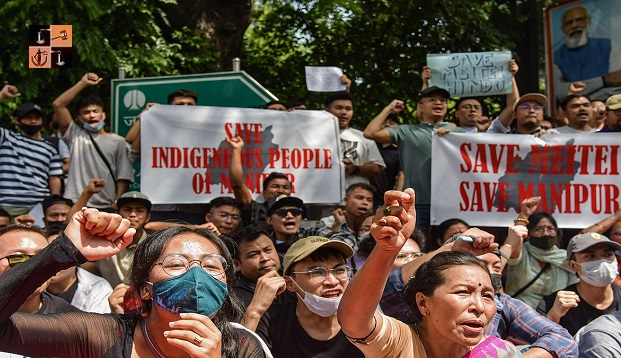
In a recent hearing regarding the Manipur violence case, the Supreme Court reiterated its limitations and emphasized that it cannot take over the responsibility of maintaining law and order, as it falls under the jurisdiction of the elected government. The court also cautioned against using the proceedings as a platform to escalate violence and urged lawyers to exercise restraint in making allegations against different ethnic groups.
The Manipur violence case involves two petitions. The first petition was filed by the Manipur Tribal Forum Delhi, seeking protection for the Kuki tribe by the Indian Army. The second petition was filed by Dinganglung Gangmei, Chairman of the Hill Areas Committee (HAC) of the Manipur Legislative Assembly, challenging the Manipur High Court's direction to consider the inclusion of the Meitei community in the Scheduled Tribe list. The issue of granting Scheduled Tribe status to the Meitei community triggered the riots in the state.
During the hearing, the Supreme Court requested "concrete suggestions" from the petitioners to de-escalate the situation and directed them to formulate these suggestions by the following day. The court also sought an updated status report from the State of Manipur regarding the violent clashes between communities that occurred in May. The State, in its report, highlighted the efforts made by the central and state governments to restore normalcy in the region.
However, senior advocate Dr. Colin Gonsalves, representing the Manipur Tribal Forum, expressed scepticism regarding the State's assurances, citing an increase in the death toll from 10 to 110. In response, Chief Justice of India DY Chandrachud emphasized that the Supreme Court's role is limited to interpreting the law and that scepticism should not lead to the court assuming responsibility for law and order.
The Chief Justice further reiterated that the court proceedings should not be used as a platform to exacerbate existing problems or escalate violence in the state. He emphasized the need to focus on the specific modalities of the case and stressed that the issue should be viewed as a humanitarian matter rather than a partisan one.
Meanwhile, the bench also addressed an application filed by the Manipur High Court Advocates Association, suggesting the lifting of a 10-kilometre blockade on National Highway 2. The Solicitor General was instructed to look into this suggestion.
The hearing will resume on the following day, during which the court will consider the petition filed by the State against the High Court's order to restore limited internet services.
The situation in Manipur has remained tense for the past two months due to clashes between ethnic groups. Recently, one policeman was killed and ten others were injured in a clash in Manipur's west Kangpokpi area. The unrest began on May 3 with a march organized against the demand for Scheduled Tribe status for the Meitei community.
As the Supreme Court continues to address the Manipur violence case, it emphasizes the need for sensitivity, restraint, and concrete suggestions to de-escalate the situation. The court recognizes the humanitarian nature of the issue and highlights its limited role in maintaining law and order, urging all parties to approach the case with the necessary modalities and focus on finding a resolution that prioritizes peace and harmony in Manipur.
Source: Link
Picture Source :




















