









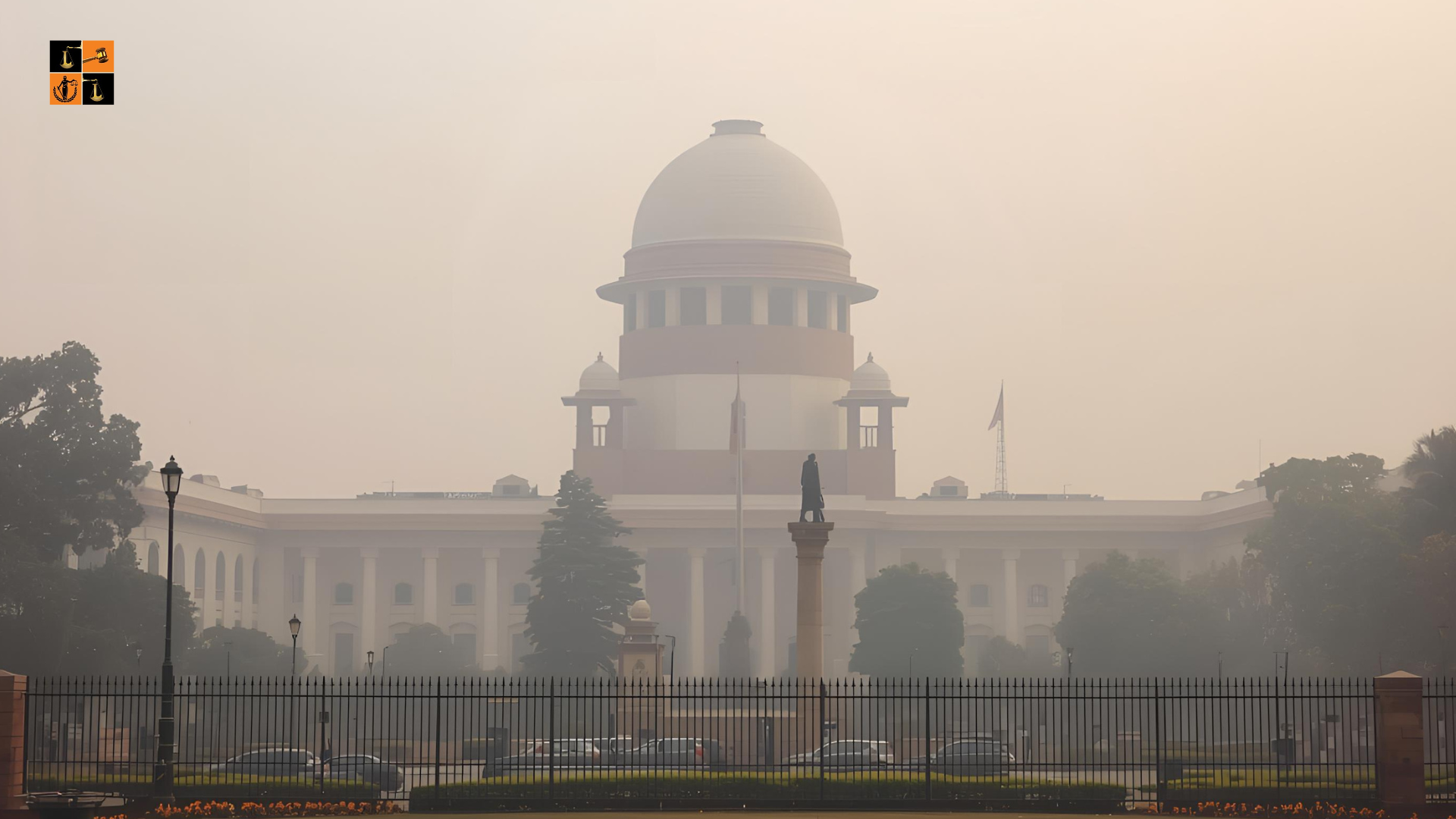
The Supreme Court directed the Commission for Air Quality Management (CAQM) to submit an affidavit outlining the preventive measures taken to control the worsening air quality in the Delhi-NCR region. The direction came amid growing concerns over deteriorating pollution levels and reports indicating the non-functioning of several air monitoring stations across the national capital.
A Bench comprising Chief Justice of India B.R. Gavai and Justice K. Vinod Chandran was hearing a batch of environmental petitions linked to the M.C. Mehta case concerning persistent air pollution in the region.
During the proceedings, Senior Advocate Aparajita Singh, acting as amicus curiae, urged the Bench to seek an immediate compliance report from the CAQM detailing proactive steps adopted to prevent the situation from reaching severe levels. She reminded the Court that previous orders had explicitly required authorities to act in anticipation rather than in reaction to pollution spikes. The Bench concurred, directing the CAQM to file an affidavit specifying “the steps proposed to ensure that the pollution does not reach the severe category.”
Counsel representing the CAQM submitted that a report had already been filed earlier but could not be discussed due to time constraints. However, the amicus highlighted multiple media reports claiming that many air quality monitoring stations in Delhi were non-operational. She pointed out that only nine out of thirty-seven stations were reportedly functional during Diwali, stressing that without accurate data, enforcement of the Graded Response Action Plan (GRAP) would be ineffective.
Responding to these submissions, Additional Solicitor General Aishwarya Bhatti, appearing for state agencies, assured the Court that the necessary report would be filed promptly in coordination with the Central Pollution Control Board (CPCB), which holds the relevant data.
Earlier, on October 14, the Apex Court had partially lifted the absolute ban on firecrackers in the National Capital Region, permitting the limited use of “green crackers” during Diwali under strict conditions. The relaxation was granted only on a “test case basis,” applicable for a specific period, and accompanied by detailed compliance directions.
The Court allowed the sale of green crackers certified by NEERI between October 18 and October 20, limited to designated sites approved by district authorities. Patrolling teams comprising police officers and officials from State Pollution Control Boards were directed to monitor the sale points and ensure that only permitted products bearing valid QR codes were sold.
The Bench further mandated that any violation, such as sale of prohibited firecrackers, those containing barium, or those imported from outside the NCR, would invite immediate confiscation and cancellation of licences issued by PESO or NEERI. The use of firecrackers was restricted to two short time slots: from six to seven in the morning and eight to ten in the evening on Diwali eve and Diwali day.
Additionally, the Court instructed the Central Pollution Control Board, in coordination with State Boards and regional offices, to continuously monitor air quality across NCR districts from October 14 to October 25 and submit a day-wise report. The monitoring teams were also directed to collect sand and water samples from high-usage zones for analysis.
The Apex Court reiterated that these directions were issued to ensure scientific and pre-emptive control over pollution levels, emphasizing that administrative agencies must act with foresight and accountability rather than waiting for environmental conditions to deteriorate.
Disclaimer: This news/ article includes information received via a syndicated news feed. The original rights remain with the respective publisher.
Picture Source :




















