









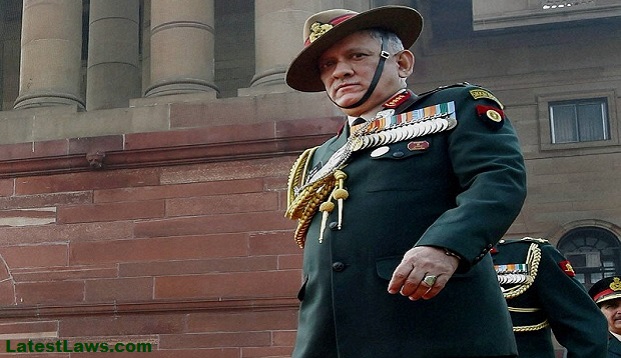
Army chief General Bipin Rawat on Friday said the armed forces have utmost respect for laws related to human rights & they not only ensure protection of human rights of people of the country, but also of its adversaries.
He was addressing interns & senior officers of the National Human Rights Commission (NHRC) on "Preserving Human Rights in Times of War & Prisoners of War" at the Manav Adhikar Bhawan here, officials said.
"The Indian armed forces are much disciplined & have the utmost respect for human rights laws & international human rights laws.
"The Indian armed forces not only ensure protection of human rights of our own people but also of adversaries & deal with Prisoners of War as per the Geneva Conventions," General Rawat was quoted as saying in a statement.
The army chief's comments came a day after he found himself in the midst of a massive row after he publicly criticised people leading protests against the amended citizenship law, saying leadership isn't about guiding masses to carry out arson & violence across the country.
Rawat in his address at the National Human Rights Commission (NHRC) event, asserted that the driving ethos of the armed forces are "'insaniyat' & 'sharafat' (humanity & decency)" & added that "they are extremely secular".
"The challenge is the changing warfare tactics with the advent of technology. Unlike the attack by any armed forces, the terror attacks remain unaccountable in international law.
"Hence, counter-terrorism & anti-insurgency operations have to be dealt in a manner of winning the hearts of the people by identifying & alienating the insurgents among them without collateral damage, which becomes very challenging & difficult," he said.
General Rawat also said the Army Headquarters had created a "human rights cell" in 1993, which is now being upgraded to the level of a directorate, which will be headed by an additional director general.
This will also have police personnel to address complaints of human rights violations against the armed force, & facilitate related inquiries, he said.
Rawat said a new initiate was taken in October by recruiting women personnel in the Military Police Force.
He said keeping in view the provisions of human rights laws & importance of protection of human rights, "now a court of inquiry is being held after every anti-insurgency operation & all records are being maintained related to such operations".
Referring to the Armed Force Special Powers Act (AFSPA), the Army chief said the Act gives "almost the same powers to the Army, which are also exercised by police & the CRPF (Central Reserve Police Force)" in connection with search & inquiry operations.
However, over the years the Army itself has "diluted its application in its own way under the ten commandments issued by the Chief of Army Staff which are to be strictly adhered by every soldier, particularly those deployed for operations in anti- insurgency areas," Rawat was quoted as saying in the statement.
The Supreme Court guidelines on this are also being strictly followed by soldiers, who are all given special training before deployment in counter-insurgency & counter-terrorism operations, he said.
National Human Rights Commission (NHRC) Member justice P C Pant addressing the gathering gave an insight into various laws protecting human rights.
He also mentioned about some of the fundamental rights, which are not given to the armed forces in line of duty, the National Human Rights Commission (NHRC) statement said.
National Human Rights Commission (NHRC) Secretary General Jaideep Govind, National Human Rights Commission (NHRC) Member D M Mulay, Director General (Investigation) Prabhat Singh, & other senior officers were also present on the occasion.
Source Link
Picture Source :



















