









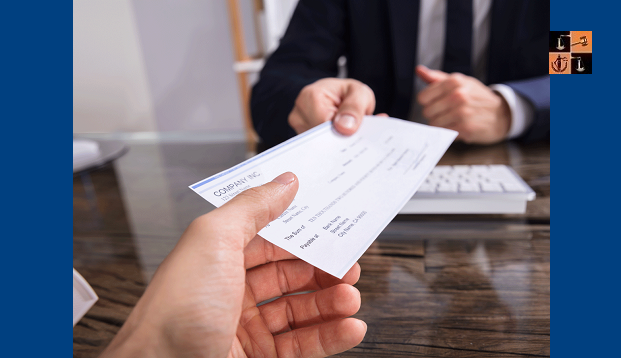
If you are a businessperson or an individual who uses cheques more often than any other mode of payment then your cost of writing cheques is going to increase from July 18, as the 47th meeting of the GST Council has approved an 18% tax on the issue of cheques by the banks, either in lose or in book form. The meeting presided over by Finance Minister Nirmala Sitharaman in Chandigarh, approved the withdrawal of exemption from levy of GST to cheques, in lose or book form & maps & hydrographic or similar charts of all kinds, including atlases, wall maps, topographical plans, & globes, printed.
While cheques & cheque books will attract 18% GST from July 18, maps, wall maps, hydrographic charts & atlases would attract 12% GST. It may have an impact on those businesses, particularly in micro, small & medium industries & businesses where cheques are still the dominant form of payment. Though a sizable chunk of such payments has been shifted to online modes such as real-time gross settlement (RTGS) national electronic fund transfer (NEFT), & electronic clearing services (ECS), for certain kinds of payments, cheques are still the preferred mode of payment.
It's particularly true where parties to the transactions want the details of the payments to be legally covered under the Negotiable Instrument Act such as business transactions, payment of loans such as home loans, automobile loans, etc. For instance, in the case of home loans & automobile loans, lenders such as banks & non-banking finance companies (NBFCs) insist on the deposit of a certain number of undated, signed cheques such as 6 or 12 cheques in addition to the signing of the electronic clearance service (ECS) mandated by the borrower to legally enforce their right to recover the money from them in case of default.
Similarly, for business transactions, a cheque is still the dominant form of payment as the responsibility of payment by the payee or endorsee or elaborately defined under the Negotiable Instrument Act of 1881 which covers all the payments made or promised to be made through promissory notes, bills & other negotiable instruments such as cheques. According to the NI Act of 1881, a cheque is a bill of exchange drawn on a specified banker & not expressed to be payable otherwise than on demand & it includes the electronic image of a truncated cheque & a cheque in the electronic form.
The Negotiable Instrument Act elaborately defines & covers the rights & responsibilities of all the parties to transactions such as payer & payee, drawer & drawee, acceptor, holder, & endorsee in case of default or dispute between them.
Who will be impacted?
Several banks offer a limited number of cheques free of cost initially at the time of opening of bank accounts such as a cheque book containing 10 or 25 leaves & charge for subsequent cheque books.
But there is an increasing tendency among the banks to charge their customers for services, including the issuing of cheque books, online & SMS alert services, and mobile & internet banking. These amount to a significant part of their cost of operations. In the case of small & medium businesses, those who use hundreds & thousands of cheques in their current accounts in a month, it will have some impact as 18% GST might make it unattractive for them to continue to use cheques & consider other formal modes of payments such as RTGS & NEFT.
(Only the headline and picture of this report may have been reworked by the LatestLaws staff; the rest of the content is auto-generated from a syndicated feed.)
Source Link
Picture Source :




















