









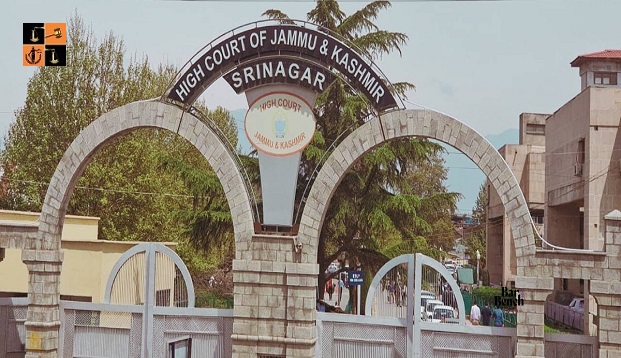
Recently, the Jammu and Kashmir High Court held that a charge must be framed if the materials on record disclose a prima facie case against the accused. The Court was dealing with a petition seeking quashing of charges framed under various provisions of the J&K Prevention of Corruption Act and the Ranbir Penal Code in connection with a bribery case involving a police officer. The Court observed that at the stage of framing of charge, it is not necessary to evaluate the sufficiency of evidence for conviction; rather, the existence of grave suspicion is adequate for proceeding with trial.
The case arose from a written complaint lodged by a private respondent alleging that the Station House Officer (SHO) and Mohrar, Head Constable at the concerned police station, had demanded a bribe of ₹10,000 for lodging an FIR regarding a molestation case involving the complainant’s daughter-in-law. Acting upon the complaint, the authorities laid a trap, during which the Head Constable (accused no. 3) was caught red-handed while accepting ₹7,000 as illegal gratification. Following investigation, the trial court charged the petitioner and co-accused under Section 5(1)(d) read with Section 5(2) of the J&K Prevention of Corruption Act, 2006, Section 4-A of the J&K PC (Amendment) Act, 2018, and Sections 201 and 120-B of the Ranbir Penal Code (RPC). Aggrieved by the order of framing charges, the petitioner filed a petition under Section 482 CrPC seeking quashing of the trial court’s order.
The counsel for the petitioner argued that the material on record did not justify the framing of charges against the petitioner. It was submitted that the petitioner had been falsely implicated, and the allegations did not establish a prima facie case warranting trial. The petitioner sought quashing of the charges, contending that the proceedings amounted to an abuse of the process of law.
The High Court observed, “Where the charge-sheet and the material placed on record disclose grave suspicion against the accused, the Court is justified in framing the charge and proceed with the trial. The Court is not required to evaluate the entire material and documents on record to conclude whether it is sufficient or not for convicting the accused. The charge has to be framed if the Court is satisfied that prima facie case is made out for proceeding against the accused".
The Court relied upon precedents such as State of Bihar v. Ramesh Singh, Union of India v. Prafulla Kumar Samal, Niranjan Singh Karam Singh Punjabi v. Jitendra Bhimraj Bijja, and State of M.P. v. S. B. Johari, to reaffirm that at the stage of framing of charges, the court cannot enter into an analysis of the probative value of evidence or the credibility of witnesses. If the material raises grave suspicion, the matter must go to trial.
The Court further noted that allowing an accused to escape trial at the preliminary stage on the ground that the material may not ultimately result in conviction would defeat the very purpose of criminal procedure and delay justice.
In light of the above observations, the High Court dismissed the petition and upheld the trial court’s order of framing charges against the petitioner.
Case Title: Nek Singh V. UT of J&K & Anr.
Coram: Justice Rajesh Sekhri
Case No.: CRM(M) No. 653/2023 CrlM No. 1278/2023
Advocate for the Petitioner: Mr. G. S. Thakur, Advocate
Advocate for the Respondent: Mr. Raman Sharma, AAG Mr. Koshal Parihar, Advocate
Picture Source : twitter.com



















