









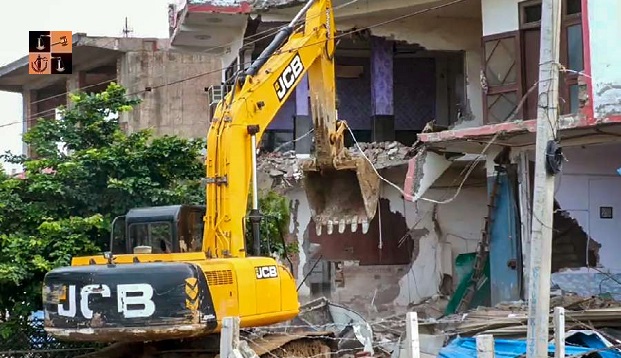
In its latest judgment, the Supreme Court observed that 'unauthorized constructions must be dismantled to maintain compliance with the rule of law.'
This statement comes in the backdrop of a dispute concerning unauthorized commercial construction on a residential plot in Meerut, originally allotted for residential purposes. Despite repeated notices, the authorities had failed to enforce the demolition of the illegal structures for over two decades, raising concerns about possible collusion between officials and violators.
Brief Facts:
The case involves a dispute over unauthorized commercial construction on a residential plot (No.661/6, Shastri Nagar Yojna No.7, Meerut) originally allotted to Respondent No.5, Veer Singh, for residential purposes by the Uttar Pradesh Avas Evam Vikas Parishad (Respondent No.1). Respondent No.5, with the assistance of his power of attorney holder (Respondent No.6), began unauthorized commercial construction on the plot. Despite show cause notices, the construction continued, leading to a demolition order by the competent authority in 2011. The Respondent No.1, unable to execute the demolition, filed a writ petition, which was allowed by the Allahabad High Court, directing demolition and other actions.
Contentions of the Petitioner:
The appellants, who are the owners of the commercial shops constructed on the plot, contended that they acquired the shops in good faith and have been occupying them for the past 24 years. They argued that when the property was converted from leasehold to freehold in 2004, Respondent No.1 accepted the existing construction, which they claim was not illegal. The appellants asserted that the High Court’s demolition order is unjust because they were not given proper notice or an opportunity to contest the action.
They further argued that the High Court should have considered the possibility of regularizing the construction instead of ordering demolition. The appellants also contended that Respondent No.1 failed to manage development in the area effectively, selectively targeting their property for demolition while similar constructions in the vicinity were ignored. Finally, they argued that the demolition order is barred by delay and laches and violates the principles of natural justice.
Contentions of the Respondent:
Respondent No.1, the statutory body governing the plot, argued that the land was originally allotted for residential purposes, and the construction was unauthorized. Despite multiple notices to Respondent No.5, the illegal construction continued, leading to the demolition order. Respondent No.1 claims it was unaware of the appellants’ involvement in the unauthorized construction and asserted that the appellants knew of the violations when they purchased the property. They further argued that the appellants' rights are not infringed because they acquired the property in violation of its original residential use designation and without proper approval.
Respondent No.1 defended the High Court’s decision, emphasizing that the violations were significant and deliberate, not minor. The appellants, according to Respondent No.1, had no grounds to challenge the demolition, and any claims for damages should be directed against Respondent No.5, who was responsible for the illegal construction.
Observation of the Court:
The Court observed that Respondent No.1 had been aware of the illegal construction since 1990 and had issued multiple notices to Respondent No.5. Despite these notices, the construction continued, leading to a demolition order in 2005 that was never enforced. The Court emphasized that the authorities’ failure to act swiftly indicated a lackadaisical attitude, possibly even collusion with the violators, and concluded that the appellants could not claim legal rights based on the prolonged existence of the buildings.
In response to the appellants’ claim that they had not received notice, the Court highlighted that the appellants should have verified the status of the property before purchasing it. The Court applied the doctrine of Caveat Emptor, emphasizing that the appellants had the responsibility to ascertain the title and defects in the property.
The Court further criticized the failure of the authorities to enforce demolition despite issuing notices since 1990 and condemned the collusion between officials and land mafias. The Court upheld the High Court's order for demolition, stating that unauthorized or illegal constructions cannot be legitimized or protected. It referenced previous rulings such as "Illegality is incurable," in K. Ramadas Shenoy v. Chief Officers.
The Court reiterated that "unauthorized constructions must be dismantled" to maintain compliance with the rule of law, as highlighted in several rulings including M.I. Builders (P) Ltd. v. Radhey Shyam Sahu and Esha Ekta Apartments Coop Housing Society v. Municipal Corporation of Mumbai. It stressed that violations of building regulations strike at urban planning and warned against regularizing illegal constructions.
The Court emphasized the need for strict adherence to demolition procedures, directing that "The proceedings of demolition shall be video-graphed," and that any violation would result in contempt proceedings and prosecution. It also stressed that unauthorized constructions must not be tolerated, stating: "Each and every construction must be made scrupulously following and strictly adhering to the Rules."
The Court upheld the High Court’s decision, ordering the appellants to vacate and "hand over the vacant premises to the respondent authorities within a period of three months," and instructed the demolition of unauthorized constructions within two weeks. It directed appropriate criminal and departmental actions against the officials at fault and mandated the refund of the appellants’ deposit.
The decision of the Court:
The Court dismissed the appeals. No order was made regarding costs, and any pending applications were disposed of. Additionally, the Registrar (Judicial) was instructed to circulate a copy of the judgment to the Registrar General of all High Courts, advising them to refer to it when addressing disputes related to unauthorized construction, deviations, or violations of building permissions and plans. The Registrar was also directed to send the judgment to the Chief Secretaries of all States and Union Territories, urging them to issue circulars to local authorities and corporations for strict compliance with the Court's directions.
Case Title: Rajendra Kumar Barjatya And Another v. U.P. Avas Evam Vikas Parishad & Ors.
Case no: CIVIL APPEAL NO. 14604 OF 2024
Citation: 2024 Latest Caselaw 790 SC
Coram: Hon'ble Mr. Justice J.B. Pardiwala and Hon'ble Mr. Justice R. Mahadevan
Advocate for Petitioner: Adv. Pahlad Singh Sharma
Advocate for Respondent: Adv. Vishwajit Singh (Dead / Retired / Elevated) [For Respondent 1], Adv. Kamlendra Mishra [For Respondent 2 And 3] And Adv. Abhishek Kumar Singh [ For Respondent 1]
Read Judgment @LatestLaws.com, Click Here
Picture Source :




















