









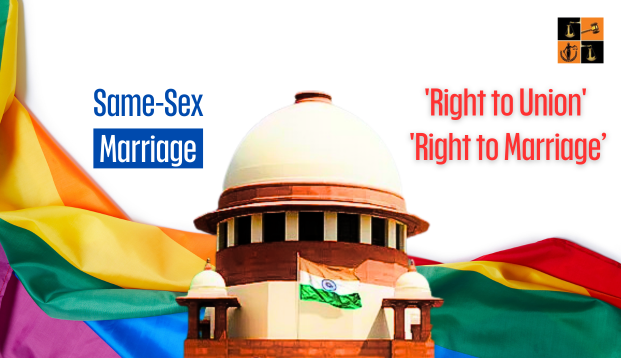
The Supreme Court judgment regarding same-sex marriage has led to the exclusion of queer couples from the provisions of the Special Marriage Act (SMA). This decision can be attributed to the legal interpretation and application of existing laws in the context of same-sex unions, resulting in the inapplicability of the SMA to queer couples.
The Constitution bench headed by CJI DY Chandrachud and comprising of S.K. Kaul, S. Ravindra Bhat, Hima Kohli, and P.S. Narasimha addressed the following questions: whether the SMA, as it stands, is applicable to queer couples, whether it violates the constitutional rights of LGBTQIA+ persons, and whether the LGBTQIA+ community has the right to form unions, while also delving into the distinction between this right and the right to marriage.
Question of Equal Rights:
The counsel for the petitioners had argued that the SMA's exclusion of LGBTQIA+ persons violates their right to dignity and decisional autonomy, effectively infringing upon Article 21 of the Constitution. Exclusion based on sexual orientation and the sex of one's partner was asserted to violate Article 15, which prohibits discrimination on these grounds. It was contended that the SMA breaches Article 14 by denying LGBTQIA+ individuals equal protection under the law and robbing them of social welfare and benefits.
Additionally, the argument highlighted the need for a gender-neutral interpretation of the SMA, emphasizing the importance of substituting gendered terms like "husband" and "wife" with "spouse."
A Constitutional Challenge:
Dr. Abhishek Manu Singhvi in his arguments reinforced the notion that the SMA is unconstitutional since the requirement for marriage under SMA to consist of a man and a woman constitutes discrimination based on sexual orientation, contrary to Article 15. Moreover, Article 19, which protects the right to enter a marital relationship as a form of expression, is restricted under the SMA, making the exclusion of queer individuals unreasonable under Article 19(2).
The SMA's exclusion of same-sex couples from marriage was also challenged on the grounds of violating the fundamental right to dignity protected under Article 21.
The Question of Right to Marriage:
The verdict considered the critical point that marriage, as a legal institution, varies across different countries and societies. Under Indian law, the SMA was initially enacted to provide a unique form of marriage for couples belonging to different religions and castes. While some sections of the SMA are gender-neutral, others impose specific gender-based requirements, thus prompting the need for judicial review.
The CJI explained that the SMA was initially designed to enable marriages between individuals of different religions and castes. Voiding the SMA for excluding queer couples could potentially regress India to a less equal era. Justice Kaul concurred, emphasizing the SMA's secular marriage framework.
Both Judges emphasized the need to avoid excessive judicial interpretation that would encroach on the legislative domain, emphasizing that this amounted to impermissible judicial legislation, a matter best suited for Parliament's consideration.
The CJI, acknowledging the importance of equality, ruled in favour of the LGBTQ community, recognizing their right to form abiding unions. This extends to queer couples, ensuring they are not discriminated against. While the CJI and Justice Kaul maintained that the right to enter into a union by queer couples is a constitutionally protected right and that the State has an obligation to recognise such civil unions and grant them benefits under the law, the other three Judges overruled this view.
On the contrary, Justice Bhat, representing both himself and Justice Kohli, upheld the constitutionality of the SMA. He argued that the Act was formulated to accommodate marriages as defined during its enactment, which excluded same-sex marriages due to Section 377 IPC's criminalization of consensual physical intimacy. Justice Bhat contended that the SMA had a distinct rationale, and diluting it was unjustifiable without demonstrating its obsolescence. Justice PS Narasimha concurred with the positions of Justice Bhat.
Regarding the application of gender-neutral terms within the SMA, Justice Bhat held that while interpreting the SMA in a gender-neutral manner might seem progressive, it could lead to inequitable outcomes and inadvertently expose women to vulnerabilities. Justice Bhat pointed out that specific terms and provisions in marriage laws were originally designed to safeguard marginalized individuals, particularly women, ensuring legal remedies for those confronting violence and injustice. He further pointed out that adopting gender-neutral interpretations might result in perplexing and unworkable consequences within these legal frameworks.
However, the Supreme Court affirmed that a transgender person's gender identity is distinct from their sexuality and that a transgender person can be in a heterosexual relationship, entitling them to marry their partner under existing laws.
The Question of Right to Union:
One crucial aspect addressed in the judgment was the violence and discrimination faced by LGBTQ individuals, both because of their gender identity and sexual orientation. The Court emphasized the need to protect the rights and freedoms of the LGBTQ community, as these rights are enshrined in the Constitution. It pointed out the imperative need for the state machinery, including the police, to safeguard these rights rather than becoming instruments of their violation.
The Chief Justice of India acknowledged the absence of an explicit right to marry but highlighted a broader right to form unions, drawing from precedents like Navtej Johar and K.S. Puttaswamy. Referred to as the 'right to relationship,' it extends beyond marriage, allowing individuals to choose partners, cohabitate, and engage intimately. Rooted in principles of privacy, autonomy, and dignity, this right applies universally, ensuring that the LGBTQIA+ community enjoys the freedom to live without fear of violence, as previously affirmed in landmark judgments.
Justice Bhat, in his dissenting opinion, highlighted the differences between marriage in the USA and India, emphasizing the uniqueness of Indian personal law systems in the context of marriage. He stated that while the Court acknowledged this 'right to union,' it is essential to differentiate it from the obligation of the state to create a new social institution. The disagreement with the Chief Justice's opinion stemmed from the distinction between recognizing a right to form a union and the subsequent creation of an institution similar to marriage.
Emphasizing that a court-mandated recognition of a civil union would infringe upon the principle of the separation of powers, a foundational tenet of the Indian legal system that delineates distinct roles for the judiciary, executive, and legislative branches of government, Justice Narasimha concurred with Justice Bhat.
The Supreme Court expressed concerns about the impracticality of establishing a new social framework through judicial intervention. Such an undertaking would require the development of an entirely new code governing the registration of non-heterosexual marriages. It would necessitate outlining conditions for the validity of these marriages, specifying eligibility criteria, determining grounds for divorce, and defining rights and obligations, such as maintenance and alimony.
In Conclusion:
While the verdict did not establish a fundamental right to marriage, it strongly advocated for the right to life, personal liberty, and human dignity. The Court recognized the institutional limitations and refrained from judicially legislating terms within the SMA.
The judgment highlighted that the State has an obligation to recognize the unions of queer couples and grant them legal benefits. It also highlighted the need for a Committee to define the scope of entitlements for queer couples in unions. In sum, while the judgment does establish that all individuals, including LGBTQIA+ couples, have the right to form abiding cohabitational relationships, it does not go as far as endorsing the creation of a parallel civil institution akin to marriage.
In the end, the judgment sets a precedent for the recognition of the rights of the LGBTQIA+ community and paves the way for a more inclusive and equal society.
Case Title: Supriyo v. Union of India
Coram: Hon’ble CJI DY Chandrachud with Hon’ble Justice SK Kaul, Ravindra Bhat, PS Narasimha, and Hima Kohli
Case No.: Writ Petition (Civil) No. 1011 of 2022 + connected matters
Citation: 2023 Latest Caselaw 802 SC
Read Judgment @LatestLaws.com
Picture Source :




















