









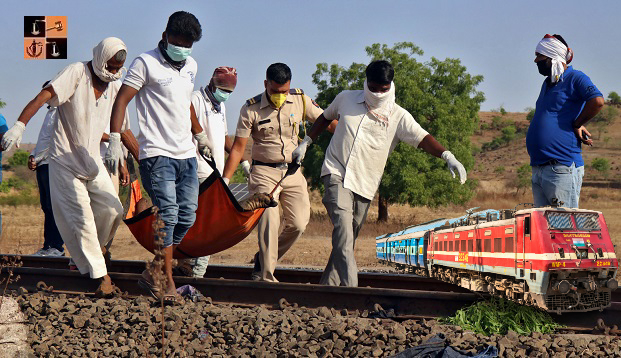
The Bombay High Court has denied compesation to family of man under Railways Act of 1989 who died in an accident while boarding a train in an in an inebriated state.
The single-judge bench of Justice Abhay Ahuja dismissed the appeal against Railway Claims Tribunal relying on MLC report which suggested that the deceased when brought to Primary Community Health Care Centre, was having an alcoholic breath indicative of the fact that he was in an intoxicated state while boarding the train.
Brief Facts of the Case
The appellant had claimed compensation alongwith interest under Section 124-A of the Railways Act, 1989 relying on Union of India Vs. Rina Devi, 2018 Latest Caselaw 360 SC
On the other hand, the Railways resisted the claim on the ground that there was no valid ticket found on the body of the deceased nor was any authority to travel found on him and also that the incident was not an untoward incident.
It was submitted that from the evidence and deposition of the pointsman and the RPF Constable that the one person was trying to board a moving train and he slipped and fell down. On going near to the place of incident and inquiring from the other passengers, it emerged that the said person while trying to board the running train, his hand slipped from the handle of the door and therefore, he fell down. It was submitted that the deceased trying to catch a running train despite warning slipped from the handle of the door and fell down, which indicates that the said incident was due to his own negligence and during the course of treatment he died in the government hospital at Chhindwara. It was therefore, submitted that the death occurred due to the person’s own actions and the said person is himself responsible for the same.
The Tribunal after taking into consideration the facts and the evidence on record held that deceased was not possessing any ticket and was therefore, was not a bonafide passenger and that the pointsman had witnessed him coming hurriedly running from outside and trying to board the running train under the influence of liquor (as evidence by the MLC report), the case could not be considered for paying compensation to the claimants and rejected the claim of the appellants.
Therefore the present apppeal.
High Court's Observation
The Court addressed the contention that no alcohol breathe was recorded in the Post Mortem report and noted that it was because the appellant was shifted from Primary Community Health Care Centre to the Hospital where he eventually died in a course of two days leading to the effect fading away.
Noting that during the course of the inquest proceedings, personal search of the deceased was conducted by the police officials and they recovered no journey ticket from the spot or from the person of the deceased. Therefore, it is quite clear that no journey ticket or railway ticket or the platform ticket as mentioned in the definition 2(29) of the Railways Act or as mentioned in explanation (ii) of section 124A of the Railways Act, the Court stated.
"The decision in the case of Union of India Vs. Rina Devi, 2018 Latest Caselaw 360 SC clearly holds that the mere absence of ticket with an injured or deceased will not negative the claim that he was a bonafide passenger. The decision however further goes on to say that the initial burden will be on the claimant which can be discharged by filing an affidavit of the relevant facts and the burden will then shift on the railways and the issue can be decided on the facts shown or the attending circumstances"
The Court stressed on the fact the affidavit only records the incidents that took place post mortem of her husband and what she has learnt after the death of her husband.
Admittedly she is not an eye-witness nor she has received any information from any eye-witness of the purchase of the ticket or of any other details except the fact that her husband had proceeded for Mahadeo Yatra, the Court stated and stressed that this is sufficient to determine or rather this fact cannot determine whether he was holding a valid ticket or not or that he was a bonafide passenger of the said train.
"Therefore in my view the deceased was not holding a valid ticket or a pass nor he had purchased the valid ticket for travelling by a train carrying passengers on any date nor he had any platform ticket although he may have become a victim of a railway accident", the Court conlcluded.
Despite the above conclusion, the Court went on to examine as to whether or not the accident is an untoward incident or whether the same falls within the exceptions under e Railways Act.
*Section 123(c)(2) provides that an untoward incident means the accidental falling of any passenger from a train carrying passengers*
The Court after analysing facts and records placed, was of the view that the deceased was running and entering the platform at railway station hurriedly and thereafter, he was trying to board the said running train and this despite the warning by the pointsman but he did not listen and while trying to board the train and to get hold of the handle of the door of the running train he slipped and fell down.
In the primary care given at a Medical Centre, MLC report detected alcohol in his breath and thereafter he was referred to the railway hospital where he eventually died.
"Although from the facts and the evidence on record it appears that the deceased appears to be negligent, however, it cannot be said that the deceased may have had the intention to self inflict, or commit suicide, however, it would be relevant to consider exception (d) in the proviso to section 124A which refers to any act committed by the deceased in a state of intoxication", the Court stated and futher develled into the facts of the case.
It thus reach conlcusion that the evidence of the MLC report indicating that the injured had an alcoholic breath is from a government hospital and is good evidence to be relied upon, which has neither been denied or disputed except to say that there was no such finding in the post mortem report.
"The MLC report at page A-173 of the record and proceedings which suggests that the deceased when brought to the Community Health Centre at Junnardeo was having an alcoholic breath indicative of the fact that the deceased was in an intoxicated state while boarding the train is clearly an evidence which cannot be ignored. The said piece of evidence has been signed by the officer on duty and has also not been denied or controverted by the appellant herein. The tribunal, in my view, is therefore correct in holding that the case of the appellants would fall under exception (d) to section 124A of the Railways Act. Therefore, the finding and the order of the Tribunal in denying the compensation under proviso (d) to section 124A of the Railways Act cannot be interfered with"
The Court accordingly dismissed the appeal.
CASE TITLE: Shobha w/o Deepak Thakre vs Union of India
CASE DETAILS: FIRST APPEAL NO.565 OF 2021
CORAM: Justice Abhay Ahuja
Read Judgement @LatestLaws.com:
Share this Document :Picture Source :




















