









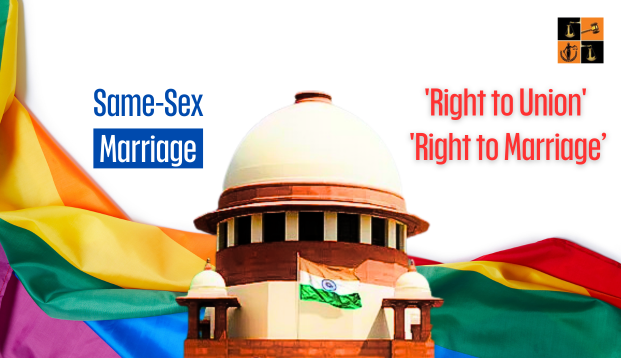
The Supreme Court of India on October 17, 2023, issued a landmark judgment reshaping the legal landscape for same-sex marriage. The five-judge constitutional bench of Chief Justice DY Chandrachud and Justices Sanjay Kishan Kaul, S Ravindra Bhat, Hima Kohli, and PS Narasimha discussed the implications of the right to marriage, matrimonial unions, adoption, and personal rights of queer couples.
Despite the decriminalization of queer relationships via Navtej Singh Johar & Ors. v. Union of India judgment[1], LGBTQIA+ members still face daily violence and oppression. The State's role in recognizing and eradicating such discrimination remains a work in progress.
Is the 'right to marry' recognized as a fundamental right in India?
Chief Justice of India (CJI) emphasized that the Constitution does not overtly establish marriage as a fundamental right. The mere inclusion of an institution within legal statutes does not suffice to elevate it to the status of a fundamental right. However, it is noteworthy that several dimensions of the institution of marriage do align with constitutional values, such as the right to human dignity and the right to life and personal liberty.
It is imperative to recognize the absence of a universal definition of marriage. The conception of marriage varies significantly across distinct spheres, encompassing legal, religious, and cultural perspectives. While some faiths consider marriage a sacred sacrament, others perceive it as a contractual agreement. The State plays a multifaceted role in the institution of marriage, as it prescribes prerequisites for a valid marriage, governs the dynamics of the marital relationship during its existence, and regulates the repercussions of marital dissolution.
Before embarking on an examination of whether the Constitution implicitly acknowledges the right to marry, it is essential to explore how the judiciary recognizes unenumerated or derivative rights. The fundamental rights enshrined in Part III of the Constitution are characterized by their abstract nature, encapsulating principles of equality, liberty, and expression. Notably, the Constitution refrains from presenting a comprehensive inventory of specific aspects related to each enumerated right.
The Indian Constitution does not recognize family or partnerships as a unit for securing rights, in contrast to some other jurisdictions like the Irish Constitution, which acknowledges the family as a natural unit of society with inherent rights. By not recognizing family or partnerships as rights-bearing units, the Indian Constitution rejects the notion of subsuming the rights of individuals within a family or partnership into a broader family unit.
In summary, the Indian Constitution does not expressly designate the right to marry as a fundamental right. The constitutional bench, led by the CJI, unanimously concurred with this perspective, confirming that the Constitution does not explicitly establish a right to marry.
Do queer couples in India possess the ‘right to union’?
The CJI discussed the importance of recognizing the freedom to enter unions without state intervention. The right to enter into a union encompasses not only the liberty to choose a partner but also securing legal recognition for that association. The Court firmly established that equality dictates that individuals in abiding cohabitation relationships should not face discrimination based on sexual orientation. Discrimination of this kind disproportionately affects queer couples, who, unlike their heterosexual counterparts, cannot marry within the existing legal framework.
In light of the rights enshrined in Part III of the Constitution, the CJI in his minority opinion affirmed that all individuals possess the right to enter into unions with their partners. This right unequivocally extends to individuals engaged in queer relationships. The State's failure to recognize the full spectrum of entitlements that arise from such unions would unjustly impact queer couples who cannot marry under the current legal framework. Consequently, the State bears the obligation to acknowledge these unions and bestow legal benefits upon them.
Similarly, the right to enter into a union cannot be restricted on the grounds of sexual orientation, as such a restriction would contravene Article 15. This freedom is universal, irrespective of an individual's gender identity or sexual orientation. This principle is reinforced by the decisions in Navtej and Justice KS Puttaswamy vs. Union of India, both of which acknowledge the right of queer couples to enter into unions while safeguarding them from external threats. Discrimination rooted in sexual orientation is unequivocally prohibited by Article 15.
Furthermore, the CJI articulated that the Union Government, State Governments, and Union Territories must refrain from discriminating against the freedom of queer individuals to enter into unions entitled to legal benefits.
Justice Bhat, Justice Hima Kohli, and Justice Narasimha, however, concurred with the right of consenting adults to decide to live together and cohabit free from external judgments. They disagreed with CJI's emphasis on establishing a formal institution and rejected the notion that the Constitution necessitates the creation of a parallel framework for non-heterosexual couples, such as civil unions or marriage. Creating such a framework would demand comprehensive legislation, covering areas like registration, eligibility criteria, divorce procedures, and more. They held that recognizing an entitlement under the Constitution for individuals to enter into enduring relationships or unions does not automatically translate into the creation of a formal institution like marriage.
Can the exclusion of non-heterosexual couples under the SMA be considered unconstitutional?
The Court recognized its inherent constraints in addressing the constitutionality of the Special Marriage Act (SMA). It clarified that it couldn't invalidate the constitutional validity of the SMA or infuse words into its provisions due to institutional limitations. Reading words into the SMA and related laws like the Indian Succession Act (ISA) and Hindu Succession Act (HSA) would venture into judicial legislation, an impermissible realm for the Court. The Court, in wielding its power of judicial review, must exercise caution in steering clear of matters that predominantly fall within the legislative domain.
The SMA was initially enacted to facilitate a distinct form of marriage for couples from diverse religious and caste backgrounds. Section 4 outlines the prerequisites for special marriages. The argument against the SMA didn't focus on an express exclusion of same-sex unions but rather on its implied exclusion by governing only heterosexual unions. The Court discussed two potential approaches. If it found Section 4 to be unconstitutional due to under-inclusivity excluding same-sex couples by implication, it could either strike down Section 4 or follow a workability model proposed by the petitioners. Striking down Section 4, however, would compromise the SMA's primary purpose of enabling marriages across diverse religious and caste backgrounds, effectively reverting India to a pre-independence era of social inequality and religious intolerance. The second approach, involving extensive amendments to the SMA and allied laws, would place the Court in a legislative role it was unequipped for, as it amounted to judicial legislation, which is impermissible. Recognizing its inherent limitations, the Court highlighted the need for Parliament, with its diverse resources and viewpoints, to consider potential legislative changes.
Justice Kaul's perspective diverged from that of Justice Bhat, emphasizing that the SMA provides a secular framework for marriage solemnization and registration. He disagreed with the interpretation that the SMA exclusively enables heterosexual marriages. To him, the SMA's intent was not to regulate marriages based on sexual orientation. He contended that the SMA's provisions while conferring benefits only on heterosexual relationships, do not necessarily reflect the statute's overall purpose. Thus, a singular focus on specific provisions may obscure the SMA's true intent, which primarily aims to facilitate inter-faith marriages. Regulating only heterosexual marriages would lack a legitimate state objective, particularly in the context of Article 15(1), which protects against discrimination based on sex and, by extension, sexual orientation.
Justice Kaul's verdict stood alone in advocating for the unconstitutionality of the SMA, as the remaining judges did not endorse this viewpoint.
Do non-heterosexual unmarried couples have the legal capacity to adopt children?
The CJI in his verdict asserted that unmarried couples, including queer couples, possess the legal capacity to jointly adopt a child. Regulation 5(3) of the Adoption Regulations was deemed ultra vires in the Juvenile Justice Act, as well as Articles 14 and 15 of the Constitution. To remedy this, Regulation 5(3) was modified to exclude the term "marital," thereby extending its applicability to both married and unmarried couples, inclusive of queer couples.
The foundational tenet present in Regulation 5(2)(a), stipulating the requirement for spousal consent within a marriage if they intend to adopt a child jointly, was deemed equally pertinent to unmarried couples pursuing joint adoption. It was acknowledged that while formulating regulations, the state retains the authority to impose conditions conducive to the best interests and welfare of the child, guided by the principles expounded in the judgment.
As per the CJI, the Central Adoption Resource Authority (CARA) was found to disproportionately impact the queer community, rendering it in violation of Article 15 of the Constitution.
Justice Bhat, however, held that while the petitioners' arguments held merit in some aspects, the suggested modification of the provision would lead to a peculiar outcome. This revision would potentially grant indirect benefits to unmarried heterosexual couples who cohabit but opt not to marry, without affording them the legal safeguards provided by other statutory provisions. This situation could render the entire framework unfeasible, analogous to the concerns raised regarding the Special Marriage Act, as discussed in Part V of this judgment. Ultimately, he did not grant the right to adopt to same-sex couples.
Is the right to marry accessible to transgender and intersex individuals within the current legal framework?
The Supreme Court held "Transgender persons in heterosexual relationships have the right to marry under existing laws, including personal laws that regulate marriage" and similarly, "Intersex persons who identify as either male or female have the right to marry under existing laws, including personal laws that regulate marriage; the state must enable the LGBTQ community to exercise its rights under the Constitution."
This verdict marks a substantial step towards recognizing and upholding the rights of transgender and intersex individuals in the context of marriage and relationships. While the judgment makes no changes to the fundamental understanding of marriage for other queer people, ly asserts the state's obligation to ensure inclusivity, equality, and protection of rights for all individuals, irrespective of gender identity or sexual orientation.
Case Title: Supriyo v. Union of India
Coram: Hon’ble CJI DY Chandrachud with Hon’ble Justice SK Kaul, Ravindra Bhat, PS
Narasimha, and Hima Kohli
Case no.: Writ Petition (Civil) No. 1011 of 2022 + connected matters
Citation: 2023 Latest Caselaw 802 SC
Advocate for the Petitioners: Mukul Rohatgi and Ors.
Read Judgment @LatestLaws.com
[1] 2018 Latest Caselaw 620 SC
Picture Source :




















