July 01, 2019:
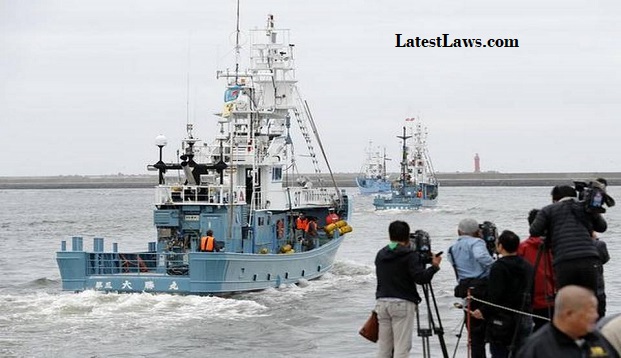
Whaling boats embarked on Monday on their first commercial hunts since 1988, when Japan switched to so-called research whaling, but will stay within the country’s exclusive economic waters.
Japan has resumed commercial whaling after 31 years, meeting a long-cherished goal of traditionalists that’s seen as a largely lost cause.
Whaling boats embarked on Monday on their first commercial hunts since 1988, when Japan switched to so-called research whaling, but will stay within the country’s exclusive economic waters. Japan’s six-month notice to withdraw from the International Whaling Commission took effect Sunday.
The Fisheries Agency said the catch quota through the end of this year is set at 227 whales, fewer than the 333 Japan hunted in the Antarctic in recent years. The quota for this season’s catch, planned for release in late June, was postponed apparently to avoid criticism during the Group of 20 summit that concluded over the weekend in Osaka.
As the boats left port, whalers, their families & local officials in two major whaling towns, Shimonoseki in southwestern Japan, which is Prime Minister Shinzo Abe’s electoral constituency, & Kushiro in the north, celebrated the fresh start, hoping for a safe return & a good harvest.
While the resumption of commercial whaling is condemned by many conservation groups, others see it as a face-saving way to let the government’s embattled & expensive whaling program gradually succumb to changing times & tastes.
Despite the massive attention & tax money & political support from ruling party lawmakers, whaling in Japan involved only a few hundred people & accounted for less than 0.1 percent of total meat consumption in fiscal 2017, according to the latest government data on food sufficiency.
Whale meat was an affordable source of protein during the lean times after World War II, with consumption peaking at 223,000 tons in 1962. But whale was quickly replaced by other meats. Whale meat consumption was down to 6,000 tons in 1986, a year before the commercial whaling moratorium imposed by the IWC.
Under the research hunts, which was criticized as a cover for commercial hunts as the meat was sold on the market, Japan at its peak caught as many as 1,200 whales but has drastically cut back on its catch in recent years after international protests escalated & whale meat consumption slumped at home.
Today, about 4,000-5,000 tons are supplied to Japan annually, or 30-40 grams of whale meat consumed per person a year, Fisheries Agency officials say.
The research whaling program lost money for years 1.6 billion yen ($15 million) in the last year alone.
Japan will stick to a very strict catch quota with respect to the IWC findings, & will continue conducting research, said Hideki Moronuki, a Fisheries Agency official & a chief negotiator at the IWC. He said Japan’s commercial whaling will never harm its stock.
The commercial whaling will be carried out by two groups. The mother boat Nisshin-maru & two support boats that used to go to the Antarctic will travel as far as the 200 nautical mile EEZ to catch minke, Bryde’s & sei whales. Five other smaller ships will stay closer to the coast but also hunt minkes, in addition to Baird’s beaked whales & dolphins that they used to catch under an IWC loophole.
Whales caught in coastal waters are expected to be brought back for fresh local consumption at any of six local whaling hubs that are mainly in northern Japan but include Taiji, the home constituency of ruling Liberal Democratic Party heavyweight Toshihiro Nikai. The town is also known for dolphin hunts because of the documentary film “The Cove.”
Whale meat caught further off the coast will be frozen & distributed for wider consumption.
Moronuki says the fate of commercial whaling depends on whether whale meat is widely accepted by consumers since it won’t be getting as much subsidies as it used to get. Moronuki said he hoped whale meat would be reasonably priced so that it will gain popularity in the long-term instead of becoming an expensive delicacy for a limited clientele.
Source Link