The Author, Rashi Bhatia is a student of 4th Year, B.A.LL.B at Mody University of Science and Technology, Rajasthan. She is currently interning with LatestLaws.com.
INTRODUCTION
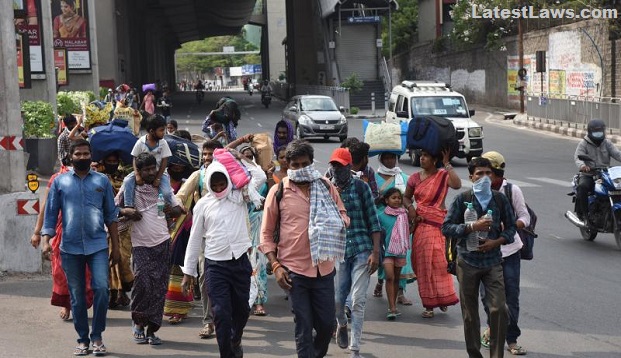
The census estimated 453.6 million internal migrants in India in 2011, adding about 139 million compared to the estimate of 314.5 million 2001.given government led urbanization programmers’ like smart cities initiatives, internal migration would have increased in 2011-21 period. If were to add the same number of migrants as was seen in 2001-11 period, the migrant population would be almost 600 million. The 2011 census showed that around one-third of all internal migrants are inter-state and inter-district migrants, which makes it almost 200 million. Of these 200 million, about two-thirds are estimated to be workers. This gives us migrant workers population of about 140 million as of today. Unfortunately in the absence of reliable data, we do not have an understanding of the migration numbers. We have failed migrants at every level during COVID-19.
About 10% of the workforce from cities would have left before the lockdown began. Another 10% would have left during the third and fourth phases, when mobility was a little eased we might see a further 10% return during the fifth phase after June 1. We should see a total of 30% of the total workforce leave cities. We can expect that around 30% of the will not come back owing to the bad experiences they had with their employers. The employers have failed to protect their workers and governments have failed to hold them accountable. To get migrant workers back to cities, the centre and states ensure that employers pay the workers not only the salaries of the previous two months, but also an advance of three months salary.
A status report filed by the ministry of Home affairs (MHA) in the Supreme Court shows that Kerala Govt. operates over 65% of the total number of active shelters and relief camps for trapped migrant workers run by various states government in the wake of COVID-19 pandemic.
ROLE OF JUDICIARY TOWARDS MIGRANTS
The court observed “Non-governmental organizations coming forward to help the migrant workers and to fight the pandemic and extend help by providing food, water and transportation at their cost which deserves all appreciation”.
The Court noted that non-governmental organizations and individuals have played a significant role in extending helping hand to the migrant. The Bench Also added “Although it is the responsibility and duty of the states and Union Territories to take care of all needs of migrant labourers but in this difficult time NGOs and individuals have also contributed and played a significant role in extending helping hand to the migrants. The society as a whole was moved by miseries and difficulties and it exhibited its passion and devotion by way of Individuals.
The SC directed authorities to consider withdrawing all the cases against migrant workers for alleged violations of lockdown norms against the Disaster management Act. The bench directed the authorities to recognize and register migrants’ workers who want to go their native places and conclude the exercise, including their transportation within 15 days.
A bench said “Majority of stranded workers have reached their native places. The second major task now to be undertaken by the concerned states and union territories is to take care of those migrant workers who have returned to their native places after cessation of their employment.
The bench directed the union government to give details of all schemes, so that workers who have migrated to their native places could avail the benefits.
REPONSE OF CENTRE AND STATES GOVERNMENT
Another aspect of government’s dealing with the crises of pandemic was relief package, ultimately announced in a bizarre and an episodic manner.
The COVID-19 has brought to centre-stage of migrant discourse fault lines in the Indian society such as Caste, Class, gender, religion and ethnicity that tend to enlarge in crisis situations. On the other hand, the failure of the state to stand with and care for its toiling classes, chiefly migrants (and also some specific sections within migrants) has once again intensifies discuss how state, democracy, market, citizenship and right to life and livelihoods mean differently to different groups of people. However, the steady but impending impact of the pandemic is likely to bring about far-reaching changes the way politics functions, push for liberalization and privatization is used, urban is reconceptualised and the workers organizations go about organizing them.
The Chief Minister of Rajasthan ‘No Migrant worker, either outbound or incoming, was asked to pay for their journeys and so far the state government has spent around Rs 25 Crore in the exercise .But more than money, what drove us was humane understanding of the pain of displaced people, suffering in the distant lands and longing to the reunited with their families in these times of the deadly pandemic.
The first train on May 1, about 1.5 lakh workers have been sent home and a similar number of people including students from kota have been facilitated to leave for their states by buses. Over 13 lakh people including workers, students, tourist etc have been brought back. Rajasthan was one of the first state to begin the rail service for migrants from day one.
The focus of the UPA government has always been the poor and the downtrodden — how to transform their lives and raise their standards of living, thus pulling them out of penury and lack of self-confidence. As we have been reading about the plight of the migrants during the lockdown, it has prompted us to think more about them. We have realised that in order to better focus on their affairs, in all situations and all times, it is best to have a separate ministry of migrants’ affairs.
The state governments set up thousands of camps to house lakhs of migrants and stop the exodus. Delhi government provided free food to 4 lakh people every day, as of late March. Over 500 hunger relief centres were set up by the Delhi government. By 5 April 75 lakh people were being provided food across the country in food camps run by the government and NGOs. As of 12 April, 37,978 relief camps and 26,225 food camps had been set up.
To cater to the needs of the migrants and prevent them from departure the camps, the government of Kerala changed the food being provided by adding north Indian dishes to the menu, providing carrom boards and recharge services for phones, as well as provide other medical basics such as masks, sanitizers, and medicines.
OTHER DEPARTMENTS HELP UNDER THIS PANDEMIC
The Central Information Commission (CIC) to make all information on migrant workers pubic and to update it periodically. In the starting of May, the government had approved that efforts to help migrant workers were stymied by the lack of data on them. The CIC launched a ‘National Migrant Information system’ under which it directed all states to register migrants’ details on the online portal.
For the success of job model, the labour department will reach out to over 13 Lakh such labourers through their mobile numbers in the coming days. They will send a text message informing them to register at the Raj Kaushal Employment Exchange Portal for jobs and to enroll for short term courses to enhance their employability in their desired sectors. The secretary of labour department said the idea is to encourage all these migrants to take advantage of the exhaustive measures to provide a livelihood to these migrants.
The unions of labour organised nationwide protests to protest the changes in labour laws, with the Bharatiya Mazdoor Sangh organizing one on 20 May and the Centre of Indian Trade Unions and the All India Trade Union Congress organizing another on 22 May. Seven left parties wrote to the President to intercede in the issue.There are ten labour unions wrote to the International Labour Organization (ILO) regarding the labour laws, on 14 May.In response, the ILO expressed "deep concern" to PM Modi and requested him to instruct the central and state governments to uphold commitments (towards labour laws) made by India.
In the Survey Report done by Stranded Workers Action Network (SWAN),said that the automated phone survey of 1,963 migrants found that 33% had managed to leave for their home states while 67% still stayed behind. Of those who had left, more than 85% had to pay for their journey home. The title of the report is “To leave or not to Leave: Lockdown, migrant workers and their journeys home”.
SCHEME MADE SPECIALLY FOR MIGRANTS
Prime Minister Narendra Modi launched the ‘Graib Kalyan Rojgar Abhiyan’ having an outlay of Rs 50,000 crore ,to provide livelihood opportunities to returnee migrant workers affected by the lockdown, the centre hasn’t yet promised additional budget (outside the existing budget for various schemes) to the states for running the campaign and that it has been ‘conceived as a convergence programme’.
According to government reports, there was enough food grain stocked up in the FCI godowns to provide for the poor for at least a year-and-a-half. While government schemes ensured that the poor would get additional rations due to the lockdown, the distribution system failed to be helpful as the ration cards are area-specific and fair price shops were largely inaccessible. Additionally, the 'One Nation, One Ration Card' system has been implemented in very few states, as of mid April. While the scheme allowed migrant workers to retrieve food grains for free anywhere across the country, very few were aware of the scheme. In addition to this, the scheme also required biometric authentication, which was discontinued due to fears of spreading the virus through common fingerprint sensors.[18] In Telangana, many could not avail of the ration due to a lack of Aadhaar cards.As such, many were left without food and money due to the lockdown.
CONCLUSION
There is wide divergence in migrants- related information that state governments have submitted in SC and the data that they have shared with the Union Labour ministry, nodal ministry keeping data on migrant workers. Even though the Solicitor general Tushar Mehta told the court close to one crore migrants had returned home on trains and by road until June, the labour ministry in June, released migrant data for about only 26.17 Lakh migrants from across states.
With over 90% of the population working in the informal economy, ILO has predicted that as a result of the crisis and subsequent lockdown, about 400 million workers will fall deeper into poverty while forcing many of them to return to their places of origin in the rural areas.
As India has started to lighten up some lockdown restrictions, impact of COVID-19 virus and containment actions on the most vulnerable groups in India, and government’s explore the social policy measures and employment opportunities that can protect informal and migrant workers from hunger and extreme poverty[1].