









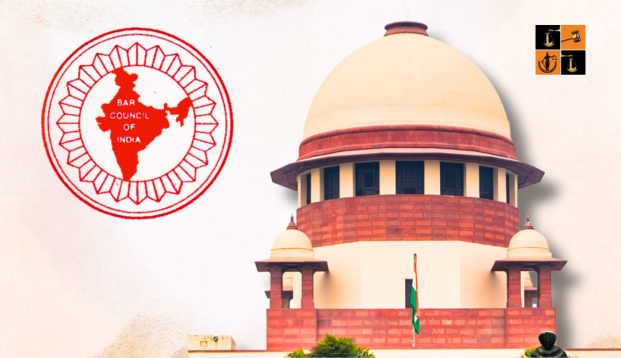
The Supreme Court questioned the Bar Council of India's authority to frame law college curricula while hearing pleas against its decision to scrap the one-year LL.M. and derecognize foreign degrees, stressing that academic decisions should rest with academicians, not regulators.
The matter stems from challenges to the Bar Council of India Legal Education (Post-Graduate, Doctoral, Executive, Vocational, Clinical and other Continuing Education), Rules, 2021, under which the BCI discontinued the one-year LL.M. degree programme and refused to recognize LL.M. degrees obtained from foreign universities. The petitioners, including law students and academic stakeholders, approached the Supreme Court contending that the BCI had exceeded its regulatory mandate.
The Bench comprising Justice Surya Kant and Justice Dipankar Datta was seized of the petitions, including Tamanna Chandan Chachlani v. Bar Council of India and connected matters.
Appearing for the Consortium of National Law Universities, Senior Advocate Dr. Abhishek Manu Singhvi submitted that the BCI's interference extended beyond LL.M. regulation and into areas such as doctoral programmes and diplomas, thereby encroaching upon the academic autonomy of legal institutions. He contended that while the BCI's statutory function is to regulate the entry of candidates into the legal profession, it was never intended to assume control over the educational content delivered by universities.
Senior Advocate Vivek Tankha, representing the BCI, defended the 2021 Rules by arguing that LL.M. degrees serve as academic qualifications necessary for teaching in law institutions and thus require thorough academic rigour, justifying the need for a two-year course.
The Bench critically examined the extent of BCI’s authority over academic curricula and expressed disapproval over its sweeping role in legal education governance. Justice Surya Kant, in particular, remarked, “Why should BCI decide curriculum, etc., of law colleges? The BCI has an onerous responsibility to provide training... it may require the services of universities... You can have training on art of drafting, citing case laws, etc., and it should be part of your statutory responsibility. The curriculum, however, has to be entrusted to the academicians.”
The Court further noted that judicial concerns about the quality of legal education were legitimate, observing, “In legal education, the judiciary is the primary stakeholder. What kind of officers are we getting? Do they understand the plight of the common man... or just deliver mechanical judgments? Academicians can look at this.”
Justice Kant also pointed out that the BCI should redirect its focus towards broader institutional responsibilities, such as improving the quality and welfare of legal professionals and promoting global recognition for Indian lawyers. Drawing a parallel with other professional bodies, he asked rhetorically, “Does the Medical Council of India prescribe what should be the qualification for the MD or MS course? The answer is a simple no.”
While no final adjudication was made on the merits of the petitions, the Court directed the Union Government and the University Grants Commission (UGC) to file comprehensive replies on the issue of BCI’s regulatory powers over legal education. The Attorney General of India was also requested to assist the Court in the matter.
Additionally, the Court suggested that any committee constituted to examine the feasibility of the one-year LL.M. should include Vice-Chancellors and legal academicians to ensure balanced academic input. “On consideration of the issue and other allied issues with respect to powers of BCI, we would like to have a reply by the Union and UGC. We request AG to assist the court on the next date of hearing. We direct UGC to submit its reply. Let the Union also file a comprehensive affidavit,” the order recorded.
Picture Source :



















