









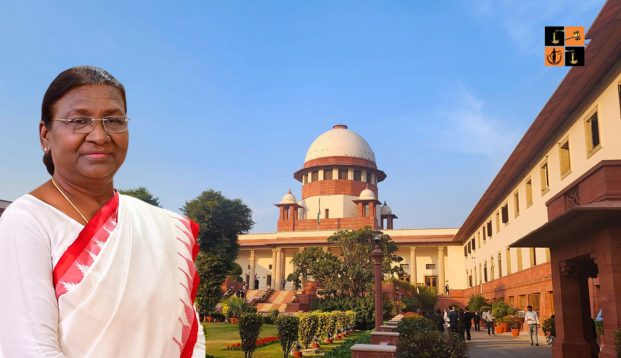
A five-judge Constitution Bench of the Supreme Court, led by Chief Justice of India Bhushan R. Gavai, will today begin examining a Presidential Reference filed under Article 143 of the Constitution. The reference seeks the Court’s advisory opinion on whether the President and Governors can be bound by judicially prescribed timelines for granting or withholding assent to state legislation.
The Bench, comprising Chief Justice Gavai, along with Justice Surya Kant, Justice Vikram Nath, Justice P.S. Narasimha, and Justice Atul S. Chandurkar, includes four current or future Chief Justices of India. The inclusion of these senior-most judges underscores the constitutional gravity of the matter at hand.
The reference follows the Supreme Court’s judgment dated April 8, which for the first time laid down specific timelines for constitutional authorities to act on state bills. The judgment mandated that the Governor must act "forthwith" or within one month on re-enacted bills, and the President is required to decide on a bill referred by the Governor within a maximum of three months. It also held that failure to act within these limits could result in "deemed assent."
President Droupadi Murmu invoked Article 143 on May 13, seeking clarity on 14 key constitutional questions arising from that judgment. Among them is whether the Constitution permits the judiciary to impose timelines on the President or Governors, particularly when the text of the Constitution remains silent on such timeframes. The reference also queries whether such directions can be enforced through Article 142, which empowers the Court to ensure “complete justice,” and whether those executive actions are justiciable before a law formally comes into force.
Sources familiar with the matter indicate that the Court’s Registry, after examining precedents and the rules governing the Supreme Court, recommended that a five-judge Constitution Bench hear the matter in its entirety from the outset. This guidance was based on the principle that advisory opinions under Article 143, which raise substantial questions of constitutional law, have historically been decided by larger benches in accordance with Article 145(3).
The move to constitute a Constitution Bench also addresses an earlier procedural debate, whether the matter should first be placed before a three-judge Bench for preliminary consideration or be taken up directly by a larger Bench for full adjudication.
The questions raised in the reference go beyond procedural timelines and touch upon the very foundations of India's federal structure and the separation of powers. Key issues include whether the President’s and Governor’s discretion under Articles 200 and 201 is subject to judicial review; whether Article 142 can override express constitutional provisions; and whether the April 8 judgment ought to have been referred to a larger Bench in light of Article 145(3).
Also under scrutiny is whether constitutional immunity granted to the President and Governors under Article 361 precludes judicial interference in matters involving their discretion, and whether such disputes should fall exclusively under the original jurisdiction of the Court as outlined in Article 131, which deals with Centre-State conflicts.
The drafting of the reference was a meticulous process, led by Attorney General R. Venkataramani and Solicitor General Tushar Mehta in coordination with the Union Law Ministry. Following the April 8 verdict, several rounds of high-level consultations were conducted to frame and refine the constitutional questions, culminating in the formal submission of the reference to the Supreme Court.
While the Supreme Court’s advisory opinion under Article 143 is not binding, it carries immense persuasive value and has historically served as a crucial interpretative guide in matters of constitutional importance.
The outcome of this proceeding could have far-reaching implications on legislative functioning in the states and the interpretation of constitutional powers vested in the executive and the judiciary.
Picture Source :



















