









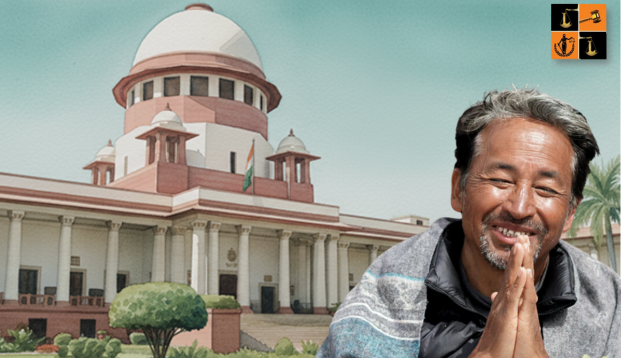
On Wednesday the Supreme Court heard a plea from Gitanjali Angmo, wife of Ladakh-based activist Sonam Wangchuk, seeking permission to amend her petition challenging her husband’s preventive detention under the National Security Act. The amendment aims to address the grounds of detention recently furnished by the Central Government.
Angmo’s original petition had sought Wangchuk’s release on the basis that no detention grounds were provided by the authorities. However, the Central Government has since asserted that these grounds were submitted, including through an affidavit filed by the District Magistrate of Leh.
During the hearing, Angmo’s counsel, Senior Advocate Kapil Sibal, requested the Court’s permission to amend the plea to directly challenge the grounds now presented by the Government. “I’ll amend it so that the matter can continue here,” Sibal submitted. The Bench, comprising Justice Aravind Kumar and Justice NV Anjaria, recorded the request and listed the matter for further hearing on October 29.
Sibal also raised concerns that Wangchuk was being restricted from exchanging certain notes regarding his detention with his wife. The Court acknowledged the submission, and Solicitor General Tushar Mehta, appearing for the Government, stated that while he had no objection to such communication, it should not be treated as a fresh ground to challenge the detention. Mehta elaborated, “Sometimes even a delay of two days is claimed as a ground for challenge. My apprehension is that this should not be used in that manner.”
Regarding Wangchuk’s health, SG Mehta informed the Court that the activist was not on any medication and was not suffering from any serious health issues. The Bench and the SG exchanged customary good wishes for his well-being as the proceedings concluded.
Wangchuk was arrested from Ladakh on September 26 in connection with protests and unrest over demands for statehood in the Union Territory. His wife subsequently approached the Supreme Court, challenging the legality of his preventive detention under Section 3(2) of the NSA, asserting that the detention was not genuinely linked to national security or public order.
The petition contended that Wangchuk had engaged solely in peaceful Gandhian protests and the detention effectively sought to silence a prominent environmentalist and social reformer advocating democratic and ecological causes. It emphasized that such detention violates Article 19 of the Constitution, which guarantees freedom of speech and peaceful assembly.
Further, the plea highlighted that procedural safeguards under the NSA were not observed, thereby infringing on Wangchuk’s right to liberty and equality under Article 21 and Article 14. It was also noted that neither Wangchuk nor the petitioner had received the detention order or its grounds.
Angmo additionally challenged her husband’s transfer to Central Jail, Jodhpur, located over a thousand kilometres from Ladakh, and sought directions for his release, production before the Court, access to communication, and provision of basic necessities such as medicines, clothing, and food during detention.
The matter now awaits hearing on October 29, following the proposed amendments to the petition.
Picture Source :



















