









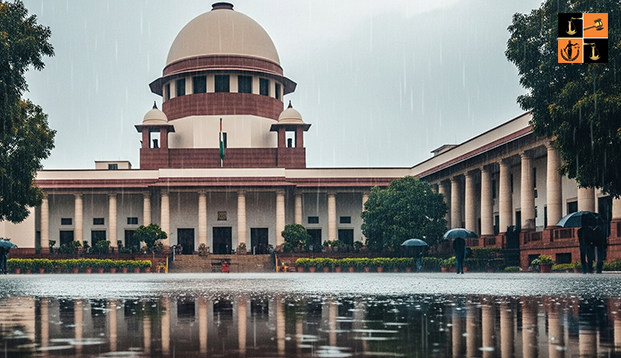
On Tuesday, the Supreme Court engaged in a detailed hearing on the scope of Article 233 of the Constitution, concerning appointments of district judges under the Bar quota, in the case of Rejanish KV v. K Deepa & Ors. The matter focused on whether judicial officers with prior service as judges, who have also completed seven years of practice as lawyers, can be considered for direct appointment as district judges.
A Bench comprising Chief Justice BR Gavai and Justice MM Sundresh, Justice Aravind Kumar, Justice Satish Chandra Sharma, and Justice K Vinod Chandran examined the constitutional text and legislative intent. Justice Sundresh observed on the weight of service experience, noting that “One year of judgeship equals to five years of being a lawyer. That is the volume of work.”
Senior Advocate Jayant Bhushan argued that Article 233 must be interpreted to give effect to all its words. He submitted that “Any construction of the statute which makes the provision redundant cannot be accepted.” Bhushan stressed that limiting eligibility to continuous practice as a lawyer would render parts of Article 233(2) meaningless and effectively exclude service judges, contrary to the provision’s scheme.
CJI Gavai cautioned against reading additional requirements into the Constitution, stating, “You cannot import rules to interpret the Constitution.” Senior Advocate Bhushan referred to the Shetty Commission report, highlighting that exclusion from Higher Judicial Service examinations had been a source of frustration among civil judges.
Opposing this view, Senior Advocate Arvind Datar insisted that the framers intended the seven-year period to reflect continuous practice as an advocate, emphasizing, “The requirement is that an advocate or pleader should be in practice for the immediate past seven years. The experience must be as a practising advocate, not in service.”
The Bench discussed prior judgments, though the precise question under Article 233 had not been definitively addressed before. Justice Sundresh reiterated the importance of recognizing the practical workload handled by service judges, while CJI Gavai noted that eligibility must be assessed on the date of application, not appointment.
Other Senior Advocates, including PS Patwalia, V Giri, Vibha Datta Makhija, and Jaideep Gupta, made submissions on statutory interpretation, legislative intent, and the significance of expressions like “has been” in determining eligibility.
The Court has reserved its observations for further consideration, as it weighs the competing interpretations of service experience versus continuous practice under Article 233, which governs recruitment to the higher judiciary.
Picture Source :




















