









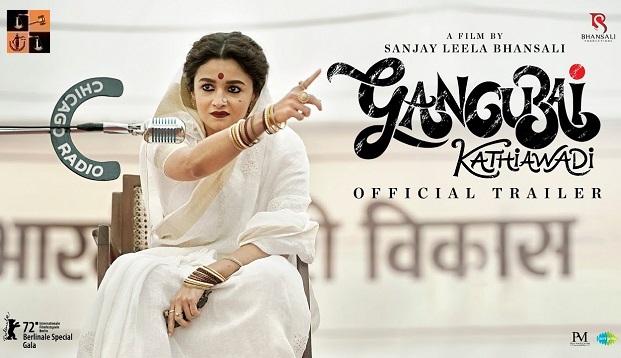
The Supreme Court while dismissing plea seeking an interim injunction to restrain release of new film 'Gangubai Kathiawadi' held that mere hurting of sensibility is not defamation, if the person said to be defamed is not lowered in character or credit in the eyes of others.
The Division Bench comprising of Justice Indira Banerjee and Justice JK Maheshwari observed that the film certificate is issued by the Central Board of Film Certification (CBFC) and prima facie showed that the film was not defamatory.
The petitioner who claims to be an adopted son of the protagonist of the film “Gangubai Kathiawadi”, filed a suit seeking, selling, assigning any rights to any entity, company, firm, cinema halls, multiplexes, social media or any other platforms or giving any press statement in public or on electronic media of the trailer/promo and/or film of the movie “Gangubai Kathiawadi”, inter alia restrainment on release of the movie “Gangubai Kathiawadi”.
The Court stated that Section 5-B of the Cinematograph Act, 1952 lays down the principles for certifying films and provides that a film shall not be certified for public exhibition, if, in the opinion of the authority competent to grant the certificate, the film or any part of it is against, inter alia, decency, or morality, or involves defamation. Section 6 of the said Act enables the Central Government to call for the records of any proceedings in relation to any film which is pending certification or has been certified.
Further noting that petitioner has apparently made no complaint to the CBFC which is required under Rule 32 of the Cinematograph (Certification) Rules, 1983, the Court went onto to state that a film which is defamatory or indecent or breaches copyright cannot be allowed to be exhibited only because a certificate has been issued but the same to be examined by the Court first.
The Court also put weight in decision to certify the film and said that the Cinematograph Act, 1952 requires the CBFC to be responsive to the values and standards of society and also take note of social changes. The CBFC is required to ensure that sensibilities are not offended by obscenity, vulgarity, defamation or denigration of any group of persons.
Citing Bobby Art International, Vs. Om Pal Singh Hoon & Ors, 1996 Latest Caselaw 395 SC, the Court stressed that a book or a film that illustrates the consequences of a social evil must necessarily show that social evil.
The Court opined that a film that carries a message and depicts social circumstances of a group of underprivileged women is not impermissible and in the present matter, the fact that the film has been certified by CBFC, which comprises of a body of experts prima facie shows compliance with the requirements of the guidelines.
Right to an injunction depends on the Legal Right
The Court observed:
"For an actionable tort, there has to be a wrongful act, and damage or loss or inconvenience or annoyance caused to another, by reason of the wrongful act. Annoyance or inconvenience or loss alone does not give right to a legal action. The question of what constitutes nuisance is a question which the Court has to determine. The Court has first to ascertain what is the legal duty of which there has been breach."
In view of this, the Court noted that there is not any provision of law which prevents an author from writing a biographical book/story or prohibits the making of any biographical film.
The appeal was thus dismissed.
Read Order Here:
Share this Document :Picture Source :




















