









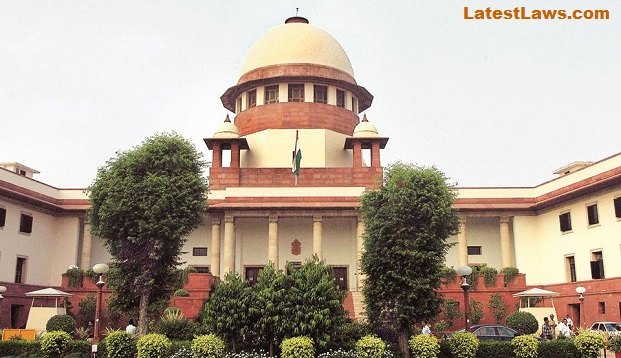
The Top Court Thursday indicated it may consider the question of referring the issue of challenge to the abrogation of provisions of Article 370, which gave special status to erstwhile state of Jammu & Kashmir, to a larger 7-judge bench after hearing the preliminary submission of all the parties.
The Supreme court's remarks came after some of the parties, challenging the Centre's decision of abrogating Article 370 of the Constitution, said there were 2 conflicting decisions by a 5-judge bench of Supreme court given in 1959 & 1970.
The provisions were abrogated by the Centre on Aug 5. "We may consider the question of referring the matter to larger bench only after hearing the preliminary submission of all the parties," a five-judge bench headed by Justice N V Ramana said.
During the hearing, senior advocate Rajeev Dhavan, appearing for some of the parties against the Centre's decision, said that court should first hear the parties who are challenging the abrogation & then hear the counsels seeking reference to a larger bench.
The bench, also comprising Justices Sanjay Kishan Kaul, R Subhash Reddy, B R Gavai & Surya Kant, said the question of referring it to 7-judge bench will be considered by it at a later stage after all the parties complete their preliminary submissions.
Senior advocate Raju Ramachandaran, appearing for bureaucrat-turned-politician Shah Faesal, Shehla Rashid & other petitioners resumed his arguments & said that in the scheme of Article 370, while the democratic power is with the State, the executive power is with the Union govt.
He said that the constituent power of Jammu & Kashmir (expressed through its elected govt as concurrence or as a recommendation of the Constituent Assembly) is the central principle observed in all the cases dealt by the Supreme court on the issue of Article 370.
"Therefore, since it is the State of J&K that has constituent powers over its own constitutional framework as well as a role in determining the constitutional relationship of the State with the Union, it is the State of J&K which can democratically decide how its constituent powers can be exercised in accordance with its Constitution," he added.
Replying to yesterday's question of the bench, as who could be the competent authority to reconstitute the Jammu & Kashmir Constituent Assembly to take a call on altering the special status of the erstwhile state under Article 370, "it is only the State of J&K that can decide who will be a successor to the Constituent Assembly of the State, who may wield constituent powers in future".
Ramachandaran said that in the present instance instead of the state of Jammu & Kashmir, it was the union govt acting through the President that decided how the constituent power of the Constituent Assembly under Article 370(3) would be exercised - by modifying Article 367(4) in Presidential order.
"Therefore, this act of the President is ultra vires his powers under the self-contained code that is Article 370. This part of the challenge thus mayn't be subsumed under the question of the President's powers under Article 356," he said.
Senior advocate Dinesh Dwivedi, appearing for petitioner Prem Shankar Jha, said there are two conflicting judgements given by the five-judge of the Supreme court in 1959 in Prem Nath Kaul versus Jammu & Kashmir & in 1970 in Sampat Prakash versus Jammu & Kashmir.
He sought referring of the matter to the larger 7-judge bench for a definite findings. The hearing remained inconclusive & would continue on Jan 21, 2020.
On Wednesday, the Supreme court had raised a query as to who could be the competent authority to reconstitute the Jammu & Kashmir Constituent Assembly to take a call on altering the special status of the erstwhile state under Article 370 of the Constitution.
The Supreme court, also raised the point that if the decision rested with people then will it be a case of "referendum, concurrence or consultation".
The petitioners have referred to the constitutional provision & said that only the Constituent Assembly, which represents the will of the people, is empowered to make recommendation to the President on any changes in the special status of Jammu & Kashmir.
Ramachandaran had contended that President could have only abrogated provisions of Article 370 only on recommendation of the Constituent assembly, which represented the will of the people of the state.
He had said the two presidential orders issued with regard to abrogation of Article 370 have completely flouted the tenets of basic structure of the Constitution of India.
Earlier, Ramachandaran had argued that the Centre's decision to abrogate provisions of Article 370 was "unconstitutional" since people of Jammu & Kashmir were "bypassed" & any proposal for altering the constitutional status of the erstwhile state should emanate from the citizens there.
A number of petitions have been filed in the matter including that of private individuals, lawyers, activists & political parties & they have also challenged the Jammu & Kashmir Reorganisation Act 2019, which splits J&K into 2 union territories -- Jammu & Kashmir & Ladakh.
Source Link
Picture Source :




















