









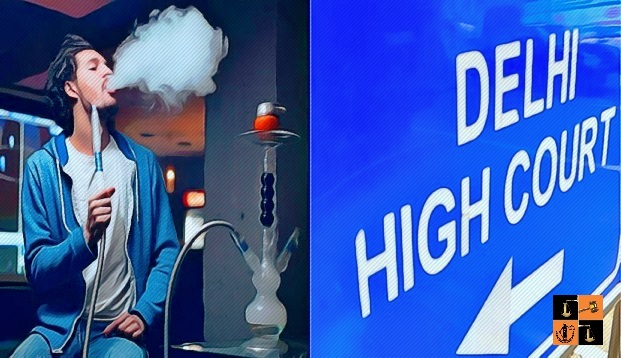
On Tuesday, Delhi High Court directed the Centre to consider a PIL petition as a representation, seeking immediate action against the “illegal online sale of Hookahs” on e-commerce platforms that lack specific health warnings.
The PIL sought directions to the respondents, including the Union of India through the Ministry of Health and Family Welfare, to take immediate action against the illegal online sale of hookahs on e commerce platforms that lack prescribed health warnings.
PIL also requested the establishment of a regulatory framework for age verification and oversight of online hookahs sales. The petition further alleged that the sale of hookahs infringes upon the public’s right to health and safety under Article 21 of the Constituition of India.
It claimed that the “uncontrolled sale and promotion of tobacco products” on various e-commerce platforms constitutes a direct violation of several existing legal frameworks, specifically the Cigarettes and other Tobacco Products (Prohibition of Advertisement and Regulation of Trade and Commerce, Production, supply and distribution) Act.
Additionally, the petition highlighted that the sale of hookahs in public spaces contributes to secondhand smoke exposure, which poses significant health risks to the public.
During the hearing the counsel for the petitioner argued that hookah smoke, even from designated smoking areas, spreads beyond walls and contaminates food, violating COTPA. He stated that no prior representations were made but RTIs were filed and responses are pending. He emphasized the public health risk and noted observing a child transporting hookah items from a paan shop, which he claimed breaches the law.
Delhi HC's division bench, comprising of Acting Chief Justice Manmohan and Justice Tushar Rao Gedela, stated that while it was not disputing what counsel for the petitioner states, it asked him to first write a representation to the centre on the issue.
HC Bench concluded by stating that, “Present writ petition is disposed of with a direction to the respondents 1 and 2 to treat the petition as a representation and pass appropriate orders including necessary action in accordance with law within three months. In the event the petitioner is not satisfied…the petitioner shall be at liberty to file appropriate proceedings in accordance with the law".
Source PTI
Picture Source :



















