









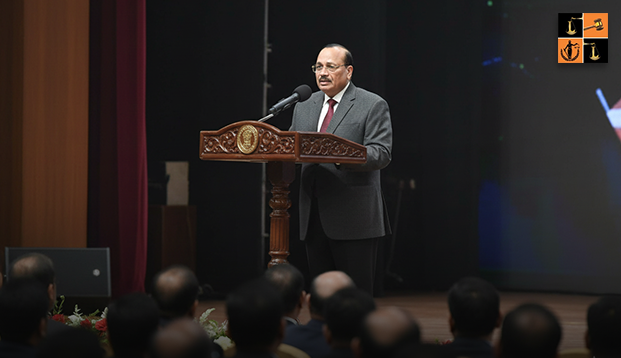
At the 23rd Hindustan Times Leadership Summit, CJI Surya Kant delivered a strong message reaffirming that the Supreme Court remains an institution meant not just for the elite, but equally for ordinary citizens seeking justice. He remarked that the Court must continue to function as an accessible forum, especially for individuals who depend entirely on it for redressal.
Speaking on the future of adjudication in India, the CJI addressed what he described as structural vulnerabilities within the present justice delivery system. Litigation, he observed, often turns into a time-consuming journey, pushing the judiciary to re-evaluate mechanisms capable of reducing pendency and costs.
Justice Surya Kant reiterated his confidence in mediation as a transformative model for dispute settlement. Describing it as both economically viable and less adversarial, he highlighted that mediation stands apart from other dispute resolution mechanisms. “It is cost-effective, less time-consuming, and does not demand a specialised class of lawyers,” he stated, noting that even individuals from non-litigation backgrounds and retired professionals are now contributing as mediators.
According to the CJI, mediation fosters win-win outcomes, preserves relationships and social harmony, and communicates in a language understandable to the common citizen, an element he identified as crucial for its success. He, however, cautioned that mediation would reach its full potential only when mediators learn to speak in the language of justice consumers.
During the session, Justice Kant outlined his primary concern, bringing down the cost of litigation and ensuring that cases move within reasonable, predictable timeframes. To achieve this, he pointed to ongoing efforts to expand free, quality legal aid across the country.
He clarified that empanelment for legal aid would no longer be limited to underutilized or inexperienced lawyers. Instead, competent practitioners with professional integrity and local standing are now being onboarded and compensated with dignified honorariums to ensure reliable assistance for the socio-economically disadvantaged.
The CJI further added that strengthening district judiciary management systems and judicial training frameworks is key to improving efficiency at the first level of adjudicatory engagement.
Expressing confidence in the nation’s institutional resilience, the Chief Justice said he sees a bright future for Indian democracy and its justice system. His optimism, he noted, stems from people’s unwavering faith in constitutional principles, the rule of law, and democratic values.
Justice Surya Kant also credited India’s youth for his belief in the judiciary’s future, remarking that their intellect, global awareness, and capacity for innovation make them well-equipped to shape evolving jurisprudence. “The future of the judiciary is safe in the hands of this informed and dynamic generation,” he concluded.
Disclaimer: This news/ article includes information received via a syndicated news feed. The original rights remain with the respective publisher.
Picture Source :



















