









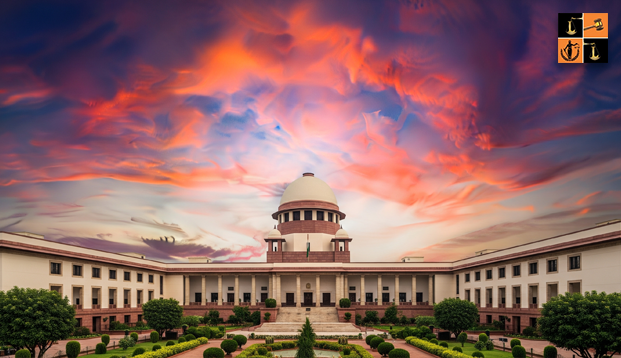
The Constitution Bench of the Supreme Court has held that a judicial officer who has already completed seven years of practice at the Bar qualifies for direct appointment as a District Judge. The Court further clarified that individuals serving in the judiciary who possess a combined experience of seven years as both an advocate and a judicial officer are equally eligible for consideration under the direct recruitment quota.
To ensure uniformity, the Bench observed that in-service candidates aspiring for direct recruitment must have attained a minimum age of 35 years. The judgment mandates that state governments frame corresponding rules prescribing such eligibility criteria, allowing in-service judicial officers with combined Bar and service experience to apply for the post.
Delivering the verdict, the five-judge Bench comprising Chief Justice of India B.R. Gavai, and Justice M.M. Sundresh, Justice Aravind Kumar, Justice S.C. Sharma, and Justice K. Vinod Chandran, ruled that the decision would operate prospectively, without affecting recruitment processes already in progress. Two concurring judgments were delivered, one by CJI Gavai and the other by Justice Aravind Kumar.
The Court interpreted Article 233 of the Constitution holistically, holding that its two sub-clauses cannot be read in isolation. Emphasizing a purposive interpretation, the Bench observed that a construction advancing administrative efficiency and merit-based selection should prevail over a literal or restrictive reading.
The matter was referred to the larger Bench following an earlier three-judge order led by CJI Gavai, along with Justice K. Vinod Chandran and Justice N.V. Anjaria, dated August 12, which identified the need for authoritative determination on the interpretation of Article 233.
The Constitution Bench considered four principal questions:
-
Whether a judicial officer who had completed seven years at the Bar before entering service could be considered eligible for District Judge appointment under the Bar quota.
-
Whether the eligibility should be determined at the time of application or appointment.
-
Whether Article 233(2) bars a person already in judicial service from seeking appointment as a District Judge.
-
Whether a candidate with seven years’ combined experience as an advocate and judicial officer satisfies the constitutional eligibility standard.
During the three-day hearing, the petitioners urged the Bench to revisit the 2020 ruling in Dheeraj Mor v. High Court of Delhi, which had held that civil judges are not eligible to compete for District Judge posts under the Bar quota.
Counsel for the petitioners, including Senior Advocates Jayant Bhushan, Arvind Datar, P.S. Patwalia, Gopal Sankarnarayanan, V. Giri, Vibha Makhija, Jaideep Gupta, Seshadri Naidu, Manish Singhvi, and Menaka Guruswamy, argued that the earlier interpretation was overly restrictive and inconsistent with the constitutional framework. They contended that the seven-year practice requirement should not be construed as seven continuous years, and that experience gained before judicial service must also count.
The respondents, represented by Senior Advocates C.U. Singh, Nidhesh Gupta, Vijay Hansaria, and Rajiv Shakdher, opposed the plea, maintaining that Article 233(2) expressly restricts eligibility to those not already in service. They emphasized that this interpretation has been consistently upheld for over six decades and rests on the doctrine of stare decisis.
The reference originated from an appeal against a Kerala High Court judgment that invalidated the appointment of a District Judge on the ground that the appointee was in judicial service at the time of appointment and was therefore not a practising advocate.
The appellant, Rejanish K.V., had over seven years of Bar experience when he applied for the post but was later appointed as a Munsiff-Magistrate while the District Judge selection process was still ongoing. After his appointment as District Judge, Thiruvananthapuram, a writ petition challenged his eligibility.
The Single Bench relied on the Dheeraj Mor precedent to invalidate his appointment, ruling that an advocate must continue to practise up to the date of appointment. The Division Bench, though concurring, acknowledged the nationwide implications and granted certification for appeal to the Supreme Court, citing the substantial question of law of general importance involved.
This Constitution Bench ruling is expected to harmonize recruitment practices for District Judges across states, balancing opportunities for advocates and in-service judicial officers while ensuring merit-based advancement within the judiciary. By clarifying the interpretation of Article 233, the Supreme Court has effectively resolved a long-standing ambiguity in the judicial appointment framework.
Picture Source :



















