









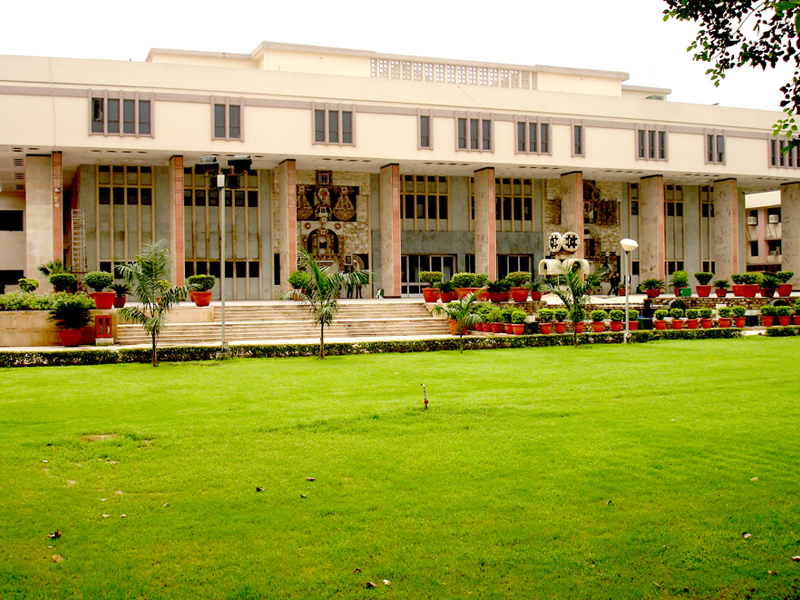
The Delhi High Court recently comprising of a bench of Justice Rajiv Shakdher observed that Section 33 of the 1947 Act plays an important role in the maintenance of the status quo between disputants, while adjudication is pending before the relevant forum. It prevents degradation of the workmen‘s rights and at the same time, allows industrial peace to prevail till such time the disputes are adjudicated upon by the relevant forum. (Central Warehousing Corporation V. Govt. Of India And Ors)
Fact of the Cases
In January 2000, a written petition was filed by a set of workmen seeking for the regulation of their services with CWC and the issuance of notification of contract labours, later another set of workmen filed a writ petition, seeking similar reliefs. The court directed that the services of the workmen, can’t be substituted with contract workers. Later the said petition was disposed of and they directed that petition should be dealt with by Central Advisory Contract Labour Board (“Board”).
The Board held a meeting as a result of meetings, Board recommended to the Government of India (GOI), that contract labour in CWC should be prohibited qua operations involving loading and unloading of imported goods and those meant for export from road vehicles, later to date GOI accepted the recommendation and accordingly issued a notice.
Being aggrieved, CWC filed a writ petition, under Article 226 of the Constitution, in which the court directed to first approach High Powered Committee, following the observation of Supreme Court in case of ONGC vs Collector of Central Excise, 2004., Accordingly, the clearance was given by the committee on the dispute.
Accordingly, workmen approached to Central Government Industrial Tribunal cum Labour Court (“Tribunal”) for relief of absorption and later, moved to Deputy Chief Labour Commissioner for wage parity.
Further to facts, the contractor was changed from time to time by CWC, without disturbing the workmen, and once they entered into an agreement with SFPL also. Later CWC ended an agreement with SFPL by supplanting SFPL with RR.
The CWC choose, not to direct the new contractor i.e., RR to continue with the workmen who were on the rolls of SFPL. For the said reason workmen approached this Court.
Another writ petition was filed by workmen not only against CWC but SFPL and RR were also arrayed as parties.
Contention of the Parties
The workmen contented that, they remained with the CWC since 1985, the contractor was changed but they remained. And they approached the court for regularization of their services.
Upon favourable recommendation by notification of GOI, that workmen deployed by CWC performed work was perennial.
Once the Board found that, workmen were deployed, was perennial and the Government of India had issued a notification, prohibiting employment of contract labour, CWC could not have taken advantage of the interim write petition order, passed staying the operation of the notification dated 17.11.2006.
The entire action of CWC, in replacing the workmen with the personnel of RR, is legally flawed, as provisions of Section 7 and 12 of the Contract Labour (Regulation and Abolition) Act, 1970 (hereinafter as to 1970 Act) have not been complied with.
They also contended that, since the issue is pending before competent authority, their services cannot be terminated without the permission of the authority.
On the other hand, CWC contented that there is no employer-employee relationship existed between CWC and Workmen.
CWC has contended that SFPL and RR are different contract tor employed their employees and now CWC is not a party, so there is no point to claim relief before CWC.
CWC contended that, engagement of contract labours by the contractor following guidelines of Central Vigilance Commission.
The CWC obtained registration, under Section 7(2) of the 1970 Act, for the concerned establishment i.e. ICD Patparganj. And the work, which is undertaken at ICDs, is not perennial.
Courts observation & Judgment
The court made reference to the judgement of Apex court in the case of Bhavnagar Municipality v. Alibhai Karimbhai and Ors., wherein the court held, “ The character of the temporary employment of the respondents being a direct issue before the Tribunal, that condition of employment, however, insecure, must subsist during the pendency of the dispute before the Tribunal and cannot be altered to their prejudice by putting an end to that temporary condition. This could have been done only with the express permission of the Tribunal. It goes without saying that the respondents were directly concerned in the pending industrial dispute. No one can also deny that snapping of the temporary employment of the respondents is not to their prejudice”.
The court also refered to the apex court judgment in the case of Shree Chamundi Mopeds Ltd. v. Church of South India Trust Assn., wherein it was held, “ While considering the effect of an interim order staying the operation of the order under challenge, a distinction has to be made between quashing of an order and stay of operation of an order. Quashing of an order results in the restoration of the position as it stood on the date of the passing of the order which has been quashed. The stay of operation of an order does not, however, lead to such a result. It only means that the order which has been stayed would not be operative from the date of the passing of the stay order and it does not mean that the said order has been wiped out from existence”.
The court considering the facts of the case and the legal precedents observed that CWC is responsible for disrupting the status quo, which prevailed before it and it would have to continue the services of the workmen who were on the rolls of SFPL. Therefore CWC should have to bear the burden of ensuring that the workmen who were on the rolls of SFPL up until 05.01.2021, continue to be deployed at its concerned establishment.
Read Judgment @Latestlaws.com
Share this Document :Picture Source :




















