









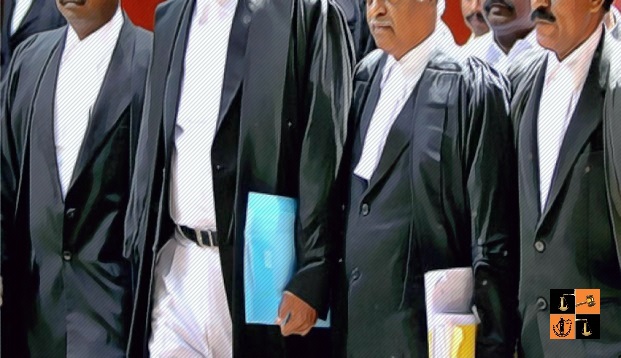
The Bombay High Court has turned down Satara District Bar Association's plea noting that Courts exists for Litigant's convenience and not Advocate's.
The Divison Bench of Justice G.S.Patel and Justice Madhav J Jamdar has rejected the writ petition filed by Satara District Bar Association opposing the decision to establish the Court of an Additional District Judge and the Court of a Civil Judge in Maharashtra's Wai town with contention that it would put Judicial officers, staff and litigants to great difficulty.
The Bar Associations at Wai and Phaltan had made representations to the High Court for the creation of the said Courts. The petitioner-Bar has however submitted that these representations by the taluka-level Bar Associations at Wai and Phaltan were “needless” as Wai did not have sufficient infrastructure.
The petitioner had before the present writ, on3rd October 2020 made a detailed representation to High Court asking that the decision to establish Courts at Wai be reconsidered. It was stated mere pendency of cases cannot be a determinative criterion for approving the establishment of a new court. A judge-to-cases ratio fixed in 2004 at 500 is outdated because there is a surge in case filings. The crux of the said representation was that the petitioner had suggested that caseload pendency is not a valid determinant for approving a proposal to establish a new court; but the lack of a pendency can be invoked to justify rejecting a proposal for a new court.
To this, the Court noted that the truth lies somewhere in between.
"What the law says, and we will turn to a binding decision a little later, that pendency and caseloads cannot be the sole determinant. No judgment says that pendency and caseloads cannot be a determinant or a consideration at all."
It went on to note that as per the petitioner, the High Court considered ‘only’ the caseload pendency, i.e. statistical figures of the numbers of cases and nothing else while arriving at its impugned approvals and that other criteria such as buildings, infrastructure, distance, transportation and convenience of litigants, though required to be considered, had not been taken into account along with the geographical conditions of the district.
The Court found the narrative about Naxalite movements, difficulties in communication etc. to be slightly fantastic and certainly hyperbolic. It rejected the same as 'exaggeration' and noted that Wai, Khandala and Mahabaleshwar are just off NH-48, the major Mumbai–Pune–Bengaluru highway and no chance of any of the factor being adverse in nature.
The Court then commented on the issue of geographical constraints as mentioned by the petitioner:
"We are then told that Mahabaleshwar is a hilly area (a statement that overstates the obvious; it is a hill-station). Apparently, it is ‘more difficult’ to reach Wai from Mahabaleshwar than it is to reach Satara. This is not common experience, but we will let that pass. There is nothing adduced to establish this. Khandala Taluka is located on a six lane highway."
The Court explained the analogy of events which led to the impugned approvals and stressed that representation of petitioner was not rejected in limine but in view of the thoughtout decision of the Administrative Committee and after considering the report from the Principal District Judge, Satara.
In the reply, it has been specifically stated that the criteria of distance, convenience of litigants and Advocates and other factors have been considered while rejecting the representation, the Court clarified.
It was also pointed out in the reply that the Petition is materially defective in that it does not make an adequate disclosure about the representation that was filed by the Petitioner. The Reply also stated that the other criteria such as infrastructure, distance, transportation etc all favour the establishment of a Court at Wai.
The Court cautioned the PIOs to be more accurate in their responses when any information is sought to be withheld as exempt for disclosure requirements wrt RTI filed by the petitioner.
"There is certainly an element of confidentiality in the notings by Judges of any Committee of this Court. There is also very good reason why such notings should not in fact ever be disclosed or allowed to be disclosed. Whether or not this falls within the description of “a fiduciary relationship” is something we need not examine further."
The Court concluded that the High Court took into account other factors down to details such as adequacy of accommodation for judicial officers in Wai and it is only on being satisfied that there were all these feasibilities that it made its proposal.
Reprimanding the petitioner herein, the Court stated that the real difficulty with this Petition is that it is unclear what is the legal right that the Petitioner is asserting when it says that this High Court should not consider establishing a Court at Wai and seems entirely self-serving.
The Court advocated for speedy and timely justice delivery and stressed that Litigant's interests are of utmost importance.
"We do not deny that the Bar has a role to play in the administration of justice. We however emphatically assert that it is the interest of the litigants that is paramount and the role of the Court and all those who enable its functioning, whether Judges or lawyers, are meant to assist the delivery of justice to the litigant. Two important aspects of this are the speedy and timely delivery of justice and physical access to justice. The establishment of a Court in a close proximity cannot really be said to be an undesirable thing to litigants who are in the vicinity of the proposed Court. There is no reason why a litigant should, on the Petitioners’ representation be required to travel 35 kms from Wai to Satara rather than have a Court in Wai itself; or to travel 55 kms from Khandala to Satara instead of 27 kms from Khandala to Wai or 60 kms from Mahabaleshwar to Satara rather than 33 kms from Mahabaleshwar to Wai."
Read Judgement Here:
Share this Document :Picture Source :




















