









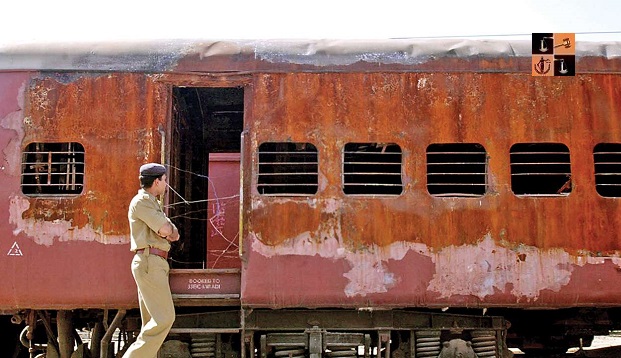
Recently, the Gujarat High Court upheld the dismissal of nine railway constables, observing that had they travelled as assigned on the Sabarmati Express, the tragic 2002 Godhra train burning incident could potentially have been averted. The Court made strong observations on the dereliction of duty and negligence on the part of the constables, highlighting the gravity of their misconduct.
Brief Facts:
The case concerned nine police constables, Gulabsinh Zala, Khumansinh Rathod, Nathabhai Dabhi, Vinodbhai Bijalbhai, Jabirhussain Sheikh, Rasikbhai Parmar, Koshorbhai Parmar, Kishorbhai Patni, and Punabhai Bariya, who had been assigned patrolling duty on the Sabarmati Express. Instead of boarding the designated train, they chose to travel on the Shanti Express, despite the delay of only six hours in the former. As a result, during the tragic Godhra incident, the S-6 coach of the Sabarmati Express was left without any armed security personnel.
A departmental inquiry followed, culminating in their dismissal from service. This decision was upheld by the appellate and revisional authorities. The constables challenged the dismissal before the High Court, alleging procedural lapses and disproportionality of punishment.
Contentions of the Petitioner:
The petitioners submitted that the punishment of dismissal was disproportionate to the allegations levelled against them. They also contended that they had no prior information or intimation regarding any threat to the Sabarmati Express. Furthermore, they alleged bias on the part of the inquiry officer who conducted the departmental proceedings. It was further argued that had they boarded the Sabarmati Express, they could have lost their lives and become martyrs, an argument that was presented during the inquiry as well.
Observations of the Court:
Justice Vaibhavi D. Nanavati, while rejecting the contentions of the petitioners, held that, “It is not in dispute that the petitioners were assigned the duty to return by Sabarmati Express. However, while making the note to travel by Sabarmati Express, petitioners instead travelled by Shanti Express. If the petitioners had departed in the Sabarmati Express train itself to reach Ahmedabad, the incident that occurred at Godhra could have been prevented.”
The Court underscored that the petitioners had made false entries in the train register and acted with gross negligence and carelessness. The train in question belonged to the 'A' Category, denoting a high risk of untoward incidents such as chain snatching and altercations, which required armed police presence as per standard operating procedures. Referring to the lack of security personnel aboard the S-6 coach at the time of the incident, the Court remarked, “The passengers were without any police personnel on such a sensitive train. This amounts to negligence and misconduct in the discharge of official duty.”
On the issue of alleged bias by the inquiry officer, the Court noted that the petitioners had never raised such an objection during the proceedings and only did so after the conclusion of the inquiry. The Court stated, “In the absence of any cogent proof or record to establish personal bias, the contention stands rejected.” Moreover, addressing the argument regarding martyrdom, the Court made a strong remark, “The petitioners are members of the police force, and such a statement from police personnel is rightly disregarded by the disciplinary authority.”
The decision of the Court:
Dismissing the petition, the High Court held that the findings of the departmental, appellate, and revisional authorities were based on sound reasoning and supported by evidence. The Court concluded that there was no violation of Article 311(2) of the Constitution of India and affirmed the penalty of dismissal, stating that it was appropriate and in line with the Bombay Police (Punishment and Appeal) Rules.
Case Title: Gulabsinh Devunsinh Jhala & Ors. vs. State of Gujarat & Ors.
Case No: R/Special Civil Application No. 25294 of 2007
Coram: Justice Vaibhavi D. Nanavati
Picture Source :




















