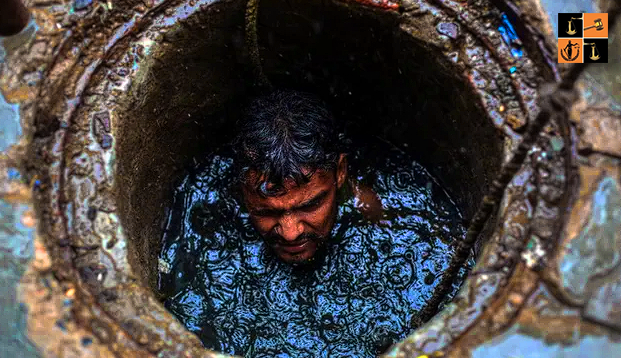
Recently, the Supreme Court directed the Union and State governments to take stringent measures to eradicate manual scavenger measures to eradicate manual scavenging and hazardous sewer cleaning while ensuring full rehabilitation for affected individuals. This decision arose from a writ petition filed under Article 32 of the Constitution of India as a Public Interest Litigation (PIL) seeking the implementation of the Employment of Manual Scavengers and Construction of Dry Latrines (Prohibition) Act, 1993, and the Prohibition of Employment as Manual Scavengers and Their Rehabilitation Act, 2013. The Court noted that manual scavenging continues despite the statutory prohibition, citing the lack of effective enforcement and the formation of mandated committees under these Acts.
In the present case, the petition highlighted that manual scavenging, unhygienic latrines, and hazardous sewer cleaning persist across the country, defying the 1993 and 2013 Acts designed to eliminate these practices. Additionally, the formation of committees such as the National Commission for Safai Karamcharis (NCSK) and other monitoring bodies required under the Acts still needed to be completed. The PIL sought enforcement of these provisions and relief for affected individuals.
The Counsel on behalf of the petitioner submitted that several provisions of the Acts, particularly concerning the mandatory survey of manual scavengers and the formation of District-Level Survey Committees, still need to be implemented. He pointed out that many states still needed to form these committees, undermining the statutory mandate. Whereas, the Counsel on behalf of the Union of India, assured the Court that efforts were underway to ensure compliance. She proposed convening a meeting of all stakeholders, including representatives from the State Monitoring Committees and the Central Monitoring Committee under the 2013 Act, to address the gaps.
The Supreme Court, while addressing the ongoing prevalence of manual scavenging and hazardous sewer cleaning, observed systemic lapses in implementing statutory mandates under the Employment of Manual Scavengers and Construction of Dry Latrines (Prohibition) Act, 1993 and the Prohibition of Employment as Manual Scavengers and Their Rehabilitation Act, 2013. The Court noted with concern that "despite advancements in technology and scientific methods, manual scavenging continues unabated," pointing to failures in enforcement mechanisms and the absence of fully functional committees mandated by the Acts. The Court expressed dissatisfaction over non-compliance with its earlier directions issued on October 20, 2023. It emphasised the need for stringent measures and reiterated the directives, stating that “eradication of manual scavenging cannot remain an aspirational goal it must be implemented through concrete action”. It highlighted that the persistence of these practices reflects not just administrative indifference but a systemic failure to uphold human dignity and constitutional rights.
To ensure effective implementation, the Supreme Court laid down the following directive, reiterating its earlier order:
- Complete Eradication: The Court mandated a phased approach for the eradication of manual sewer cleaning, stating that reliance on manual methods when technological alternatives exist violates the principles of human dignity and equality.
- Rehabilitation Measures: It called for “full rehabilitation for sewage workers and families of those who died in sewer-related incidents,” including provisions for employment, education, and skill training. The Court also enhanced compensation for sewer deaths from ₹10 lakh to ₹30 lakh and introduced “provisions for victims with disabilities.”
- Accountability Measures: Emphasizing accountability, the Court directed the “cancellation of contracts and imposition of monetary liabilities for sewer deaths during outsourced work.” This measure seeks to ensure contractor compliance with safety norms.
- National Portal: The Court instructed the creation of a “national portal to track sewer deaths, compensation disbursements, and rehabilitation measures,” ensuring transparency and accountability.
The Court underlined the urgency of compliance, particularly concerning the survey of manual scavengers under Section 11 of the 2013 Act. it directed the Union to take immediate steps to coordinate with states, noting that, “filling vacancies in statutory bodies is essential for effective implementation.” The Supreme Court warned that any further delay would “deepen the indignity and inequality faced by affected individuals”. Additionally, the Court deferred contempt proceedings for now, providing the Union and State governments a window to implement its directives. It directed the Union to file an affidavit within two weeks detailing compliance measures, gaps, and state-wise progress, emphasizing that “the dignity of affected individuals cannot be deferred indefinitely.”
The Apex Court's detailed observation and directives highlight its firm stance against manual scavenging and hazardous sewer cleaning. By enhancing compensation mandating accountability and ensuring rehabilitation the Court has set a clear roadmap for eradicating these practices and restoring dignity to those affected. The matter is scheduled for further review on January 29, 2025, with the expectation of significant progress by then.
Case Title: Dr. Balram Singh v. Union of India & Ors.
Citation: Writ Petition(s)(Civil) No(s). 324/2020
Order Date: 11.12.2024
Coram: Justice Sudhanshu Dhulia, Justice Aravind Kumar
Advocate for Petitioner: Adv. K.Parameshwar, Sr.Adv./AC Ms. Kanti, Adv. Ms. Raji Gururaj, Adv. Mr. Shreenivas Patil, Adv. Ms. Chitransha Singh Sikarwar
Advocate for Respondent: Adv. Aishwarya Bhati (A.S.G.), Gurmeet Singh Makker (AOR), Ruchi Kohli, Shradha Deshmukh, Swarupama Chaturvedi, Sweksha, Ishaan Sharma, Astha Sharma (AOR), Ripul Swati Kumari, Mukesh Kumar Maroria (AOR), Shreekant Neelappa Terdal (AOR), Harish Pandey, Vatsal Joshi, Shashwat Parihar, Vinayak Sharma, Varun Chugh, Piyush Beriwal, Kanu Agrawal, Mrinal Elker Mazumdar, Indira Bhakar, Rajesh Singh Chauhan, Mukesh K Verma, Amrish Kumar (AOR), Aishwarya Bhati (A.S.G.), Shradha Deshmukh, Swarupma Chaturvedi, Aman Shukla, Ruchi Kohli, Purnendu Bajpai, Sweksha, B.l.n. Shivani, Ameyvikrama Thanvi, N. Visakamurthy (AOR), Vanshaja Shukla (AOR), Ankeeta Appanna, Madhura Chitnis, Sanjay Jain (AOR) Attorney General For India, Jayna Kothari (Sr. Adv.), Anindita Pujari (Sr. Adv.), Aparna Mehrotra, Piyush Dwivedi (AOR), Shaileshwar Yadav, Deepak Bhardwaj, Raghav Gupta, Bhumika Chouksey, Radhika Mohapatra, Akshay Amritanshu (AOR), Pragya Upadhyay, Swati Mishra, Drishti Saraf
Read Order @LatestLaws.com
Picture Source :