









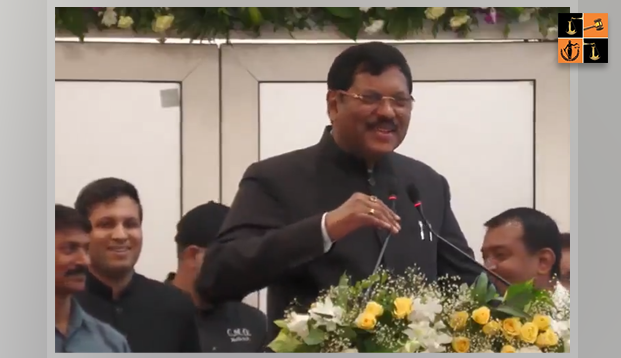
On Saturday, CJI B.R. Gavai described the Constitution as the very soul of Indian democracy, emphasising that it is this living document that sustains the strength and stability of the Republic. Speaking at Allahabad University as the chief guest at the inauguration of three newly constructed buildings, the CJI reflected on the constitutional design that binds the Union and the States under one supreme charter.
“In many countries, different constitutions operate for the central and state governments, but in India, a single Constitution operates for both the states and the central government,” CJI observed, highlighting the unity of India’s federal structure within a single constitutional framework.
Justice Gavai remarked that the constitutional scheme has endowed India with a judicial system that ensures accessibility to justice “from the district level to the Supreme Court.” He stressed that such a system, grounded in the rule of law, has fortified public confidence in democratic governance.
Defending the judicial collegium system, the CJI said it “allows input from the state and central governments and various agencies,” thereby reflecting a collaborative institutional process while preserving judicial independence. In drawing a comparative perspective, he referred to “unstable democracies” in neighbouring nations such as Nepal, Bangladesh, and Sri Lanka, noting that India’s stable constitutional structure has enabled its democratic resilience.
Paying homage to Dr. B.R. Ambedkar, Justice Gavai said it was due to his vision that the nation’s powers were wisely divided among three coordinate branches, the Legislature, the Executive, and the Judiciary, each functioning within its defined constitutional limits.
Justice Vikram Nath, Judge of the Supreme Court, in his address, recalled Ambedkar’s enduring commitment to liberalism and social justice, noting that he “believed that no individual was above the Indian Constitution.” He lauded Ambedkar’s call for the annihilation of caste and the eradication of discrimination that corrodes the constitutional promise of equality.
Justice Arun Bhansali, Chief Justice of the Allahabad High Court, reflected that for Ambedkar, the Constitution was “an instrument to eliminate inequality and untouchability.” He observed that the document remains both a moral and legal charter for social transformation.
Allahabad University Vice-Chancellor Prof. Sangeeta Srivastava concluded the ceremony with the reminder that “only education can truly build the nation,” echoing Ambedkar’s belief that constitutional ideals must be realised through enlightenment and empowerment.
Source Link
Picture Source :




















