









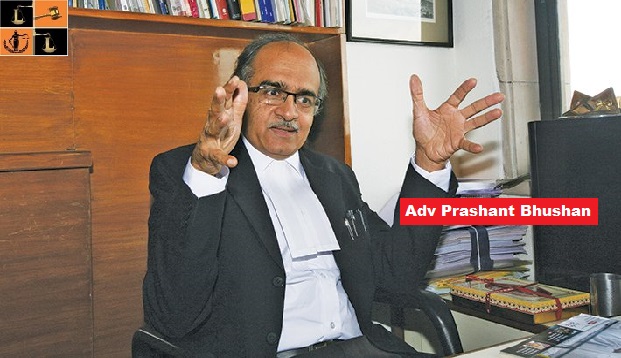
Allegations of corruption cannot be “per se” contempt because truth is a defence to contempt proceedings, civil rights lawyer Prashant Bhushan has told the Apex Court.
Prashant Bhushan was responding to a Contempt Case against him for his remarks on “corruption in judiciary” in an interview to the Tehelka magazine in 2009. A 3-Judge Bench led by Justice Arun Mishra is scheduled to hear the case on merits on Monday.
On Aug 10, the Court passed an interim order that it would hear arguments on whether the remarks in the interview against the judiciary amounted to per se contempt.
Mr Bhushan, in his written submissions to the Court, said that “Allegation of corruption per se cannot be contempt because the same pertains to criticism of a judge for a biased dispensation of justice & would in all cases require further investigation before such allegations are brushed aside at the threshold,” Mr. Bhushan said in his written submissions to the court.
The senior lawyer said truth is a defence under Section 13 (b) of the Contempt of Courts Act, 1971.
“When such truth/defence is invoked, the court to hold the alleged contemnor guilty of contempt will have to necessarily return a finding that (a) such defence is not in public interest; & (b) the request for invoking such defence is not bona-fide,” he argued.
Mr Bhushan said he used the word ‘corruption’ in a wider sense to include any act of impropriety other than merely financial corruption.
Wide & expansive definition
The written submission said, “Corruption in public life has a wide & expansive definition. Corruption is not restricted to pecuniary gratification alone but various instruments identify its particular forms such as bribery, embezzlement, theft, fraud, extortion, abuse of discretion, favouritism, nepotism, clientelism, conduct creating or exploiting conflicting interests".
He said the factum of corruption in the judiciary has been stated in Parliamentary Committee reports on Prevention of Corruption, has been commented upon by Ex-Judges of the Top Court & noted in judgments.
Source Link
Picture Source :



















