









September 18,2018 :
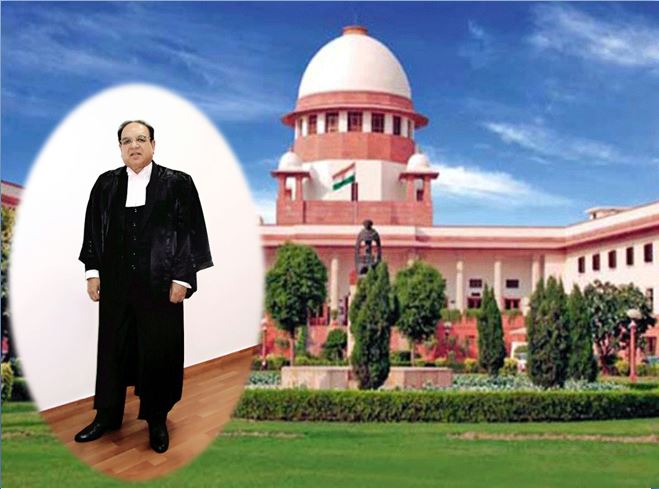
Name of Legal Stalwart: Advocate Navin Kumar Jaggi
The interviewer, Rohit Garg is a 3rd Year Law student of Fairfield Institute of Management and Technology, New Delhi. He is currently interning with LatestLaws.com.
Mr. Navin Kumar was a student of St. Columbus High School and thereafter majored in Economics from the University of Delhi. He is a former Law Teacher of Delhi University, where he taught Law of Pleadings and Conveyancing, Law of Limitation, Arbitration Law, Labour Law, Law relating to the Seas and Constitutional Law. He has been Counsel for the Union of India as well as the Delhi Development Authority and several other Public Undertakings for many years.
Q.1 Tell me something about your early childhood & schooling?Ans.. I was fortunate enough to have studied in the best School of the Country St. Columbus, where Mr. Sanjay Gandhi, Grandson of the first Prime Minister of India Pandit Jawahar Lal Nehru and Mr. Sunil Shastri, son of former Prime Minister Lal Bahadur Shastri, were my class fellows. The school boasted
of the most elite Students and perhaps the most elite Faculty of the country. Moral Science was a compulsory subject in the Curriculum and Ethics, Morality, Integrity, Loyalty to the Nation, Patriotism, Fraternity, Human Kindness, Dignity, Respect for the Fellow Human Being, Gentlemanly Demeanor, Disciplined conduct and above all Honesty were vehemently ingrained and imbibed in us as basic human values.
Q.2 Are you a first generation lawyer?
Ans. No, I’m a second-generation Lawyer. My father, Mr. Basant Kumar Jaggi, of the landed gentry, started his practice in the year 1923. He set up his legal practice at Rawalpindi (now Islamabad in Pakistan). He practised in Poonch under a special license from the then Maharaja of Kashmir, who recommended Mr. Jaggi's name as the King's Counsel. In 1927, he established a large practice at Lahore. In 1947, upon the partition of the Indian sub-continent, Mr. Basant Kumar Jaggi shifted to Delhi, where he was eminently successful in his legal practice.
My daughter Ms. Tanvi Bakshi Jaggi is a third-generation Supreme Court Lawyer and my wife Professor Veena Bakshi is the former Professor-in-Charge of Law Centre 1, Faculty of Law, University of Delhi.
My Sister’s Husband and Son, Mr. Karan Bal and Mr. Ans.human Bal, respectively who are part of Triple J have a large practice in MACT (Motor Accident Claims Tribunal) cases, a branch of law which was virtually pioneered by my Father and who had almost a monopolistic practice in this field at Lahore and Delhi.
Q.3 When did you decide to pursue law as a profession & why?
Ans. I knew possibly from the womb that the only calling for me was to practice law with the outmost dignity, integrity and nobility. Perhaps it was in the Fourth Standard when I first started reading my Father’s Law Books, who was very proud of his collection of AIRs, which was first published in 1914, and of which he had an entire complete set, and also Halsbury’s Laws of England and as well as LexisNexis that I knew my destiny was practising law. My Father wanted me to join the Indian Administrative Services or the Judiciary and I cleared the written exams in both but I was never interested in anything except practicing as a Counsel to uphold the Majesty of Law.
Q.4 How was your experience in the Law School?
Ans. I had a wonderful experience because I was possibly the second or third batch when the LLB course was made compulsory from a 2-year course to a 3-year course. The Faculty was most Profoundly Learned, and we had the best facility of the Library and the Case Material being made available to us. The Faculty of Law at that time had only two Law Centres, the Campus Law Centre and Law Centre I, at Mandir Marg, where I first started teaching from October 23, 1975. The University of Delhi was a very confined and a prized institution and rated very highly, inter alia, also for its disciplined student force. The camaraderie and the bonding between the Professors and the Students was most respectful and dignified, and it pains me tremendously, when I see the pathetic state, that the University of Delhi has now become.
Q.5 How do you think the Law School is changed since then?
Ans. With the outburst of private law universities and colleges the standard of legal education has fallen pathetically low to the level that one feels the Bar Council of India should invoke greater and stricter measures to insist upon these universities and private law colleges employing competent faculties.
Q.6 Would you like to share any experience of your first case in court?
Ans. My first case in the High Court was a Writ Petition filed by New Delhi Tyre Company against the Government of Delhi. As my Father had a vast practice and was virtually commanding the Transport Industry as his Clients, we were called upon to make an Application under Order 1 Rule 10 Sub Rule (2) of the Code of Civil Procedure (Act V) of 1908 for impleading the Truck Operators Union as a necessary and proper party.
This case was to be handled by my Father, but unfortunately for him, and fortunately for me, my Father was held up at the High Court of Judicature at Allahabad. The circumstances constrained me to appear. The matter was listed before the Hon’ble Mr. Justice Prakash Narain, who later became the Chief Justice, Delhi High Court and the Hon’ble Mr. Justice Pritam Singh Safeer. In a packed Courtroom my knees wobbled and knocked against the Podium, when I commenced my arguments. But I picked up the courage and fortitude, and till date, I have not been able to overcome, leave alone forget, the euphoria and the ecstasy, that I experienced during the course of my long drawn and lengthy arguments.
This was the year 1972, and till date the memory of the vehemence of my arguments, and the control and modulation of my voice, in an overcrowded courtroom, leaving the Court and the audience mesmerized and spell bound, shall live with me, till my last breath. Till date I have not been able to curtail my innate happiness and joy when I recollect that The Lordships used the epithets ‘Mr. Jaggi very ably argued’. More so, when the Bench, in open court stated that they had never come across such a depth of knowledge on the Writ Jurisdiction.
Q.7 Please share 2-3 memorable cases you dealt with in your professional journey?
Ans. I filed a PIL and got the law changed for Dyslexic students. A dyslexic child cannot be failed from Fist till Ninth Standard and Eleventh Standard. For Tenth and Twelfth Classes, the Dyslexic child is provided with writer/scribe of the same class and also extra half an hour to complete the paper.
- I filed a PIL and got the Narcotics Act amended. Now Opium Tablets are available for terminally ill Cancer Patients at the Cancer Hospitals to ameliorate their pain.
- On May 26, 1980, I won a batch of eight cases on an Excise matter as to whether Excise Duty could be imposed on ‘Asbestos’. I was opposed by the topmost Eight Lawyers of the Country except Mr. Nani Palkhivala.
Q.7 Please share three strengths of the Indian Legal System, which make it strong pillar of democracy.
Ans. Honesty, Integrity and Impartiality.
Q.8 What according to you are the areas in Law, which needs to be improved?
Ans. All branches of the Indian Legal System except the Income Tax.
Q.9 What is your wisdom and success mantra for young legal professionals?
Ans. For a lawyer to be successful in this field he has to have a command over the English language. A person cannot be a good Lawyer, let alone a successful lawyer without having proper knowledge of the English language.
- The Ability to take decisions.
- A Lawyer should possess the ability of taking the Initiative to do things on his own.
- Discipline
- Treat the Clients as ‘anndata’ and not somebody to pay your bills for your luxuries.
Picture Source :




















