









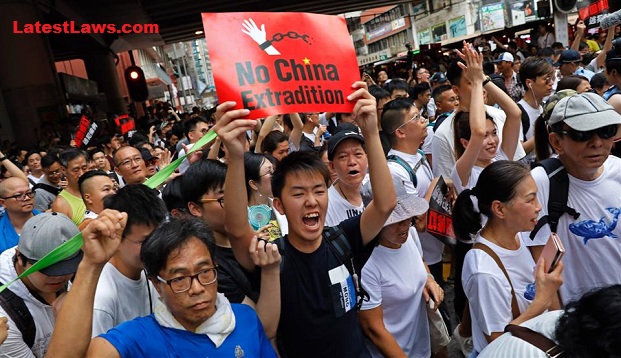
On Tuesday, Hong Kong was in a state of unprecedented lockdown with barricades in the city centre, shuttered stores and a heavy police presence, as authorities scrambled to ensure protests do not overshadow China’s National Day celebrations in Beijing.
The Former British Colony has been racked by nearly four months of street clashes and demonstrations, posing the gravest popular challenge to Chinese President Xi Jinping since he came to power.
Protesters have vowed to seize on the 70th anniversary of the founding of the People’s Republic of China on Tuesday to propel their calls for greater democracy onto the international stage, hijacking an occasion Beijing sees as an opportunity to showcase China’s economic and military progress.
Authorities have denied permission for a protest march, but demonstrations are expected across the city regardless.
“I’d rather die than have no freedom,” said a college student who identified himself as just Green, speaking outside the Che Kung Temple in the New Territories region where a protest is expected.
Police said on Monday they expected a “very serious violent attack” in the city but gave no details.
Police said they arrested five people, aged between 17 and 25, in the central district of Wan Chai on Monday night after finding them with walkie-talkies, lighters, and material for petrol bombs, including 18 litres (4.75 gallons) of fuel and empty bottles.
Hundreds of officials and members of the pro-establishment elite began the day with a flag-raising ceremony and National Day reception at the Convention and Exhibition Centre, held early and moved behind closed doors. Roads to the centre were closed and tightly policed.
Hong Kong has benefited from China’s support under the “one country, two systems” policy, Acting Chief Executive Matthew Cheung told the assembly, referring to guarantees of political freedoms after the city’s handover from British to Chinese rule in 1997.
However, he said the “escalating violence of some radical protesters, including unlawful assemblies and blockage of roads, petrol bomb hurling, arson and attacks on other citizens, has not only disrupted social order but also posed a severe challenge to the rule of law, affecting the safety and normal lives of citizens”.
The protests had “further hit the local economy, which is already facing downward pressure”, he added.
The protests have taken a heavy toll on shopping malls that house some of the world’s best-known luxury brands, with many closing early in recent weeks amid escalating violence.
The IFC mall, close to the city centre, was closed on Tuesday. One of Hong Kong’s largest upscale shopping centres, IFC houses an Apple Inc store, jewellers Tiffany & Co and Chow Sang Sang, cosmetics maker L’Occitane and Gucci, which is owned by French group Kering.
The closure of IFC and several other malls means retailers will miss out on what would normally be a busy shopping week when mainland tour groups traditionally flood in for the annual Golden Week holiday.
Latest data showed visitor arrivals plunged 39% in August from a year earlier, with the number of mainland tourists to Hong Kong dropping 42.3% over the period.
Source Link
Picture Source :



















