









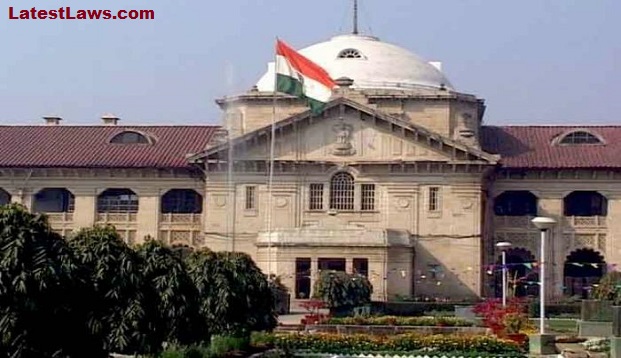
The Allahabad High Court while expressing serious concern over misuse of Public Interest Litigation (PIL), has dismissed a petition, alleging illegal encroachment by a sugar mill, with costs of ₹25,000 on an advocate, holding it to be a “gross abuse of the process of law” driven by personal motives rather than genuine public interest.
The Division Bench comprising Chief Justice Arun Bhansali and Justice Kshitij Shailendra of Allahabad High Court was hearing a PIL filed under Article 226 of the Constitution, seeking directions to authorities to remove alleged encroachments by Daurala Sugar Mill, Meerut, over a canal-side ways used by villagers.
The petitioner, an advocate, alleged that the sugar mill had illegally occupied land on both sides of the Daurala Lower Rajwaha (mini canal), causing inconvenience to villagers who relied on the way for connectivity. It was further contended that despite repeated complaints and administrative instructions issued in 2022 for removal of encroachment, no action had been taken by authorities.
However, the respondent sugar mill strongly contested the allegations, questioning the petitioner’s bona fides. It was submitted that the petitioner had concealed material facts, including his past role as Chairman of the Cane Development Council and his involvement in multiple criminal cases. The respondent argued that the PIL was filed with mala fide intent to harass the mill management following personal disputes.
On merits, the respondents asserted that the mill had obtained lawful permission in 2018 from the Irrigation Department to use the land, and subsequent inspections in 2024 found no encroachment or public inconvenience. Official reports confirmed that farmers continued to use the way without obstruction.
The High Court emphasized that a petitioner invoking PIL jurisdiction must approach the court with “clean hands” and disclose full and truthful credentials. It found that the petitioner had deliberately suppressed relevant facts and misrepresented his status, thereby undermining the credibility of the petition.
The Court examined established principles governing PILs and highlighted that such jurisdiction cannot be used for personal gain or vendetta. It referred to key procedural safeguards, including the requirement of disclosure of credentials under the Allahabad High Court Rules.
The Bench has placed reliance on several landmark Supreme Court judgments, including State of Uttaranchal v. Balwant Singh Chaufal (2010), which laid down guidelines to prevent misuse of PILs. It also cited Janata Dal v. H.S. Chowdhary (1992), Dr. B. Singh v. Union of India (2004), and K.D. Sharma v. SAIL (2008), reiterating that courts must filter out frivolous petitions filed with oblique motives.
The bench, while holding the petition to be a misuse of judicial process, dismissed the PIL with costs of ₹25,000. The petitioner was directed to deposit the amount within three weeks, failing which recovery proceedings would be initiated as arrears of land revenue.
In a stern warning, the Court cautioned the petitioner against engaging in such conduct in future, reinforcing that PIL jurisdiction must remain a tool for genuine public causes and not a weapon for personal disputes.
Case Details:
Case No.:PIL NO. 331 of 2026
Court: High Court of Judicature at Allahabad
Bench: Chief Justice Arun Bhansali and Justice Kshitij Shailendra
Petitioner: Ravindra Ahlawat
Respondent: State of UP & 4 others
Picture Source :




















