









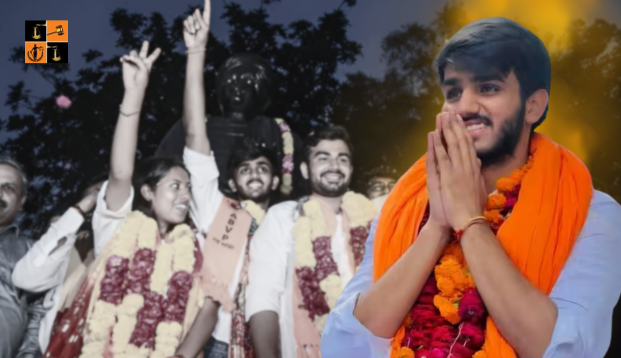
The Delhi High Court strongly condemned the conduct of candidates in the Delhi University Students’ Union (DUSU) elections, observing that Court directives and university guidelines were flagrantly ignored, and warned that such actions undermine democratic processes on campus. The bench described the use of extravagant displays, including heavy machinery and luxury vehicles, as deeply troubling, emphasizing the need for responsible conduct in student elections.
The controversy arose during the DUSU elections when multiple candidates, including newly elected president Aryan Maan, vice president Rahul Jhansla, and secretary Kunal Choudhary, were accused of violating the university’s restrictions on ostentatious campaigning. Despite prior warnings and monitoring by the court, candidates reportedly employed high-end cars, construction equipment, and other disruptive methods to display political strength. The Delhi University had issued show-cause notices seeking explanations, which the candidates denied, demanding evidence for the alleged breaches.
Delhi University, represented by counsel Rupal Mohinder, submitted that the university had taken formal action by issuing notices to seven candidates for the alleged violations, but the students largely refuted the charges. Delhi Police, through Additional Solicitor General Chetan Sharma, noted that thousands of traffic violations had been fined during the election period, yet asserted that this year’s elections were comparatively smoother than in previous years. ABVP-affiliated candidates, represented by Sanjay Poddar, maintained that their members had complied with the prohibition on victory processions, limiting their celebrations to symbolic gestures, such as placing garlands on statues.
The bench, comprising Chief Justice D.K. Upadhyay and Justice Tushar Rao Gedela, expressed deep disappointment, noting that earlier warnings had failed to influence candidate behavior. The judges highlighted that candidates’ responses to the university’s notices were mere legal formalities without any acknowledgment of wrongdoing. Chief Justice Upadhyay observed, “Court’s cautionary orders have not worked… every single candidate knew that the court is monitoring it, yet none abided by the guidelines. This is very, very painful… Over the years, the shape these elections have taken has been a cause of concern.”
The Court criticized the overt use of wealth and muscle in student elections, calling it a “tragic, painful, sad commentary on the state of democratic functioning and institutions.” The bench noted that extravagant displays such as JCBs, luxury cars, and other forms of ostentation are “unwarranted and unwelcomed”, and stressed that economic or coercive influence has no place in campus politics.
The judges also observed that the current state of student politics reflected broader concerns about democratic conduct. The Court emphasized that the right to conduct elections must be balanced with adherence to rules, discipline, and the spirit of fair competition.
The matter was adjourned for further hearing on November 6. Earlier, the High Court had warned that it would not permit newly elected office bearers to assume charge if the elections were tainted by disorder or unrest. The Court has maintained its prohibition on victory processions within college campuses, hostels, and elsewhere in the city, underscoring the need for strict compliance with both the Lyngdoh Committee recommendations and the DUSU 2022–26 election code of conduct.
Picture Source :



















