









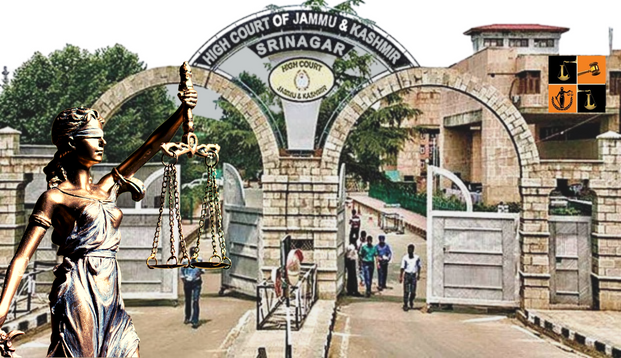
Recently, the High Court of Jammu & Kashmir and Ladakh was seized of an intra-court appeal arising from disciplinary proceedings initiated against a police constable in connection with a militant attack on a minority guard post in Kulgam. The Appeal called into question the validity of the departmental inquiry, the competence of the inquiry authority, and adherence to the procedure prescribed under the J&K Police Rules, 1960.
Brief Facts:
The case arose when the respondent, appointed as a Constable in 1992, was posted at a minority guard post at Adjin, Kulgam. On the intervening night of May 2016, militants attacked the guard post and forcibly snatched service weapons from the police personnel without any resistance or retaliatory firing. An FIR was registered under relevant provisions of the RPC, Arms Act, PEPO and the Police Act. Following the incident, the Respondent was placed under suspension and departmental proceedings were initiated. A chargesheet was served and, after completion of the inquiry, a show-cause notice proposing the penalty of dismissal was issued. Thereafter, the Superintendent of Police passed an order dismissing the Respondent from service, which led to the filing of a writ petition before the High Court.
Contentions of the Appellant:
The counsel for the Appellants contended that the Respondent had exhibited negligence, carelessness and cowardice by surrendering his weapon to militants without firing a single round, conduct unbecoming of a police officer on active duty. It was argued that the departmental inquiry was conducted strictly in accordance with Rule 359 of the J&K Police Rules, 1960, by a competent authority. The Appellants maintained that the respondent was given adequate opportunity at every stage of the inquiry, including the opportunity to reply to the chargesheet and the show-cause notice. According to the Appellants, the Writ Court erred in interfering with the disciplinary action despite there being sufficient material on record to justify the proceedings and the punishment imposed.
Contentions of the Respondents:
The counsel for the Respondent contended that his dismissal was illegal and violative of principles of natural justice. The counsel argued that the mandatory procedure under Rule 359 of the Police Rules was not followed, no proper oral inquiry was conducted, and he was denied an effective opportunity to defend himself. The counsel further contended that the Inquiry Officer lacked competence to conduct the inquiry and that the disciplinary authority failed to consider relevant mitigating circumstances, including under-strength deployment at the guard post, lack of adequate infrastructure, and the Respondent’s long service of over two decades. The Respondent submitted that the extreme penalty of dismissal was arbitrary and disproportionate in the facts of the case.
Observation of the Court:
The Court examined Rule 359 of the J&K Police Rules, 1960 and held that the provision lays down a detailed and mandatory procedure for conducting departmental inquiries against police personnel. The Court noted that an inquiry must ordinarily be conducted by a competent Gazetted Officer and must ensure due notice of allegations and opportunity of defence to the delinquent officer. The Bench observed that “From a reading of Rule 359, it is evident that an inquiry into the misconduct of a police personnel is, as far as possible, required to be conducted by a Gazetted Officer empowered to inflict a major punishment upon the accused person.”
On facts, the Court found that the respondent was served with a summary of allegations, a formal chargesheet and a show-cause notice of proposed penalty, and was afforded opportunity to participate in the inquiry. Rejecting the plea of violation of natural justice, the Court recorded that “Each and every step envisaged in Rule 359, right from serving of summary of allegations to the framing of charge and issuance of show-cause notice of proposed penalty, has been scrupulously followed.”
Addressing the nature of misconduct, the Bench made a strong observation on the conduct of police personnel on duty, stating that “The failure of the Police Guards on duty to retaliate an attack by the militants and surrendering their weapons without firing a single round is a serious act of cowardice bringing moral disgrace to the police force as a whole.”
The decision of the Court:
The intra-court appeal was allowed and the judgment of the Writ Court was set aside. The Court held that the departmental inquiry was conducted by a competent authority in accordance with Rule 359 of the J&K Police Rules and principles of natural justice. Finding no procedural illegality or perversity, the Court upheld the disciplinary action. Consequently, the order dismissing the respondent from service was restored.
Case Title: UT Of J&K Vs Bashir Ahmad Mir
Case No.: LPA No. 27/2022
Coram: Hon’ble Mr Justice Sanjeev Kumar and Hon’ble Mr Justice Sanjay Parihar
Counsel for the Appellant: Sr. AAG Mohsin Qadri with Adv. Maha Majed and Adv. Nowbahar Khan.
Counsel for the Respondent: Adv. Hamza Prince with Adv. Urba Naseer
Read Judgement @LatestLaws.com
Picture Source :




















